Sunday, September 28, 2014

Family Movie Night: Muppet Treasure Island

Title: Muppet Treasure Island
Director: Brian Henson
Original Release: 1996
Choice: Purple Penguin's
My Overall Rating: 4 stars out of 5
via Muppet Wiki
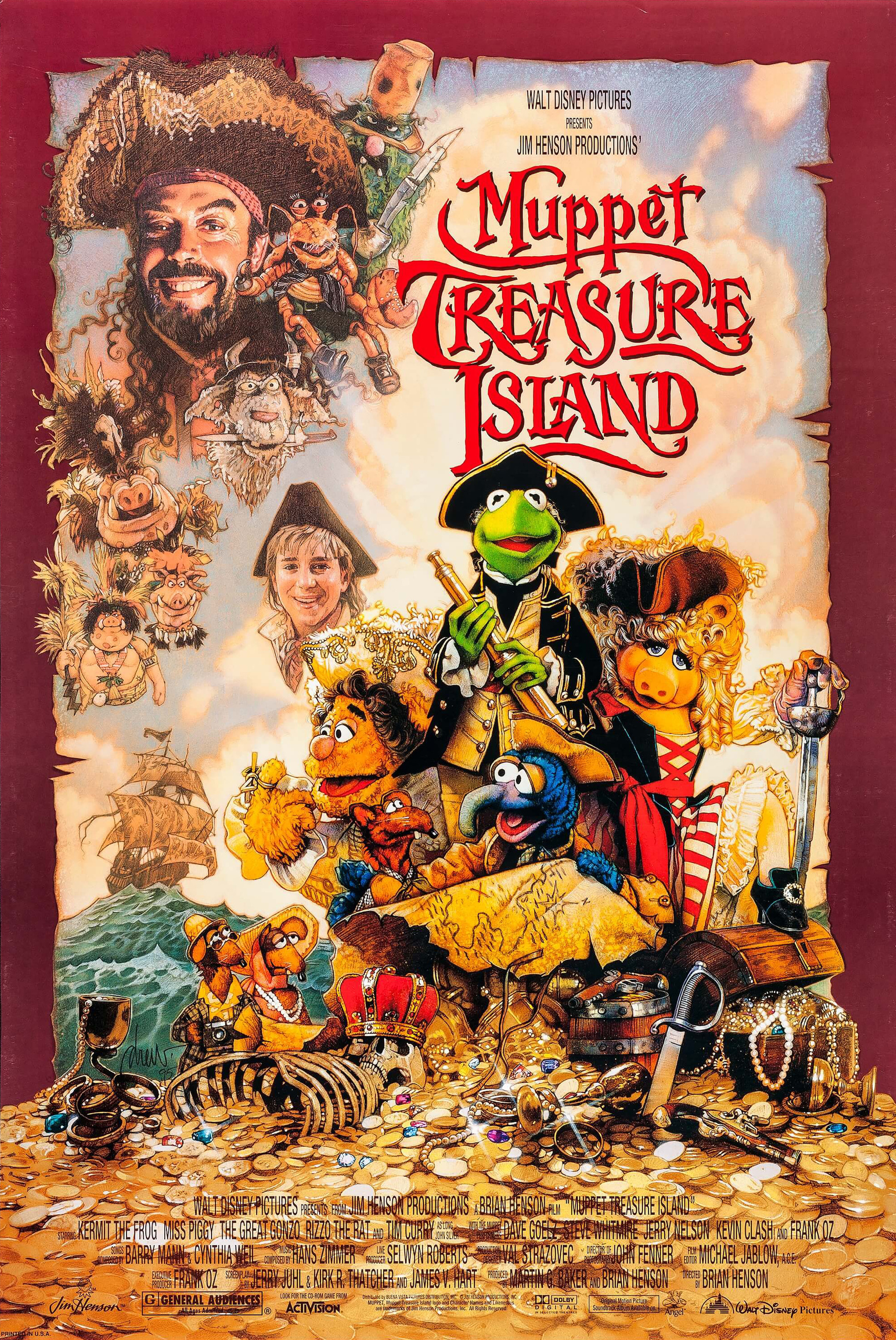
As the title would suggest, Muppet Treasure Island is based on Robert Louis Stevenson's classic adventure novel.  It was the second Muppet feature film after the death of Jim Henson in 1990.  To me, it's one of the weaker Muppet movies but due to my devotion to the franchise, anything less than a rating of 4 is unthinkable.


The biggest difference for me between this viewing and my first is the fact that I have since read the book.  The "good guys" in Stevenson's story - that is, the gentleman sailors who unexpectedly find themselves pitted against Long John Silver and his gang - are portrayed more or less as idiots in the book.  Thus, casting them as goofy Muppets works pretty well.  Mind you, most of the pirates on Long John's side are felted, too.  But the success of any Muppet movie is dependent upon the buy-in of the human cast.  Long John is the key role and in a master stroke, Tim Curry was cast in the part.  Billy Connolly and Jennifer Saunders also appear.  Kevin Bishop is the protagonist, young Jim Hawkins.  The only other human of note is Jessica Hamilton, Brian Henson's wife, who has a memorable cameo as Big-Fat-Ugly-Bug-Faced-Baby-Eating O'Brien.


I think I have fallen asleep both times I have watched the movie, though I missed different parts each time.  There's really nothing wrong with the film but it doesn't maintain the same consistently goofy energy as others in the series.  The same is true for 1992's The Muppet Christmas Carol but that movie's adherence to the source material more than makes up for it.  Treasure Island's music is, it must be said, eye-roll inducing, especially Jim's songs.  But it's still the Muppets and Muppets are wonderful.

*****

My Rating System:

5 = The best of the best.  These are the films by which I judge other films.
4 = High quality films which I feel could hold up well in repeated viewings.
3 = The vast majority of films.  They're fine.  Once was enough.
2 = I wasn't even sure I wanted to finish it.  It's not a 1 because I'm not prepared to say it's a terrible film - just not my cup of tea.
1 = A terrible film.  An insult to the art form.

Saturday, September 27, 2014

The Cephalopod Coffeehouse: October 2014 Blog List

Greetings to all!  I hope you'll join us for the next installment of the Cephalopod Coffeehouse, an online gathering of bloggers who love books.  The next meeting is set for Friday, October 31st.  If you're interested, please sign on to the link list at the end of this post.

The idea is simple: on the last Friday of each month, post about the best book you've finished over the past month while visiting other bloggers doing the same.  In this way, we'll all have the opportunity to share our thoughts with other enthusiastic readers.  Please join us:


Friday, September 26, 2014

The Cephalopod Coffeehouse: September 2014

Welcome one and all to the Cephalopod Coffeehouse, a cozy gathering of book lovers, meeting to discuss their thoughts regarding the tomes they enjoyed most over the previous month.  Pull up a chair, order your cappuccino and join in the fun.  If you wish to add your own review to the conversation, please sign on to the link list at the end of my post.

Title: Consider the Oyster
Author: M.F.K. Fisher
via Wikipedia
M.F.K. Fisher is the grande damme of American food writers.  As Julia Child was to the television screen, Ms. Fisher was to the printed page.  Consider the Oyster is exactly as advertised, an exploration of one of humanity's most extraordinary foods: its biology, its history and its preparation.  There's even a chapter on pearls.

In my own foodie book wanderings, I find I'm more interested in learning about ingredients than in preparation.  Of course, this is largely because to this point in my life, I've done a lot more eating than cooking.  I can't say I have much of an opinion about oysters myself.  I'm sure I've eaten them but not much.  This is the sort of book that makes one hungry and I'm particularly curious about the oyster loaf the author used to eat as part of a clandestine operation with her friends at boarding school.

Fisher, a woman unashamed of her appetites, shares the sensuality of eating beautifully.  On choosing the best wine to pair with her favorite bivalve, "I have had Pouilly-Fuissé, various kinds of champagnes nature, a pink Peau d'Onion, and both bottled and open wines of Anjou with oysters in France, and whether they were correctly drunk or not, I was."  Consider the Oyster is a fun book and it's short, only 73 pages.

Please join us and share your own review of your best read from the past month.  This month's link list is below.  I'll keep it open until the end of the day.  I'll post October's tomorrow.  Meetings are the last Friday of each month.  Next gathering is October 31st.


Wednesday, September 24, 2014

Star Trek: The Paradise Syndrome

Episode: "The Paradise Syndrome"
Series: Star Trek: The Original Series
Season 3, Episode 3
Original Air Date: October 4, 1968
via Memory Alpha
The landing party of Kirk, Spock and McCoy arrives on a planet remarkably similar to earth in terrain.  They soon discover inhabitants resembling a Native American tribe.  While investigating a mysterious pylon reminiscent of "Land of the Lost," the Captain falls through a trap door and hits his head, inducing amnesia.  Spock and Bones return to the ship in order to attend to the original mission, diverting an asteroid from colliding with the planet. 

Side discussion: How does this asteroid diversion effort jive with the Prime Directive?  Doesn't that qualify as intervention, even if the intention is good?

When he returns to the surface, he encounters two native women who take him for a god.  This divine status is enhanced when he administers CPR to a dying boy.  Kirk becomes tribal medicine man, inspiring understandable hostility from his predecessor.  To make matters worse, Kirk stole his girlfriend, too!

The narrative treatment of natives is definitely patronizing, a shame as it detracts from the more interesting aspects of the story.  Kirk spends two months on the planet, during which time he marries and impregnates his wife.  Apparently not interested in the new potential tangent, the writers did the convenient thing and (SPOILERS) killed her off at the end of the episode.

*****
via Memory Alpha
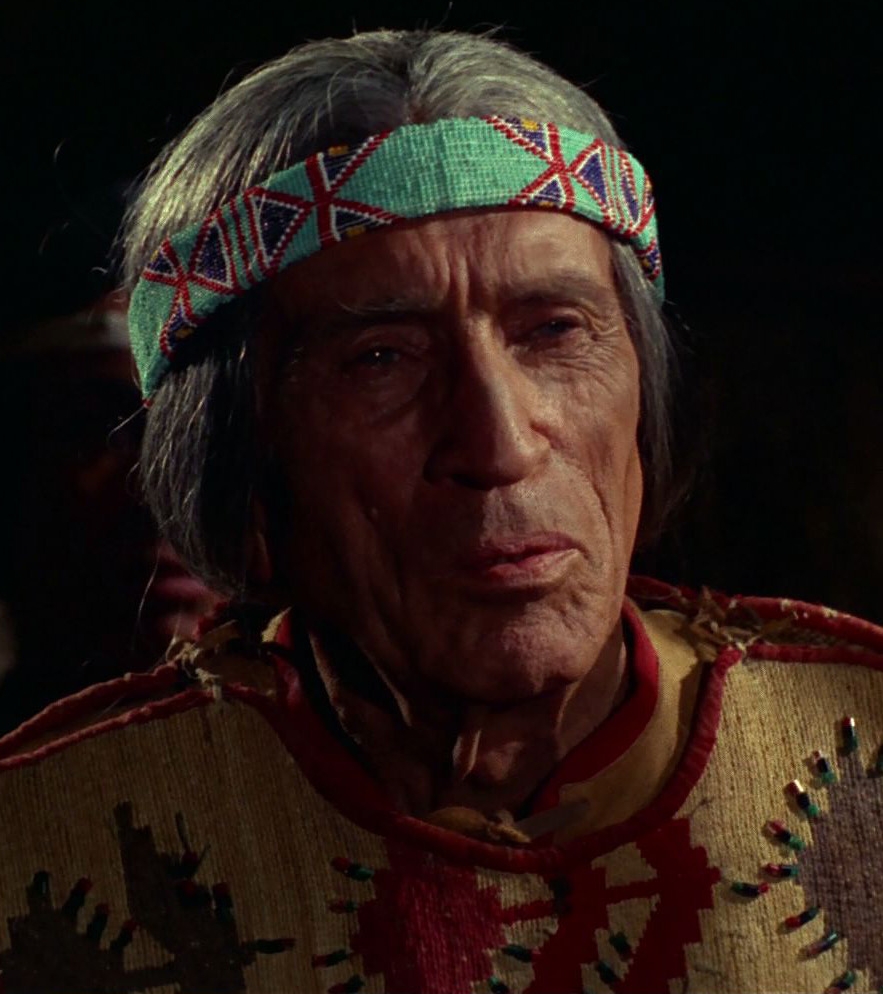
Richard Hale played the role of Goro, the tribal chief.  Hale was born November 16, 1892 in Rogersville, Tennessee.  An opera baritone by training, he went to Columbia on a music scholarship before pursuing a career on stage. 

He hit the screen later in life, notable films including Friendly Persuasion, Julius Caesar and To Kill a Mockingbird.  Among many television gigs, he made four appearances on Perry Mason.  Hale died in 1981 of cardiovascular disease.

Sunday, September 21, 2014

Family Movie Night: The Golden Compass

Title: The Golden Compass
Director: Chris Weitz
Original Release: 2007
Choice: My Wife's
My Overall Rating: 2 stars out of 5

The Golden Compass.jpg
"The Golden Compass" by The poster art can be obtained from the following website: IMP Awards.. Licensed under Fair use via Wikipedia.

Let me begin by saying that the book, The Golden Compass by Philip Pullman, is wonderful as the entire trilogy, His Dark Materials.  My Wife and I fell in love with the story through the full cast audiobooks during road trips even before we were married.  We have enjoyed sharing the series with our daughter, too.  We have avoided the film until now.  The reviews were not good during the original release and we all know the disappointment of a mediocre adaptation of a beloved book.


Lyra Belacqua (Dakota Blue Richards) is an orphan under the care of professors at Oxford.  Times are dark, with children being stolen away from their homes in the middle of the night.  When Lyra's best friend, Roger is abducted, she vows to find him.  One day, the mysterious Mrs. Coulter (Nicole Kidman) whisks her away to a new life, though it quickly becomes apparent that her new benefactor is very wicked indeed.  Lyra bolts and makes many colorful new friends: river-traveling Gyptians, witches, an armored bear and a Texan aeronaut. 

Lyra has a daemon, as do all humans in her parallel world.  A daemon is an external manifestation of the soul, taking the form of an animal companion, remaining faithfully at the human's side for his/her entire life. The daemons are the defining feature of this fantasy world and the book lingers lovingly over the relationship between Lyra and hers, Pantalaiman.  Pan is her playmate and confidant.  His ever-changing shape - cat to bird to squirrel to whatever - is a constant delight.  Lyra dreads the day Pan's form will settle, as always happens when the human comes of age.  This beautiful bond is essential for fully appreciating the horror exacted upon the abducted children.

The movie glazes over the daemons.  They're included but I don't know if I would have fully understood their importance if I hadn't read the book.  Without that context, it's just another adventure story, the world's essential magic lost.  I don't know if I would even have cared if I hadn't read the book.  Then they screwed up the ending.  More on that in a bit.

The film is not without its strengths.  The casting is superb.  In addition to Kidman, we get Daniel Craig as Lord Asriel, Christopher Lee as First High Councillor and Sam Elliott as the balloonist, Lee Scoresby ("It's really too bad," My Wife said of Elliott. "This is the role he was born to play.").  The voice cast is outstanding, too: Sir Ian McKellan, Kristin Scott Thomas and Kathy Bates.  The visuals are very satisfying as well. If they'd seen the story all the way through to the end of the book, I might have been convinced to grant a rating of 3 but alas, no...

!!!!!!!!!SPOILER ALERT!!!!!!!

The film ends after Lyra finds Roger and they head toward the North Pole to find Lyra's father, Lord Asriel.  Lyra believes this will solve everything, just as in the book.  We are left with hope.

The book ends with Roger dead and Lyra and her entire world betrayed by Lord Asriel and Mrs. Coulter.  We are also left with the sense that even with all the adventures of book 1, Lyra's story is just beginning.  The movie ends with no resolution whatsoever.  Were they planning to leave the "real ending" for a sequel film?  Whatever.  I felt cheated.

!!!!!!!!!END OF SPOILER!!!!!!!

*****

My Rating System:

5 = The best of the best.  These are the films by which I judge other films.
4 = High quality films which I feel could hold up well in repeated viewings.
3 = The vast majority of films.  They're fine.  Once was enough.
2 = I wasn't even sure I wanted to finish it.  It's not a 1 because I'm not prepared to say it's a terrible film - just not my cup of tea.
1 = A terrible film.  An insult to the art form.

Wednesday, September 17, 2014

Star Trek: The Enterprise Incident

Episode: "The Enterprise Incident"
Series: Star Trek: The Original Series
Season 3, Episode 2
Original Air Date: September 27, 1968
via Memory Alpha
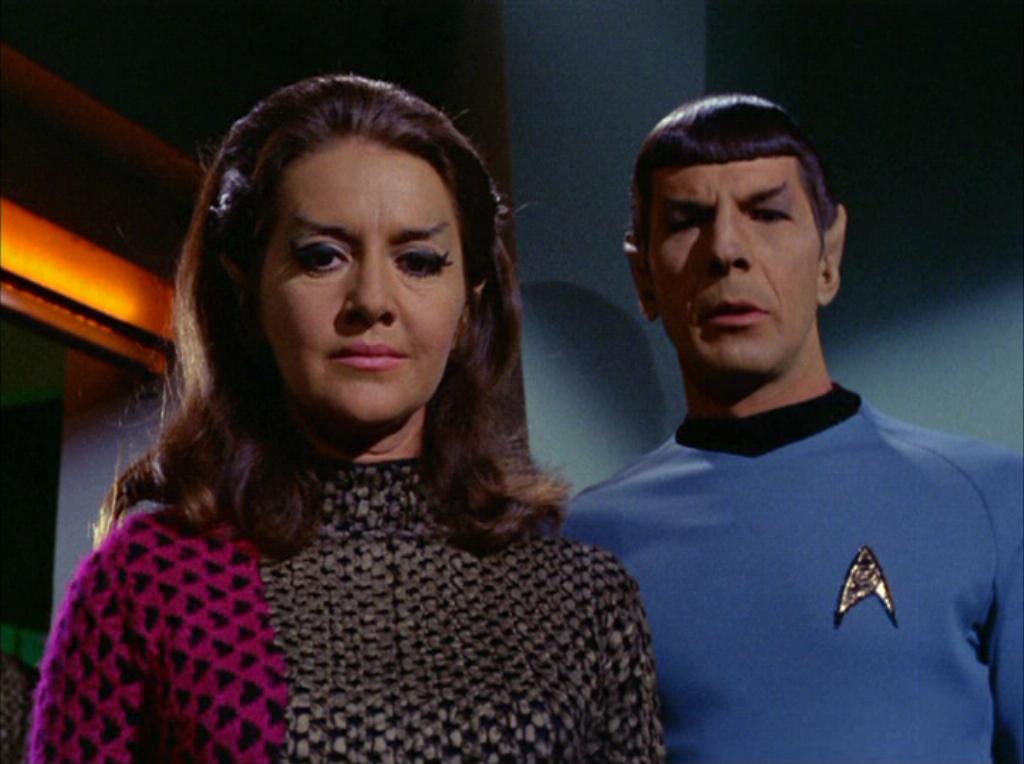
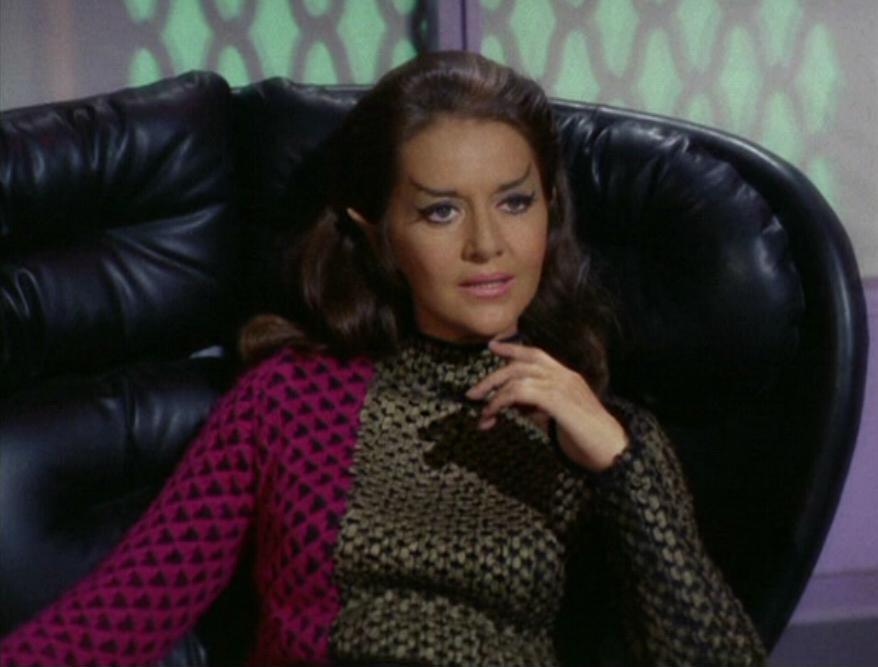
Just like that, the series bounced back a bit.  A week after what is considered by many to be the Grand Turkey episode of Star Trek's original series (review here), our heroes found steadier ground in "The Enterprise Incident."  To the bafflement of his crew, Captain Kirk orders entry into the Neutral Zone, drawing the immediate attention of the Romulans.  In time (actually, a little too early for my tastes), it is revealed that Kirk and Spock both have orders from Starfleet to steal a Romulan cloaking device.  Along the way, the captain of the enemy ship, a woman, falls in love with Spock and attempts to convince him to come over to the dark side.

I like this story for a lot of reasons.  Furthering the broader Romulan narrative was certainly important to the franchise.  The brief romance - genuine or not - develops Spock's character and also broadens the concept of Romulan nature, revealing them to be more than the ruthless warriors the Enterprise crew expects.  Just as Mark Lenard (Sarek) and Jane Wyatt (Amanda) invented the Vulcan sign of affection for "Journey to Babel," Leonard Nimoy and Joanne Linville (Romulan commander) created their own intimate gestures to take the place of human kissing.

*****
via Memory Alpha
Beverly Joanne Linville was born January 15, 1928 in Bakersfield, California.  She had a long and varied acting career over a 50-year period.  Film appearances include The Goddess, Gable and Lombard and Scorpio.  In addition to Trek, she found television roles in The Guiding Light, One Step Beyond, Twilight Zone and Bus Stop among many others.  She co-starred with George Grizzard in Bus Stop's final episode, entitled "I Kiss Your Shadow."  Stephen King has identified the episode as one of his favorite television horror stories.

Sunday, September 14, 2014

Family Movie Night: Gentlemen Perfer Blondes

Title: Gentlemen Prefer Blondes
Director: Howard Hawks
Original Release: 1953
Choice: Mine
My Overall Rating: 3 stars out of 5
via Wikipedia
Based on the stage musical of the same name, Gentlemen Prefer Blondes tells the tale of two beautiful showgirls and their adventures in romantic conquest.  Dorothy Shaw, the snarky brunette played by Jane Russell, and Lorelei Lee, the deceptively ditzy blonde played by Marilyn Monroe, are on a boat bound for Europe.  Also aboard are rich old men practically begging to be poached and the US Olympic team.  Between the women in their dazzling wardrobes and the muscular athletes in their short, skin-tight swim trunks, there's no shortage of eye candy, no matter your preference.


Even before there was a stage play, there was a novel, written by Anita Loos and published in the Jazz Age, 1925.  The sexual politics aren't exactly progressive but Dorothy and Lorelei are no fools, either.  In fact, the women in the story run rings around the fellas from beginning to end.  The dialogue is frequently very funny indeed and Jane Russell sparkles.  For better or for worse, Marilyn is Marilyn.  Her acting never quite lives up to the writing but she doesn't ruin it either.  And my goodness, could that woman wear a dress!

The film had a budget of over $2 million, a lot of money in 1953.  Surely, at least half of it was spent on costumes.  How two struggling showgirls could afford so many high-fashion gowns is beyond me but the dresses are truly the highlight of the movie.  Kudos to designer Travilla.

The music's fun, too.  All of the songs from the Broadway show, including "Diamonds Are a Girl's Best Friend," were penned by Jule Styne and Leo Robin.  New songs were supplied by Hoagy Carmichael and Harold Adamson.  In yet another stage-to-screen controversy, many were upset that Carol Channing was not cast as Lorelei but I think history has afforded Ms. Channing her due.  I would bet that for many people, it's Monroe we see singing "Diamonds" in our mind's eye but more often, it is Channing we hear.  Thanks to YouTube, we can have both.  (Credit the omnipresent Marni Nixon with an assist on Marilyn's.  Her voice was dubbed in for the tricky spots.)

A twofer from Channing:


Monroe:


*****

My Rating System:

5 = The best of the best.  These are the films by which I judge other films.
4 = High quality films which I feel could hold up well in repeated viewings.
3 = The vast majority of films.  They're fine.  Once was enough.
2 = I wasn't even sure I wanted to finish it.  It's not a 1 because I'm not prepared to say it's a terrible film - just not my cup of tea.
1 = A terrible film.  An insult to the art form.