Friday, February 28, 2014

The Cephalopod Coffeehouse: February 2014

Welcome one and all to the Cephalopod Coffeehouse, a cozy gathering of book lovers, meeting to discuss their thoughts regarding the tomes they enjoyed most over the previous month.  Pull up a chair, order your cappuccino and join in the fun.  If you wish to add your own review to the conversation, please sign on to the link list at the end of my post.

Title: Splinter of the Mind's Eye
Author: Alan Dean Foster
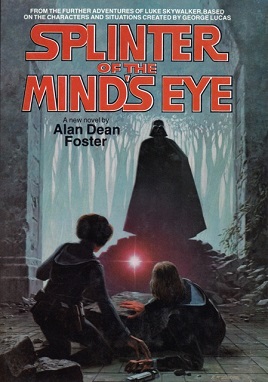
via Wikipedia
Does everybody have their geek hats on?  Alrighty, let's go.

When Alan Dean Foster was signed on to ghost write the novelization of Star Wars, his contract included a second book.  Splinter of the Mind's Eye, first published in 1978, was conceived as a low-budget sequel to the first movie if it failed at the box office.  Of course, we all know Star Wars was one of the most successful films in history and there was plenty of cash on hand to produce the big-budget masterpiece, The Empire Strikes Back.  But as the first full-length novel after the original, Splinter became a cornerstone of Star Wars's Expanded Universe, the enormous body of lower canon material which has been created over the decades since.

Splinter is a Luke and Leia story.  Han Solo is never even mentioned by name - Harrison Ford had not yet been signed for a sequel film.  Luke and Leia, unexpectedly detoured from a diplomatic mission, find themselves on a quest for the Kaiburr crystal, an object with great power and not fully understood connection with the Force.  Naturally, they must get to the crystal before Darth Vader and his minions get ahold of it. Along the way, they make new friends and enemies among the weird and wild creatures that make up The Galaxy Far, Far Away.

George Lucas has, over the years, waffled on the question of whether he knew the entire Star Wars saga from the beginning or if he made it up as he went along.  While he did not write Splinter, he did have a lot of control over its content so inconsistencies with the movies are well worth exploring. Luke and Leia are still a way's off from discovering their brother/sister relationship so they are free to test the sexual tension between them.  Yes, it's a bit icky when you know what's coming down the line but I, for one, do not believe that Lucas knew he would eventually make them siblings, or even the children of Vader.  There is a direct confrontation between Luke, Leia and Vader in Splinter, with a very different result from the duel to come on Bespin.

While I found the original Star Wars novelization a bit of a mess (review here), Splinter of the Mind's Eye is tidier.  It's hard to say it's a better book because the story isn't as good but it is a more polished work.  Star Wars devotees will find plenty to like and plenty to ponder.

Please join us and share your own review of your best read from the past month.  This month's link list is below.  I'll keep it open until the end of the day.  I'll post March's tomorrow.  Meetings are the last Friday of each month.  Next gathering is March 28th.


Wednesday, February 26, 2014

Star Trek: The City on the Edge of Forever

Episode: "The City on the Edge of Forever"
Series: Star Trek: The Original Series
Season 1, Episode 28
Original Air Date: April 6, 1967
via Wikipedia
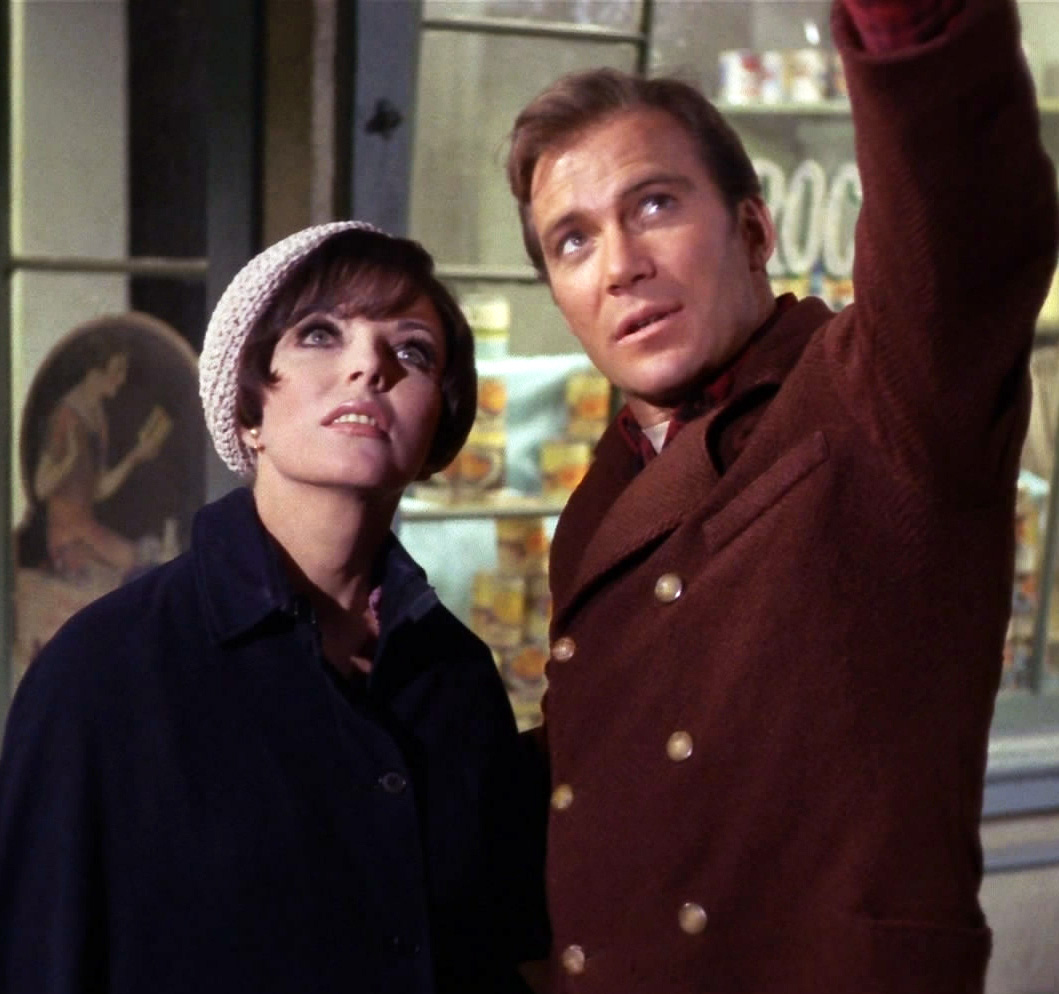
For many, "The City on the Edge of Forever" is the episode in Star Trek's original series, the one by which all others are judged.  It is one of two original series episodes to win the Hugo Award for Best Dramatic Presentation (the other being "The Menagerie" - reflections here and here).  As such, I've been looking forward to this story.  In addition to general critical acclaim, I figured it would be the ultimate test of my patience with Trek where time travel narratives are concerned.  As discussed in previous posts, I feel it is a storyline the franchise generally doesn't handle well.  If the most revered tale in that vein can't change my mind, there's no hope for me.

The Enterprise crew discovers the "Guardian of Forever," a time/space travel portal.  Driven mad by an inadvertent drug overdose, Dr. McCoy leaps through the portal and apparently alters history.  Their own existence at risk, Kirk and Spock have no choice but to follow him in hopes of undoing whatever temporal damage has been done.
via Memory Alpha
They arrive in 1930s New York, approximately a week before McCoy's arrival in the same place. They have a most fortunate encounter with Edith Keeler, a young, beautiful missionary woman who gives them work and finds them cheap lodging.  Before McCoy turns up, Spock discovers the temporal dilemma. In the original time stream, Edith is killed by an automobile. In the new, McCoy saves her life. Her peacekeeping work is effective in keeping the US out of the Second World War, allowing for eventual Nazi world conquest, killing the space program that would ultimately lead to the Enterprise's mission.  To complicate matters further, Kirk has fallen in love with her.

My verdict: this is definitely a good episode.  Edith is a great character and the moral dilemma presented is exactly the sort of thing I love about Trek.  However, I still have my issues with the time travel.  If the time stream had changed when McCoy went back, not only would the Enterprise have disappeared but so would the landing party standing in front of the portal, Kirk and Spock included.  In fact, McCoy himself wouldn't even have been there to jump through in the first place, so history wouldn't have changed, and so forth.  Sure, it's fun and well-written but take a step back and it's messy.

*****
via Wikipedia
Joan Collins (Edith) was born May 23, 1933 in London.  In show business from the age of 9, she didn't achieve the cultural icon status she enjoys today until 1981, when she landed the part of Alexis Carrington on Dynasty.  She made her big screen debut in 1951's Lady Godiva Rides Again and her credits include appearances in softcore porn adaptations of her younger sister's novels. Jackie Collins is, of course, one of the titans of the publishing industry but Joan is no slouch herself, having written 17 books with more than 50 million copies sold worldwide.  She's an accomplished singer, too, including a performance with Bing Crosby and Bob Hope in The Road to Hong Kong.

Joan Collins has been married five times, including Percy Gibson from 2002 to the present.  She has three children and three grandchildren.  A devoted royalist, she was appointed an Officer of the Order of the British Empire in 1997.

Sunday, February 23, 2014

On the Road: The Berkshires

From time to time, we are lucky enough to score an invitation from the Commish and Wild Turkey to join their family at his parents' vacation home in the Berkshires, a mountain range in western Massachusetts.  Previous visitors to The Squid may recall that the Commish and Wild Turkey are friends of mine from college, and particularly important ones for the fact that they introduced me to My Wife.  We had not seen them in about a year, I think, so we were glad for the chance to catch up.

Saturday evening's festivities centered around the following:

Our dear friends share our love for games.  We introduced a couple of our new favorites to them this weekend.
via Games by Play Date
Love Letter is a simple card game.  The manufacturer's description:

All of the eligible young men (and many of the not-so-young) seek to woo the princess of Tempest. Unfortunately, she has locked herself in the palace, and you must rely on others to bring your romantic letters to her. Will yours reach her first? Love Letter is a game of risk, deduction, and luck for 2 to 4 players. Your goal is to get your love letter into Princess Annette's hands while deflecting the letters from competing suitors. From a deck with only sixteen cards, each player starts with only one card in hand; one card is removed from play. On a turn, you draw one card, and play one card, trying to expose others and knock them from the game. Powerful cards lead to early gains, but make you a target. Rely on weaker cards for too long, however, and your letter may be tossed in the fire. 

The game is easy to learn and fast to play.  Strategy is subtle.  While the game is playable with just two, it's better with more people.  The artwork is satisfying.
via BoardGameGeek
Forbidden Desert is a cooperative game with a constantly shifting board.  Manufacturer's description:

Gear up for a thrilling adventure to recover a legendary flying machine buried deep in the ruins of an ancient desert city. You'll need to coordinate with your teammates and use every available resource if you hope to survive the scorching heat and relentless sandstorm. Find the flying machine and escape before you all become permanent artifacts of the Forbidden Desert.

As with Pandemic (review here), it's not a hold hands and sing "Kumbayah" sort of cooperative game - rather, it's get your act together or everybody dies.  I'd say it's easier than Pandemic but we've also only played the easiest level so far.  This game also has excellent artwork.  It's recommended for ages 10 and up but their seven-year-old daughter got the hang of it pretty quickly.

Overall, it was a fun weekend.  Too much of the vino on Saturday put a bit of a dent in my Sunday, I must confess, but an enjoyable time nonetheless.  Fortunately, we've already made plans to see them again in a few weeks.

Wednesday, February 19, 2014

On the Coffee Table: Kidnapped

Title: Kidnapped
Author: Robert Louis Stevenson
via Wikipedia
And so, my initially unplanned tour of Robert Louis Stevenson's Big 3 novels comes to an end.  After reading Jeckyll and Hyde in August (reflection here) and Treasure Island in December (here), rounding out the trio with Kidnapped seemed only natural.  Of the three, Kidnapped was the one I knew the least about beforehand.  Now, I'd have to say it's the one I like best.

The story was not quite what I expected.  After Treasure Island, I anticipated more pirates and seafaring adventures.  While there's some of that, Kidnapped is more a grand tour of the author's native Scotland.  Upon the occasion of his father's passing, young David Balfour is sent off with a letter of introduction to meet an uncle he never knew he had.  Said uncle is a crazy recluse who first tries to kill David but then has him, you guessed it, kidnapped by shady sailor types.  The boat shipwrecks but not before David befriends Alan Breck Stewart, a real-life Scottish Jacobite.  Most of the rest of the story follows the two on the lam from a bum murder rap.  It's the sort of story that would be torn apart by modern critics for its zig-zag narrative but it's a lot of fun.

Like the other two RLS novels I've read, Kidnapped is thick with details, particularly in setting - the author's wheelhouse.  I found it more enjoyable than the other two as suspense is better maintained throughout.  My own lack of foreknowledge may have helped.  After all, Jeckyll and Hyde would undoubtedly be more suspenseful if one didn't already know the plot twist. 

I think I've had enough of RLS for a while but I'm glad to have read the greatest hits.

Star Trek: The Alternative Factor

Episode: "The Alternative Factor"
Series: Star Trek: The Original Series
Season 1, Episode 27
Original Air Date: March 30, 1967
via Memory Alpha
"The Alternative Factor" was the first Star Trek episode to explore the concept of parallel universes. During a routine mapping assignment of an uninhabited planet, the entire universe suddenly winks out of existence, then back in again.  You know, ordinary Thursday stuff.  Obviously, they must go to the planet's surface to investigate where they encounter a strange, clearly tormented man: Lazarus.  Turns out, he is at war with his doppleganger in another dimension.  As the story develops, the Enterprise crew finds his anti-universe double to be the rational one and helps him to mend the breach between the two astral planes.

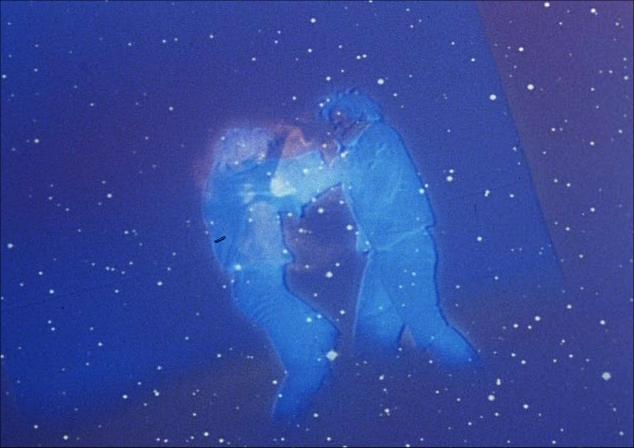
I found this story hard to follow.  I actually had to restart the episode ten minutes in because I'd already lost my way.  The effects used to realize the alternate reality are respectable for the era: superimposed images of the Trifid Nebula to represent the winking and action in the negative universe in color-negative.  However, the effects fail to cover up the weakness of the narrative.

A few noteworthy trivia tidbits:
  • I noticed changes in Lazarus's facial hair from scene to scene.  I assumed it was part of the dual-identity but according to Memory Alpha, the inconsistencies are rampant even from one camera shot to the next.
via Wikipedia
  • No Scotty in this episode.  Instead, Lt. Charlene Masters is the head of engineering.  Originally, there was supposed to be a romance between Lazarus and Masters but when Janet MacLachlan, an African-American woman, was cast in the role, the southern NBC affiliates balked at the idea.
*****
via Wikipedia
Robert Brown (Lazarus) was born Robin Adair MacKenzie Brown on November 17, 1926 in Trenton, New Jersey.  He was a last-minute casting for the episode.  John Drew Barrymore was supposed to play the role but he failed to show on the day of shooting.  His absence would ultimately result in a six-month suspension from the Screen Actors Guild.

Brown had numerous television roles during the 1960s and 70s.  He had starring roles in both Here Come the Brides and Primus.  In addition to Trek, he made guest appearances on The Lawless Years, Perry Mason, Archie Bunker's Place and In the Heat of the Night, the last two a result of his close friendship with Carroll O'Conner.

Sunday, February 16, 2014

Family Movie Night: Jaws

Title: Jaws
Director: Stephen Spielberg
Original Release: 1975
Choice: Mine
My Overall Rating: 3 stars out of 5
via Amazon
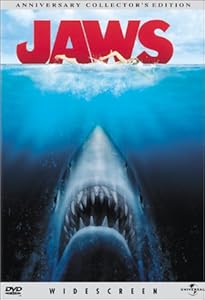
Amazingly, I had never seen Jaws before.  I was but a wee child when the film was first released and became the original summer blockbuster.  Scary movies generally aren't my thing so it's never been at the top of my must-see video rental list either.  However, any exploration of music in film would be incomplete without Jaws.  People who have never seen the film know the shark's theme music instantly, certainly one of the most easily recognizable leit motifs in all of cinema.


An enormous shark is eating swimmers off the coast of the fictional Amity Island.  When a young boy is killed, his mother offers a reward to anyone who can catch the offending beast.  After the amateurs make fools and occasional meals of themselves in the pursuit, an expert is hired.  Science, law enforcement and seafaring testosterone combine forces to hunt down the deadly fish.

Jaws is filmed mostly in and around Martha's Vineyard in Massachusetts, a part of the world we've come to know well.  While we've never been to the island itself, the Philosopher's Island (not its real name) is very close by.  The terrain is quite familiar.  In fact, I'm pretty sure one of the ferries featured in the movie is still in operation - or it was rebuilt to look exactly the same.

John Williams won his second Academy Award for the Jaws score.  The shark's theme incorporates a simple, effective and legendary half-step alternation which has served as a mnemonic device in ear training classes ever since:


Multi-generational considerations:
  • The movie is definitely scary.  Few films in history have built suspense more effectively.  There is both blood and severed limbs - pretty gross.
  • Before the movie, we assured Our Girl that sharks don't really act like this in the wild.  As My Wife likes to point out, one is statistically more likely to be killed by a falling coconut than by a shark.

Wednesday, February 12, 2014

Star Trek: Errand of Mercy

Episode: "Errand of Mercy"
Series: Star Trek: The Original Series
Season 1, Episode 26
Original Air Date: March 23, 1967
via Memory Beta
"Errand of Mercy" introduced the Klingons, the primary adversaries in Star Trek's original series. The race was originally intended to be Asian in appearance and quite Spartan in their approach to life and warfare.  They did not yet have the bulging prosthetic foreheads nor the well-developed language they would gain in later series and films.  Apparently, the Klingons became the enemy of choice for the show simply because the make up was cheaper and less time consuming than it was for the Romulans.

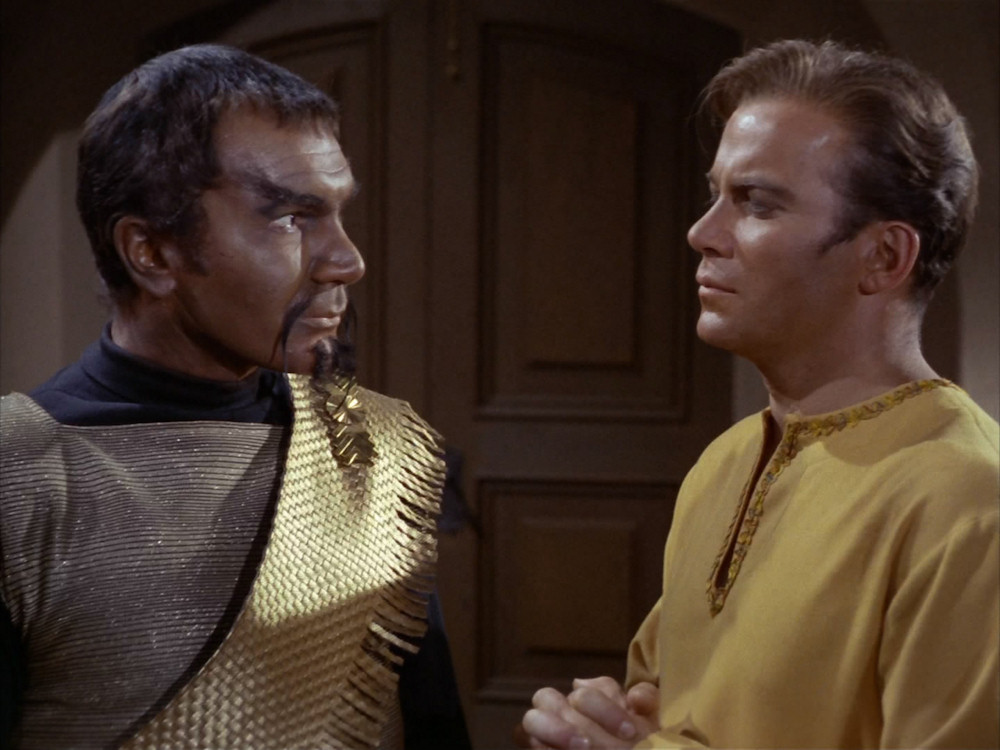
In our story, the United Federation of Planets and the Klingon Empire are on the brink of war.  The Enterprise has been sent to the planet Organia to stop the Klingons from claiming it for strategic advantage.  Alas, the Klingons, led by the ruthless Commander Kor, march in, claim the locals as subjects and eventually capture both Kirk and Spock.  Fortunately for all involved, the Organians turn out to be far more than peacenik pushovers and take matters into their own hands.

I enjoyed this episode, one of my favorite so far.  The verbal sparring between Kirk and Kor is great fun and I like the fact that both Federation and Kligons get their comeuppance from beings they had grossly underestimated.

*****
via Wikipedia
John Colicos (Kor) was born December 10, 1928 in Montreal.  Colicos built his career on the stage, appearing in numerous New York productions: Mary Stuart, King Lear, The Devils, Serjeant Musgrave's Dance and Soldiers.  His sci-fi credentials were extensive.  In addition to his appearances as Kor in both Star Trek's original series and Deep Space Nine, he portrayed Count Baltar in the original Battlestar Galactica series and a mad scientist in the soap opera General Hospital.  There were film credits, too, including 1981's The Postman Always Rings Twice.  Colicos died after multiple heart attacks in 2000.