Greetings to all! I hope you'll join us for the next installment of
the Cephalopod Coffeehouse, an online gathering of bloggers who love
books. The next meeting is set for Friday, June 27th. If you're
interested, please sign on to the link list at the end of this post.
The
idea is simple: on the last Friday of each month, post about the best
book you've finished over the past month while visiting other bloggers
doing the same. In this way, we'll all have the opportunity to share
our thoughts with other enthusiastic readers. Please join us:
"If more of us valued food and cheer and song over hoarded gold, it would be a merrier world." - J.R.R. Tolkien
Saturday, May 31, 2014
Friday, May 30, 2014
The Cephalopod Coffeehouse: May 2014
Welcome one and all to the Cephalopod Coffeehouse, a cozy gathering of
book lovers, meeting to discuss their thoughts regarding the tomes they
enjoyed most over the previous month. Pull up a chair, order your
cappuccino and join in the fun. If you wish to add your own review to
the conversation, please sign on to the link list at the end of my post.
Title: The Sports Gene: Inside the Science of Extraordinary Athletic Performance
Author: David Epstein
Have you ever wondered how Jamaica, a nation of under 3 million people, has come to dominate world sprint competition? Or how particular tribes in both Kenya and Ethiopia have done the same in distance running? Or whether or not you should pick a sport for your child based on DNA analysis? If so, The Sports Gene is the book for you. As advertised, Epstein's book is an exploration of various studies on the biological and environmental factors which contribute to athletic performance. Genome mapping has allowed deeper examination but mysteries still abound.
In my exploration of sports books, I'm always on the lookout for those that would be enjoyable for non-fans. I think it's a reasonable measure for books in any genre but more importantly for me personally, such a book is one I can safely recommend to my wife. My dear bride is a voracious reader with a life list to put all of us to shame. However, to say she is not a sports fan is comparable to saying a duck is not a water balloon. But I still make modest efforts to convert her from time to time. Giving her the right book to read is as strong a tactic as any. The Sports Gene is a good candidate.
For starters, the book is very well-written. David Epstein follows in the grand tradition of gifted Sports Illustrated staff writers. Also, I think the anecdotal style and the attention to broader topics beyond sports are selling points for the general-interest reader.
Make no mistake, there's plenty to love for sports fans, too. The book opens with a story about Hall of Fame-caliber baseball players being completely flummoxed by Jennie Finch, the world's best softball pitcher. Turns out, despite all their physical gifts (average eyesight for Major League hitters is 20/11 in the right eye, 20/12 in the left), batters rely heavily on a highly refined mental database for recognizing pitches even before the ball leaves the hurler's hand. The same goes for tennis players reading an opponent's serve and chess grandmasters processing positions on the board. Take away that database, as in the case of facing an ace softball pitcher, and all of the expert hitter's advantages fly out the window. The book is filled with peak-behind-the-curtain revelations such as this.
I spoil nothing by sharing the book's conclusion as Epstein lays it out plainly in the book's introduction. Athletic success is dependent upon the combination of both nature and nurture. All the talent in the world will only take you so far if you don't put in the work. Similarly, a stellar work ethic, while admirable, is rarely enough to reach the top of the medal podium without the help of a genetic advantage or two.
Please join us and share your own review of your best read from the past month. This month's link list is below. I'll keep it open until the end of the day. I'll post June's tomorrow. Meetings are the last Friday of each month. Next gathering is June 27th.
Title: The Sports Gene: Inside the Science of Extraordinary Athletic Performance
Author: David Epstein
| via Barnes & Noble |
In my exploration of sports books, I'm always on the lookout for those that would be enjoyable for non-fans. I think it's a reasonable measure for books in any genre but more importantly for me personally, such a book is one I can safely recommend to my wife. My dear bride is a voracious reader with a life list to put all of us to shame. However, to say she is not a sports fan is comparable to saying a duck is not a water balloon. But I still make modest efforts to convert her from time to time. Giving her the right book to read is as strong a tactic as any. The Sports Gene is a good candidate.
For starters, the book is very well-written. David Epstein follows in the grand tradition of gifted Sports Illustrated staff writers. Also, I think the anecdotal style and the attention to broader topics beyond sports are selling points for the general-interest reader.
Make no mistake, there's plenty to love for sports fans, too. The book opens with a story about Hall of Fame-caliber baseball players being completely flummoxed by Jennie Finch, the world's best softball pitcher. Turns out, despite all their physical gifts (average eyesight for Major League hitters is 20/11 in the right eye, 20/12 in the left), batters rely heavily on a highly refined mental database for recognizing pitches even before the ball leaves the hurler's hand. The same goes for tennis players reading an opponent's serve and chess grandmasters processing positions on the board. Take away that database, as in the case of facing an ace softball pitcher, and all of the expert hitter's advantages fly out the window. The book is filled with peak-behind-the-curtain revelations such as this.
I spoil nothing by sharing the book's conclusion as Epstein lays it out plainly in the book's introduction. Athletic success is dependent upon the combination of both nature and nurture. All the talent in the world will only take you so far if you don't put in the work. Similarly, a stellar work ethic, while admirable, is rarely enough to reach the top of the medal podium without the help of a genetic advantage or two.
Please join us and share your own review of your best read from the past month. This month's link list is below. I'll keep it open until the end of the day. I'll post June's tomorrow. Meetings are the last Friday of each month. Next gathering is June 27th.
Labels:
Book Club,
good reading,
sports books,
tennis
Thursday, May 29, 2014
On the Coffee Table: Guy Delisle
Title: Shenzhen: A Travelogue from China
Writer and Artist: Guy Delisle
Not all international travel is glamorous. That's
not to say it's not interesting anyway. One can learn plenty from the
painfully mundane.
Guy Delisle is a Quebecois graphic novelist best known for his travel narratives. I have featured his work for the Cephalopod Coffeehouse twice before: here and here. In late 1997, he was sent to Shenzhen, China to serve as liaison between a Belgian animation company and their layout artists in China. His tales lack the exoticism of Burma Chronicles. The city, essentially a mainland satellite of Hong Kong, seems to offer very little charm. Few he meet are English/Chinese bilingual. No one speaks his native French. His experience consists of work and his valiant attempts at building a routine life. Sounds pretty dull, right?
And yet, there's much to glean from Delisle's adventure. The Chinese he meets and works with lead the same sort of humdrum lives and unlike him, they're stuck. They are curious about the outside world but have little access to it. His tales of struggling to communicate and derive what joy he can from life are highly amusing. We share in his relief when his three-month stint is over. I don't think this is the book that would have drawn me into his work but I'm glad to have read it.
Writer and Artist: Guy Delisle
![]() |
| via Drawn & Quarterly |
Guy Delisle is a Quebecois graphic novelist best known for his travel narratives. I have featured his work for the Cephalopod Coffeehouse twice before: here and here. In late 1997, he was sent to Shenzhen, China to serve as liaison between a Belgian animation company and their layout artists in China. His tales lack the exoticism of Burma Chronicles. The city, essentially a mainland satellite of Hong Kong, seems to offer very little charm. Few he meet are English/Chinese bilingual. No one speaks his native French. His experience consists of work and his valiant attempts at building a routine life. Sounds pretty dull, right?
And yet, there's much to glean from Delisle's adventure. The Chinese he meets and works with lead the same sort of humdrum lives and unlike him, they're stuck. They are curious about the outside world but have little access to it. His tales of struggling to communicate and derive what joy he can from life are highly amusing. We share in his relief when his three-month stint is over. I don't think this is the book that would have drawn me into his work but I'm glad to have read it.
Wednesday, May 28, 2014
Star Trek: The Deadly Years
Episode: "The Deadly Years"
Series: Star Trek: The Original Series
Season 2, Episode 12
Original Air Date: December 8, 1967
A stop at Gamma Hydra IV proves disastrous for the Enterprise crew. Intending to resupply a research station on the planet, our heroes find all of the scientists to be rapidly aging and dying. Upon returning to the ship, most of the landing party begin aging faster as well, apparently due to radiation exposure while on the planet. The balance of the episode is devoted to reversing the effects and also questioning whether Kirk, Bones and Spock are still fit for duty when compromised mentally by the aging process.
Just for fun, let's compare the artificial aging in the episode to William Shatner's own natural course since.
1967:
2012:
Overall, I'd say the years have been kinder to ol' Bill than the makeup staff was.
*****
Judging Kirk unfit for duty, Commodore Stocker - hitching a ride with the Enterprise to his new post - assumes command of the ship. Stocker is played by Charles Drake, born Charles Ruppert on October 2, 1917 in New York City. After graduating from Nicholls College he became a salesman. But Hollywood beckoned and Drake signed a contract in 1939 with Warner Brothers.
Among 144 screen credits, Drake played Dr. Sanderson, the young psychiatrist in one of our family's favorite movies: 1950's Harvey. Drake died September 10, 1994 at the age of 76. His ashes were scattered in the Atlantic Ocean.
Series: Star Trek: The Original Series
Season 2, Episode 12
Original Air Date: December 8, 1967
A stop at Gamma Hydra IV proves disastrous for the Enterprise crew. Intending to resupply a research station on the planet, our heroes find all of the scientists to be rapidly aging and dying. Upon returning to the ship, most of the landing party begin aging faster as well, apparently due to radiation exposure while on the planet. The balance of the episode is devoted to reversing the effects and also questioning whether Kirk, Bones and Spock are still fit for duty when compromised mentally by the aging process.
Just for fun, let's compare the artificial aging in the episode to William Shatner's own natural course since.
1967:
![]() | ||||
| via Wikipedia |
![]() |
| via Wikipedia |
*****
![]() |
| via Memory Alpha |
![]() |
| via Aveleyman |
Labels:
comics,
family adventures,
film,
good reading,
sources,
star trek,
TV
Tuesday, May 27, 2014
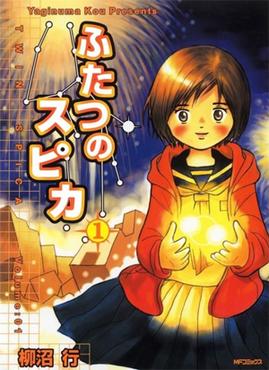
On the Coffee Table: Twin Spica
Title: Twin Spica, Volume 1
Writer and Artist: Kou Yaginuma
Asumi is a high school student with dreams of space exploration. She is accepted to space school in Tokyo - a Hogwarts for astronauts? - but first must convince her father to let her go. So begins the scifi/supernatural adventure Twin Spica, a Japanese manga first published in 2002, now available in translation. The story is set in a not-too-distant future in which Japan has already attempted to launch its own manned rocket - an attempt that ended disastrously.
For her first test upon arriving at the school, Asumi is locked into a barren dorm room with two other girls for several days, tasked with building an enormous domino run. If they give up, they're out of the program. It is also apparent that they are being observed via video camera, presumably to assess their interactions. Of course, one of the girls is easy to get along with, the other not so much.
With the female protagonist and the fantasy elements, this is an obvious choice to pass on to my ten-year-old daughter at some point but I think I'll wait a little while. The language is occasionally on the mature side. It's classified by the publishers as seinen, meaning it's aimed at younger men, approximately 17-40. I think Our Girl will be okay with it long before she's 17, though.
Volume 1 includes the first four issues of the manga series plus two prequel stories. In Japan, the story has spawned two television series: one animated, one live-action. There are 12 English-language volumes in all. With strong characters and compelling storytelling, this one's looking like a long-term winner for me.
Writer and Artist: Kou Yaginuma
![]() |
| via Wikipedia |
For her first test upon arriving at the school, Asumi is locked into a barren dorm room with two other girls for several days, tasked with building an enormous domino run. If they give up, they're out of the program. It is also apparent that they are being observed via video camera, presumably to assess their interactions. Of course, one of the girls is easy to get along with, the other not so much.
With the female protagonist and the fantasy elements, this is an obvious choice to pass on to my ten-year-old daughter at some point but I think I'll wait a little while. The language is occasionally on the mature side. It's classified by the publishers as seinen, meaning it's aimed at younger men, approximately 17-40. I think Our Girl will be okay with it long before she's 17, though.
Volume 1 includes the first four issues of the manga series plus two prequel stories. In Japan, the story has spawned two television series: one animated, one live-action. There are 12 English-language volumes in all. With strong characters and compelling storytelling, this one's looking like a long-term winner for me.
Labels:
children's literature,
comics,
good reading,
trades,
Twin Spica
Monday, May 26, 2014
On the Coffee Table: Barefoot Gen
Title: Barefoot Gen, Volume 1: A Cartoon Story of Hiroshima
Writer and Artist: Keiji Nakazawa
If ever there were a single day that changed the world, it was most certainly August 6, 1945. On that horrific Monday morning, an atomic bomb exploded over Hiroshima, Japan, killing thousands, leveling the city and raising the stakes of warfare forever. Nakazawa's Barefoot Gen series, first published in Japanese in the early '70s, is the semi-autobiographical account of the author's childhood experiences before, during and after the bombing. It is a powerful work of high stature among the world's serious subject comic books.
Volume 1 begins in April 1945 and ends on the day of the bomb. The hardships of the average Japanese family during the late stages of the war are laid plain. Gen, a young boy and fictional stand-in for the author, and his family live under constant air raid threat while struggling to even feed themselves. One older brother is evacuated to the countryside. Another enlists in pilot training and learns the horrors of kamikaze pilots. To complicate matters further, Gen's father is openly critical of Japan's involvement in the war, a position that inspires vicious hostility from the neighbors.
Rambunctious little boys in manga often seem to bounce and Gen and his brother Shinji come off as a bit clownish at times. The father's occasional violent outbursts are off-putting. But overall, the reader develops great affection for Gen's family in plenty of time for the crushing blow we all know is coming. We are not spared the graphic details when the bomb hits - skin melting off the victims, bodies covered with shards of shattered glass, etc.
I never made it to Hiroshima during my time in Japan, though I did go to Nagasaki, target of the second A-bomb on August 9th. Visiting the bomb museum was a haunting experience I'll carry with me always. Fortunately, both cities thrive in modern Japan and have been at the forefront of world peace and nuclear antiproliferation movements for decades - always aware of the horrifying past, but also determined to help make sure it never happens again. First person accounts such as Nakazawa's have long been an important aspect of these efforts.
Writer and Artist: Keiji Nakazawa
![]() |
| via Atomic Books |
Volume 1 begins in April 1945 and ends on the day of the bomb. The hardships of the average Japanese family during the late stages of the war are laid plain. Gen, a young boy and fictional stand-in for the author, and his family live under constant air raid threat while struggling to even feed themselves. One older brother is evacuated to the countryside. Another enlists in pilot training and learns the horrors of kamikaze pilots. To complicate matters further, Gen's father is openly critical of Japan's involvement in the war, a position that inspires vicious hostility from the neighbors.
Rambunctious little boys in manga often seem to bounce and Gen and his brother Shinji come off as a bit clownish at times. The father's occasional violent outbursts are off-putting. But overall, the reader develops great affection for Gen's family in plenty of time for the crushing blow we all know is coming. We are not spared the graphic details when the bomb hits - skin melting off the victims, bodies covered with shards of shattered glass, etc.
I never made it to Hiroshima during my time in Japan, though I did go to Nagasaki, target of the second A-bomb on August 9th. Visiting the bomb museum was a haunting experience I'll carry with me always. Fortunately, both cities thrive in modern Japan and have been at the forefront of world peace and nuclear antiproliferation movements for decades - always aware of the horrifying past, but also determined to help make sure it never happens again. First person accounts such as Nakazawa's have long been an important aspect of these efforts.
Labels:
Barefoot Gen,
comics,
family adventures,
good reading,
on the road,
trades
Sunday, May 25, 2014
Family Movie Night: The Extraordinary Adventures of Adèle Blanc-Sec
Title: The Extraordinary Adventures of Adèle Blanc-Sec
Director: Luc Besson
Original Release: 2010
Choice: My Wife's
My Overall Rating: 3 stars out of 5
Okay, imagine combining Tintin with Indiana Jones and Jurassic Park. Throw in a beautiful, take-no-prisoners female lead. Set it all in a steampunky pre-Great War Paris and you've pretty much got The Extraordinary Adventures of Adèle Blanc-Sec. Based on the comic book series of the same name by Jacque Tardi, Besson's film introduces Adèle, a fearless reporter/adventurer. Adèle travels to Egypt in order to exhume and resurrect Pharoah Ramesses II's personal physician so that he, in turn, can cure her comatose sister, out of commission for five years since a gruesome hatpin accident during a tennis match. Meanwhile, a live pterodactyl hatches out of a 136 million-year-old egg at a paleontology museum in Paris. Yes, the two stories are related. Crazy, crazy movie...
I'd explain more of the plot but that would ruin the fun for anyone who decides to watch. Suffice to say, the narrative is absurd without apology. The film is well cast with quirky character-actor types. The visuals - mostly live action but with CGI for the movie's supernatural and prehistoric elements - are dazzling. Louise Bourgoin is infinitely charming in the lead. This is really a very solid picture, but only a 3 for me. I don't feel a strong need to watch it again, though I have a feeling it will come up again in our rotation.
Director: Luc Besson
Original Release: 2010
Choice: My Wife's
My Overall Rating: 3 stars out of 5
![]() |
| via Wikipedia |
I'd explain more of the plot but that would ruin the fun for anyone who decides to watch. Suffice to say, the narrative is absurd without apology. The film is well cast with quirky character-actor types. The visuals - mostly live action but with CGI for the movie's supernatural and prehistoric elements - are dazzling. Louise Bourgoin is infinitely charming in the lead. This is really a very solid picture, but only a 3 for me. I don't feel a strong need to watch it again, though I have a feeling it will come up again in our rotation.
Labels:
comics,
family adventures,
film,
good reading,
tennis
Subscribe to:
Posts (Atom)