Wednesday, November 12, 2014

Star Trek: Plato's Stepchildren

Episode: "Plato's Stepchildren"
Series: Star Trek: The Original Series
Season 3, Episode 10
Original Air Date: November 22, 1968
via Memory Alpha
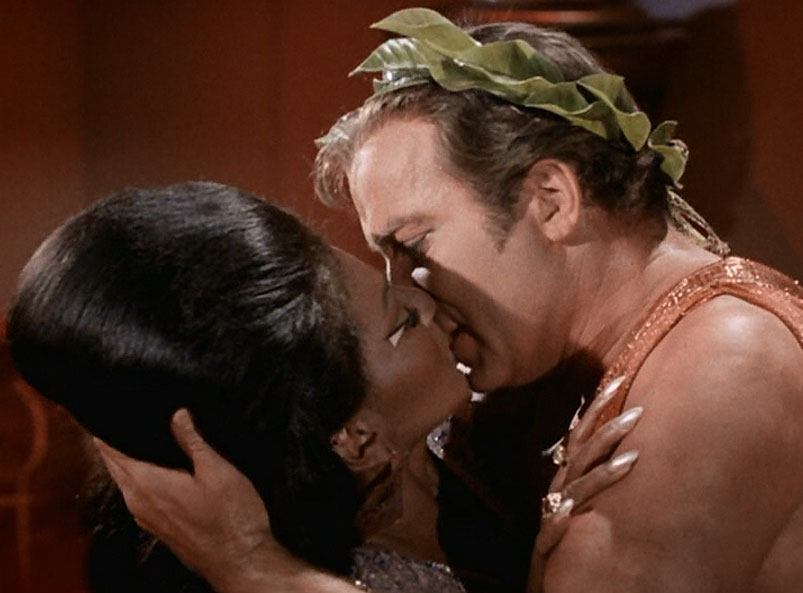
The kiss.  This one's all about the kiss.

Star Trek broke significant cultural ground on the evening of November 22, 1968 when Captain James T. Kirk kissed Lieutenant Nyota Uhura.  For the first time in the history of American television, a kiss was scripted between a white man and a black woman.  In 1968, interracial marriage was still illegal in much of the United States so this was no small matter.  Network executives feared a boycott of the episode in the Deep South and demanded that two versions of the crucial scene be filmed, one with the kiss and one without.  The cast deliberately botched every single take of the no-kiss version so in the end, there was no choice.

For all the worry, the backlash was essentially non-existent.  The show got more fan mail for this episode than any other.  Nichelle Nichols (Uhura) tells the story of the one mildly negative letter from a Southern fan. He wrote "I am totally opposed to the mixing of the races. However, any time a red-blooded American boy like Captain Kirk gets a beautiful dame in his arms that looks like Uhura, he ain't gonna fight it."  The episode was banned in Britain, not for the kiss as the BBC had already crossed that threshold but for the story's sadistic imagery.

Oh right, the story...

Drawn once again by a pesky fake distress call, Kirk, Spock and McCoy beam down to a planet which, according to their readings, does not support life.  There, they encounter a civilization that has patterned itself after ancient Greece, particularly the philosophy of Plato.  All possess telekinetic powers - all, that is, except for Alexander, the dwarf who first greets them.  Because of his deficiencies, Alexander is mistreated by the others on the planet.  As power dynamics shift, the episode engages in unusually insightful explorations of the relationship between the powerful and the powerless in a society, all of which feeds into the story's big moment.  Our heroes fall under the control of the natives, as do Uhura and Nurse Chapel, all of which leads eventually to the kiss.

The kiss really isn't much of one.  In fact, it's difficult to tell if lips ever actually touch.  Shatner has always claimed it was a mere stage kiss whereas Nichols insists it's the real thing.

Vital musical side note:  in our story, Spock sings a song called "Maiden Wine."  Leonard Nimoy wrote the song himself.  However, a double was hired for his flamenco dance, a Mr. Armando Gonzales.

*****
via Wikipedia
Michael Dunn (Alexander) was born Gary Neil Miller on October 20, 1934 in Shattuck, Oklahoma.  Escaping Dust Bowl conditions, the family moved to Dearborn, Michigan when Gary was four years old.  His parents were pressured to send him to a school for disabled children but they insisted he go to the neighborhood public school.  He learned to read at the age of three and won the Detroit News Spelling Bee in 1947.  He entered the University of Michigan at 16, then transferred to the University of Miami partly for its more accessible campus.

Dunn's showbiz career began on the stage, then moved to film and television.  He was nominated for a Tony in 1964 for his performance in The Ballad of the Sad CafĂ© and for an Oscar for 1965's Ship of Fools.  On TV, he was best known for his multiple appearances on The Wild Wild West as Dr. Miguelito Loveless.

Dunn did a great deal of philanthropy work for children with dwarfism.  Sadly, his own spinal deformities led to health complications that shortened his life.  Dunn passed away in 1973 at age 38. 

Sunday, November 9, 2014

On the Road: The Quest for Penguins


Our daughter is way into penguins.  What began as a childhood fascination is gradually evolving into a deeper interest including discussions of possible career paths.  From a book about Jane Goodall, she learned the word ethologist: one who studies animal behavior in the subject's natural environment.  It is now a life goal to see penguins in the wild.

Alas, there are no wild penguins in Vermont, though they're not as far away as I'd have thought before my daughter's interest emerged.  Nearly all penguins live in the southern hemisphere but there is one species that hangs out around the equator in the Galapagos Islands.  Still, that trip's way beyond the current family budget so it'll have to remain in the long-term plan for now.

Fortunately, there are penguins relatively nearby in captivity, including three different species at the New England Aquarium in Boston.  We've lived in New England for twelve years yet we've spent  little time in the region's largest city.  The penguins were as good an excuse as any!  Combining the penguin quest with a visit to see dear friends in Worcester made for a most enjoyable, eastern Massachusetts weekend.

The Boston excursion did not go quite as planned. We thought we were being clever by parking at the Alewife station then taking the subway into the city.  Alas, construction along the red line meant we had to first take a shuttle bus - free, thankfully - to Harvard before continuing our adventures by rail.  It was not exactly a banner day for Boston's ever-disastrous infrastructure.

That said, the aquarium was amazing.  The penguins dominate the ground floor display space: southern rockhoppers, African penguins and, the smallest species in the world, the little blue penguins.  Interestingly, none of the three is native to Antarctica.  The little blues are in pretty good shape ecologically but the rockhoppers are classified as vulnerable and the Africans are endangered.  All three are adorable and the girl was most impressed.  There's plenty more to see, including an enormous octopus, a sea turtle that's over 85 years old and California sea lions.  We were there for around three hours total, I think: plenty of time to see everything.  Great facility - I'd definitely go again.

Otherwise, I'd have to say Boston was a bit of a disappointment.  I'm not a big fan of cities in general - too many people, too much asphalt and concrete - and Boston is unusually confusing with its crazy street layout.  Even with our public transit fiasco, it was better than trying to drive.  I will concede, the average person you run into is pretty friendly, especially when compared to their counterparts in New York or Washington.  I'm sure I would learn my way around with time and patience and it's totally unfair to judge a city by such a short visit but we didn't leave keen to come back.  Montreal is more my speed - closer to us, too.

For the record, the aquarium was definitely worth the effort.  Plus, I got to sing the following on our way out of town.  My poor, suffering wife...


I can now relate to feeling trapped on the Boston transit system.

Wednesday, November 5, 2014

Star Trek: The Tholian Web

Episode: "The Tholian Web"
Series: Star Trek: The Original Series
Season 3, Episode 9
Original Air Date: November 15, 1968
via Wikipedia
The heart of Star Trek is the relationship between the three principal characters: First Officer Spock, Dr. McCoy and Captain Kirk, representing logic, emotion and judgment respectively.  "The Tholian Web" explores a pertinent quandary: what happens when Kirk and his stabilizing influence are removed?  With no one to weigh their frequently opposing viewpoints, can Spock and the Doc lead the crew and its mission effectively?

The story opens with the Enterprise in search of her sister ship, the USS Defiant.  Eventually, the ship is found but its entire crew is dead and the entire vessel seems to be winking in and out of existence.   Kirk is lost in a transporter malfunction and presumed dead.  Spock assumes command of the Enterprise, as is his duty, but not without abrupt and significant challenges from McCoy at every turn.  As if all of this weren't troubling enough, beings called the Tholians show up, demanding that our friends hightail it out of their territory.  Spock would be only happy to oblige if not for the slim hope that the captain might be saved.  He pleads with the Tholians to allow them more time but when the extension expires, the Tholians weave a lasery web around the Enterprise.

Fortunately, Kirk had planned for the possibility of his own untimely demise.  He left a recording for his two confidants to watch in which he advises each of the other's strengths and their need for each other.  His message is a fair summation of the moral/ethical landscape upon which the entire series is built.  Even more fortunate, Kirk is ultimately rescued from the parallel universe to which the transporter had sent him and the future of the franchise is saved.

*****
via Wikipedia
The voice of Loskene, the commander of the Tholians, was performed by Barbara Babcock, highly distorted.  Babcock was born February 27, 1937 in Fort Riley, Kansas.  Her father was an army general and, as a result, she spent much of her childhood in Tokyo while he was stationed in Japan.

Babcock has had a highly distinguished television career.  In 1981, she won an Emmy for Outstanding Lead Actress in a Drama Series as Grace Gardner on Hill Street Blues.  In 1993, she was nominated for another, this time for her supporting role on Dr. Quinn, Medicine Woman.  There have been big screen credits, too, including Day of the Devil Gun, Bang the Drum Slowly and Chosen Survivors.  She had six appearances on Trek's original series, four for voice work, two on camera.  She appeared on both "A Taste of Armageddon" and "Plato's Stepchildren."

Sunday, November 2, 2014

Family Movie Night: The Princess Bride

Title: The Princess Bride
Director: Rob Reiner
Original Release: 1987
Choice: My Wife's
My Overall Rating: 5 stars out of 5
via Amazon
Until this weekend, I had never seen The Princess Bride on a big screen.  It is easily one of my top ten favorite films as it is for so many of my generation, yet I fell in love with it through the late-'80s magic of VHS.  But this Saturday evening, our local movie theater and our favorite independent bookstore teamed up to present a screening as a promotion for Cary Elwes's new memoir, As You Wish: Inconceivable Tales from the Making of The Princess Bride.  Luckily, we were smart and bought our tickets ahead of time because the event sold out, despite snow in the forecast.  With door prizes and costume and trivia contests on offer, the geeks of our stripe came out in full force, plenty of us with the next generation of devotees in tow.

This is how I first learned of the movie back in the day:


The Dread Pirate Roberts (aka Farm Boy/Westley/The Man in Black) must save his true love, Buttercup, from having to marry evil Prince Humperdink.  Meanwhile, master swordsman Inigo Montoya seeks to avenge the death of his father.  Their paths cross and Hollywood magic ensues.

The Princess Bride is a mix of everything that made movies great in the Golden Age of the 1930s: a swashbuckling romance worthy of Errol Flynn combined with witty dialogue to rival Billy Wilder or Preston Sturges.  It is, without a doubt, one of the most beautifully written films of all time.  Calling it quotable doesn't go far enough.  The script sings from beginning to end, every single line finding its mark.  William Goldman, Oscar-winning screenwriter of Butch Cassidy and the Sundance Kid and All The President's Men, adapted the screenplay from his own novel of the same name.

The sword fight at the top of the Cliffs of Insanity isn't just the best scene in the film, it's one of the most perfectly scripted and acted scenes in the history of cinema.  I would happily skip the rest of the movie just to watch that one sequence over and over again.  The two actors did all their own fencing, especially impressive considering they had to do it with both hands.

For all the well-deserved praise the writing has received over the years, I believe the true genius of The Princess Bride is in the casting.  Billy Crystal was the only genuine A-lister at the time and even he was still a couple years away from When Harry Met Sally...  The story is led magnificently by two essential unknowns: Cary Elwes and Mandy Patinkin, well-trained and (particularly for the Tony-winning Patinkin) accomplished stage actors with relatively few screen credits to that point.  In the titular role, Robin Wright, another newcomer, combined with Elwes to create the most beautiful on-screen couple since Rhett and Scarlett. Many of the actors were better known for their work on television: Peter Falk and Carol Kane in the United States, Peter Cook and Mel Smith in Britain.  Andre the Giant was quite famous, indeed, but as a professional wrestler.  Every actor fits his or her role like hand to glove.

Predictably, many in the audience recited the most famous lines in time with the film.  There was rowdy applause at both beginning and end.  It's funny the things you notice when you've seen a movie over and over again.  For instance, of course Westley (Elwes) knows Inigo (Patinkin) isn't really left-handed because his scabbard is on the left side.  I also paid closer attention to the toys on the gradson's shelf: He-Man and Captain America action figures, a Return of the Jedi glass from Burger King, etc.

The film's music was composed by Mark Knopfler, far better known as the front man for Dire Straits.  He agreed to do the score on one condition: that Reiner include his baseball cap from This Is Spinal Tap somewhere in the movie.  Knopfler meant it as a joke but Reiner made good, creating a replica cap for the grandson's bedroom.  The end credits song "Storybook Love" garnered the movie's only Oscar nomination. 

Saturday, November 1, 2014

The Cephalopod Coffeehouse: November 2014 Blog List

Greetings to all!  I hope you'll join us for the next installment of the Cephalopod Coffeehouse, an online gathering of bloggers who love books.  The next meeting is set for Friday, November 28th.  If you're interested, please sign on to the link list at the end of this post.

The idea is simple: on the last Friday of each month, post about the best book you've finished over the past month while visiting other bloggers doing the same.  In this way, we'll all have the opportunity to share our thoughts with other enthusiastic readers.  Please join us:


Friday, October 31, 2014

The Cepholopod Coffeehouse: October 2014

Welcome one and all to the Cephalopod Coffeehouse, a cozy gathering of book lovers, meeting to discuss their thoughts regarding the tomes they enjoyed most over the previous month.  Pull up a chair, order your cappuccino and join in the fun.  If you wish to add your own review to the conversation, please sign on to the link list at the end of my post.

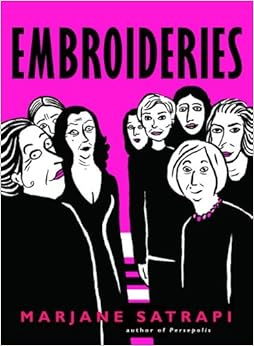
Title: Embroideries
Writer and Artist: Marjane Satrapi
via Amazon
As I finished Embroideries and set it down in front of My Wife for her to read, she asked if I liked it.   "Well yes," I responded.  "It's Iranian women sitting around, talking about their sex lives.  What's not to like?"

Marjane Satrapi is best known for the groundbreaking Persepolis, a comic book and film about her experiences growing up in revolutionary Iran (my review here).  Embroideries is also about Satrapi's own family, this time exploring the intimacies of the bedroom.  The typical western image of the Iranian woman has her shrouded in a burka, completely disconnected from pleasures of the flesh.  Satrapi chucks that idea out the window as she and the other ladies in her circle hold forth.

Personalities run the gamut from Marjane's blunt, fearless grandmother to her more naive cousins.  Men, for the most part, don't come off well in the discussion - no surprise.  They're thoughtless, clueless and/or manipulative.  It's also clear they're not welcome to partake in the conversation.  I feel lucky to be offered the fly-on-the-wall perspective. 

The book's title could be taken to refer to the common threads that run through the women's stories.  However, it is also a specific reference to an operation to restore the hymen, thus preserving the illusion of a new wife's virginity - apparently a growing issue in modern, though still theocratic Iran.

As a graphic novel, Embroideries is a quick, engaging read.  The subject matter - handled frankly and humorously - is sure to keep the pages turning.  Those interested in Satrapi's work might also enjoy Chicken with Plums (review here).

Please join us and share your own review of your best read from the past month.  This month's link list is below.  I'll keep it open until the end of the day.  I'll post November's tomorrow.  Meetings are the last Friday of each month.  Next gathering is November 28th.


Wednesday, October 29, 2014

Star Trek: For the World Is Hollow and I Have Touched the Sky

Episode: "For the World Is Hollow and I Have Touched the Sky"
Series: Star Trek: The Original Series
Season 3, Episode 8
Original Air Date: November 8, 1968
via Wikipedia
This week's episode is a Dr. McCoy story.  There aren't too many of those.  Generally speaking, Bones gets the least attention of Trek's Big 3.  He's the George Harrison to Kirk and Spock's Lennon and McCartney (I guess Scotty is Ringo in this analogy).  While Trek wouldn't be Trek without him, McCoy rarely benefits from the scant character development on offer in the original series. 

In our story, the Enterprise is sent on a mission to stop an asteroid from careening into an inhabited planet.  One small snag: the asteroid has people inside of it! 10,000 years previously, just before their star went supernova, the Fabrini built an asteroid-shaped spaceship called Yonada and sent it off into space, hoping to find a new home.  Our heroes are faced with the dilemma of how to save both Yonada and the four billion inhabitants of Daran V.

Interesting story, yet it's not even the best narrative running through the episode.  McCoy has diagnosed himself with a rare, incurable illness, estimating he only has one year to live.  When he goes down to Yonada with Kirk and Spock as part of the landing party, the high priestess Natira falls in love with him and invites him to live out the rest of his days as her husband.  He accepts, understandably seeking companionship at the end.  "For the world is hollow and I have touched the sky" perhaps translates to "life is lonely but I have known love." 

Obviously, there's more to play out as we all know from future stories that McCoy survives his illness and returns to the Enterprise.  But there are a few memorable scenes along the way.  The love affair moves along quickly but manages to be quite touching at times.  The very best scene, though, is between Spock and Bones.  Spock's human side shines through when he learns of the doctor's illness.   Spock grasps McCoy's shoulder - the gesture begins as physical support but evolves into an expression of compassion.  It's a wonderful moment in the development of a relationship so crucial to the spirit of Trek

*****
via Find A Grave
Kate Woodville (Natira) was born December 4, 1938 in London.  She moved to the States in 1967, the year before her appearance on Trek.  Film credits include The Clue of the New Pin, The Wild and the Willing and The Informers.  She had numerous TV appearance in both Britain and the US.  British credits included The Avengers, The Saint and No Hiding Place.  Besides Star Trek, Woodville had American television gigs on Mission: Impossible, The Rockford Files and Eight Is Enough among others. 

Woodville was in the very first episode of The Avengers and later married the show's leading man, Patrick Macnee.  Her second husband, Edward Albert, was also an actor.  Woodville died of cancer in 2013.