Thursday, June 30, 2016

On the Coffee Table: Showa 1944-1953

Title: Showa 1944-1953: A History of Japan
Writer and Artist: Shigeru Mizuki
via Goodreads
This is the third volume of Mizuki's outstanding Showa comic book series.   My reflections on the first two books can be found here and here.  Japan's Showa era was defined by the reign of Emperor Hirohito: 1926-1989, a period of extraordinary national transformation.  Mizuki lived through it all and his books weave historical events with his own personal experiences.

The war was not going well for Japan in 1944.  After scoring early, dazzling victories over the Allies, deficient supply lines were taking their toll.  Defeat was essentially inevitable but no one within the military establishment was willing to admit it.  Surrendering was not considered an option.  Instead, thousands of Japanese soldiers and sailors scattered about the Pacific - the author included - were expected to go "onward toward their honorable deaths."  The lives of individuals were worth nothing compared to the honor of the nation.  Under-supplied and with no hope of reinforcements, they fought disease and starvation as much as the enemy.

By his own admission, the author survived it all through sheer luck, though hardly unscathed.  He lost his left arm and endured violent bouts with malaria.  When he finally returned home to Japan, his homeland was physically, emotionally and economically devastated, hardly in a position to absorb legions of servicemen back into society.

The post-war occupation of Japan by the United States had as much to do with the forming of the modern nation as the war did.  With the country's own military leaders defeated and disgraced, the Japanese looked to General Douglas MacArthur as the new father figure.  Even when I was in Japan 50 years later, MacArthur was still held in high reverence by those who remembered.  Not all American decisions were popular or effective but their presence allowed the newly demilitarized Japan to build an economic foundation for the future.  Prosperity came sooner than expected.  When the United States entered the Korean War in 1950, Japan provided a staging ground and vital supplies.  The economy boomed.

Meanwhile, the author struggled to find his own place in the world.  The genius of the series is the effective interweaving of Mizuki's story with that of the nation.  For all of his troubles, his suffering was minimal compared to millions of Japanese.  The Showa series is a powerful reminder of the extraordinary journey the country has been on over the past three generations.

Wednesday, June 29, 2016

On the Coffee Table: Phil Jackson

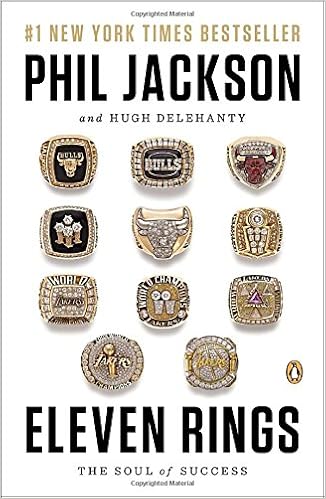
Title: Eleven Rings: The Soul of Success
Authors: Phil Jackson and Hugh Delehanty
via Amazon
Do you remember Suze?  She of the now defunct Subliminal Coffee blog?  Well, I sought out this book on her recommendation and finally got around to reading it.

Phil Jackson is the most successful coach in the history of American professional team sports.  Between Michael Jordan's Chicago Bulls and Kobe Bryant's Los Angeles Lakers, his basketball teams won 11 NBA championships.  Some have belittled Jackson's own contributions to those star-laden squads.  But anyone who follows sports for any length of time knows that it takes more than assembling talent to win titles.  Those who worked with him and played for him admire his ability to manage egos and convince superstars to buy into a team concept.

Eleven Rings got a lot of press when it came out in 2013 as a different kind of sports book.  After all, Jackson was a different kind of coach, his style of leadership derived from his own, broad-ranging spiritual explorations, particularly Zen Buddhism.  He teaches his players meditation.  His famed Triangle Offense is designed to allow creativity rather than depending on rigid set plays.  He believes that a team's success or failure ultimately depends on players' relationships with one another, and also their coaches.  Eleven Rings documents all of this and as a teacher, I find Jackson's insights valuable.

But the book is still mostly basketball.  I don't know if one would enjoy the book much if one didn't like basketball.  I personally love the game but I don't follow the NBA, preferring the college game.  Interestingly, Jackson sees the same problem with the league that I do.  Since the Magic-Bird-Jordan days of the '80s, the NBA has valued individual players over teams and marketed itself accordingly.  As a result, the very rules of the game have evolved to spotlight the superstars and teams employ their tactics in order to take full advantage.  It's been years since I followed the league closely, really not since the mid '90s.  But I know the players well enough to enjoy a glimpse into their world.  I don't know if a non-fan would care.

Thanks for the recommendation, Suze, wherever you are!


Tuesday, June 28, 2016

The Clone Wars: Monster

My friends and I are watching Star Wars: The Clone Wars.  Every Tuesday, we will be featuring an episode from the series which began in 2008 (as opposed to the one that started in 2003).  All are welcome to join us for all or parts of the fun.

Episode: "Monster"
Series: Star Wars: The Clone Wars
Season 3, Episode 13
Original Air Date: January 14, 2011
via Wookieepedia
Obviously, if there are Nightsisters, there are going to be Nightbrothers, too!  In "Monster," the second episode of a three-part arc, we accompany Asajj Ventress as she ventures to the far side of Dathomir, where the males of the planet live, in order to find a suitable new apprentice for Count Dooku.  Darth Maul, Darth Sidious's first apprentice, emerged from this community, a major selling point for those in the market for young and promising evil henchmen.  In reality, the new guy will be loyal to Asajj, central to her plan for revenge upon her former master.  She sets the best young bucks on a three-stage challenge, the survivor to become her new minion.

The big winner is the subtly-named Savage Opress.  Savage distinguished himself from the other candidates by being protective of his younger brother, Feral.  In true Dark side fashion, this devotion is ultimately used to test his loyalty to his new master.  Once Asajj gets him back to the Nightsisters' abbey, they use their powers to bulk him up.  His emergence from this transformation is highly reminiscent of the birth of Lurtz, the first of the Uruk-hai created in the film version of The Fellowship of the Ring.

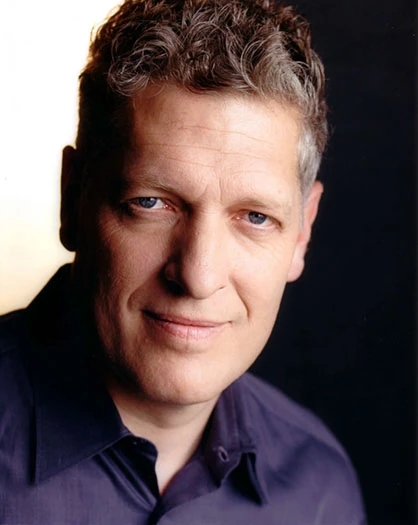
Savage is voiced by Clancy Brown, born Clarence J. Brown III on January 5, 1959 in Urbana, Ohio.  His mother was a professional classical musician.  Both his father and grandfather were Congressmen so he spent much of his childhood in Washington, DC.  He graduated from St. Albans School, then went on to Northwestern University.
via Wookieepedia
Brown has had a long, esteemed career playing the heavy.  He is almost certainly best-known as the sadistic prison guard Captain Hadley in The Shawshank Redemption.  Other films include Highlander, The Adventures of Burckaroo Banzai Across the Eighth Dimension and The Bride.  On television, he was the ultra-creepy Brother Justin Crowe in Carnivàle.  Other voice credits include Lex Luthor in various media and Mr. Krabs in SpongeBob SquarePants.

Despite what his characters would lead one to believe, he is apparently a very nice guy, active in numerous charities.  He and his wife Jeanne Johnson have been married since 1993.  They have two children, a boy and a girl.

If you would care to join us for all or part of our travels, sign on to the list below.  Please visit the other participants today.  Next week: "Witches of the Mist."


Saturday, June 25, 2016

The Cephalophod Coffeehouse: July 2016 Blog List

Greetings to all!  I hope you'll join us for the next installment of the Cephalopod Coffeehouse, an online gathering of bloggers who love books.  The next meeting is set for Friday, July 29th.  If you're interested, please sign on to the link list at the end of this post.

The idea is simple: on the last Friday of each month, post about the best book you've finished over the past month while visiting other bloggers doing the same.  In this way, we'll all have the opportunity to share our thoughts with other enthusiastic readers.  Please join us:


Friday, June 24, 2016

The Cephalopod Coffeehouse: June 2016

Welcome one and all to the Cephalopod Coffeehouse, a cozy gathering of book lovers, meeting to discuss their thoughts regarding the works they enjoyed most over the previous month.  Pull up a chair, order your cappuccino and join in the fun.  If you wish to add your own review to the conversation, please sign on to the link list at the end of my post.

Title: Samskara
Author: U.R. Anantha Murthy
Translator: A.K. Ramanujan
via goodreads
I've had this Indian novel on my shelves for 21 years.  I was assigned to read it in college but never did.  I've kept it with me through several moves and a brutal household book purge.  At 138 pages, it never took up much space.  Surely I'd read it one day, finally making my old Eastern Religions prof proud.  It took 21 years.  And now it's done.

So good, too.  Samskara packs a lot of punch into what is really a simple story.  A man, Naranappa, dies and his neighbors are at a loss as to how to properly dispose of the body.  According to Hindu law, he must be cremated.  But who should do the job?  Naranappa is a Brahmin so only another Brahmin can perform the necessary rites.  But Naranappa was not a good Brahmin.  He openly lived with his low caste concubine, Chandri, out of wedlock.  But he was never excommunicated for fear he would convert to Islam, poisoning the entire community beyond repair.  But Chandri offers a heap of gold jewelry to anyone who will claim responsibility and do the deed.  Such a dilemma...

While perspective switches between characters, most of the tale is told through Praneshacharya, the community's religious scholar.  His neighbors come to him for guidance but he is at a loss.  To his credit, though, while the others are motivated by self-interest, Praneshacharya (Acharya for short) genuinely wants to do the right thing.  For this man of pious virtue, life gets complicated when he is unexpectedly confronted with his own humanity.  Everything he has ever understood about himself and his world is thrown into confusion.

Samskara paints a richly detailed picture of India and the important role religion still plays in people's daily lives there.  Interestingly, it is only because of the mention of things like buses, flashlights and the Great Communicator (Nehru) that the story can reliably be placed in the 20th century.  One can easily imagine the same moral dilemmas playing out a thousand years before.

So yes, I finally read it and genuinely enjoyed it.  Prof got the last laugh.

Please join us and share your own review of your best read from the past month.  This month's link list is below.  I'll keep it open until the end of the day.  I'll post July's tomorrow.  Meetings are the last  Friday of each month.  Next gathering is July 29th.


Thursday, June 23, 2016

On the Coffee Table: Diana Wynne Jones

Title: Charmed Life
Author: Diana Wynne Jones
via Goodreads
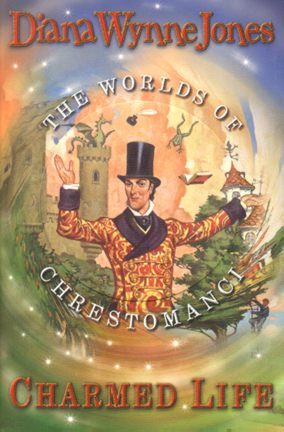
Charmed Life is the first book of The Chronicles of Chrestomanci series, at least according to the author's own suggested reading order.  Diana Wynne Jones has long been my daughter's favorite author and when I asked her for her favorite book, Charmed Life is the one she handed to me.

Eric and Gwendolyn Chant are orphaned when their parents drown in a boating accident.  Gwendolyn seems to have inherited all of her parents' magical powers while Eric (referred to as Cat by his sister) appears to have none.  Eventually, they come under the care and tutelage of Christopher Chant, better known in the wizarding world as Chrestomanci.

Being a Miyazaki fan, I am more familiar with Jones's Howl's Moving Castle series.  Charmed Life was actually written first, though anyone who knows the Howl books will notice common narrative elements.  For starters, Howl and Chrestomanci are similar characters: tall men in flashy clothing, powerful wizards, not especially verbal, intimidating to everyone around them.  Travels between parallel worlds are important to both stories and in both cases, one of the worlds is our own.

Now that I've read it, I'm a little surprised at my daughter's fondness for it.  Not that it's not good.  It is good.  But for a long time, I've worked under the assumption that she preferred stories with female protagonists - not the case here.  In fact, Gwendowlyn turns out to be highly objectionable indeed.  My daughter does love stories about magic, though, and there's plenty of it here.  It's a fun read.  I'm definitely interested in reading more of the series.


Wednesday, June 22, 2016

On the Coffee Table: Fumi Yoshinaga

Title: All My Darling Daughters
Writer and Artist: Fumi Yoshinaga
via Wikipedia

Yukiko is a career woman in her thirties who still lives with her mother, though the relationship is not an easy one.  Tensions mount when Mom announces she's getting married - to a man younger than Yukiko.  The rest of the book explores the relationships both romantic and familial of Yukiko and her circle of friends.  The themes are subtle ones: no relationship is ever simple and what one sees from the outside is never the whole story.

All My Darling Daughters is a josei manga, meaning it is targeted to women, ages 15-44.  The North American publisher recommends it for older teens, probably about right.  The sexual content, while far from pornographic, is too heavy for me to simply hand it to my twelve-year-old daughter.  I enjoyed the book but was not swept away by it.  The stories are sophisticated and the artwork competent.  Explorations of sexual politics in Japan are always interesting to me and the balancing of personal and professional lives is a hot topic there now.  So, I'd say it's a good book, not a great one.