Tuesday, December 31, 2013

On the Coffee Table: Marvel Star Wars, Vol. 5

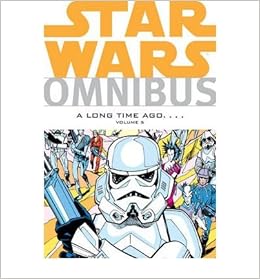
Title: Star Wars Omnibus: A Long Time Ago...., Volume 5
via Amazon
Volume 5 collects the final 22 issues (#86-107) of Marvel's Star Wars comic book series of the 1970s and '80s.  I've made it to the end.  My reflections on previous volumes are here: One, Two, Three and Four.  Marvel continued with their spinoff Ewoks and Droids series for a couple more years but after 1987, there was radio silence on the Star Wars comic book front until Dark Horse picked up the baton in 1991.

My highlights from Volume 5:

Lumiya
via Wookieepedia
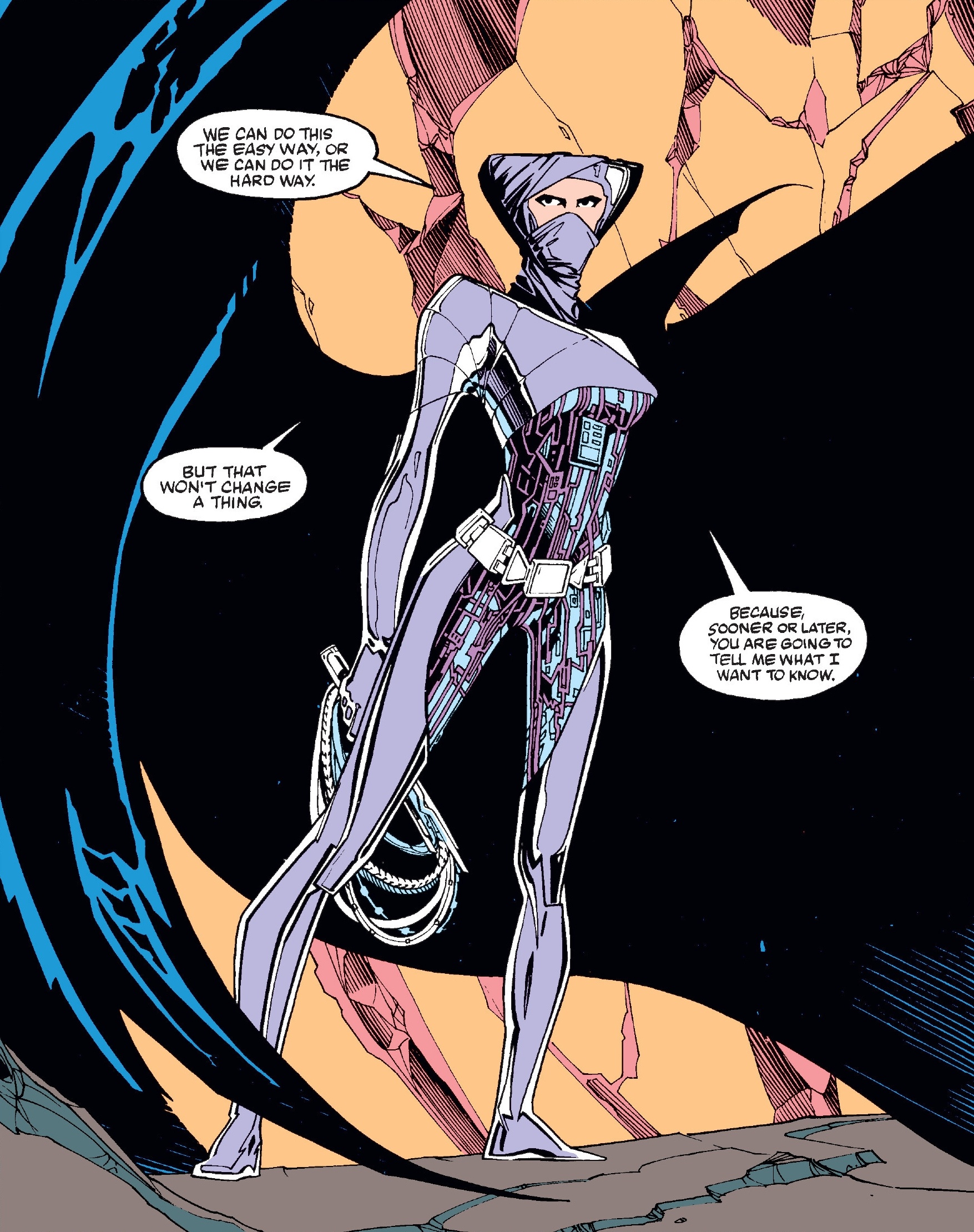
Marvel's most interesting Star Wars invention was the character Shira Brie.  Shira first appeared in issue #56 as a Rebel pilot.  In time, it is revealed that she is actually an Imperial agent, assigned by Darth Vader to go after Luke, who ultimately avoids her traps and leaves her for dead.  She reappears in Marvel #88 as Lumiya, an agent of evil with cybernetic enhancements much like Vader's.  She is bent on revenge against Luke and has no scruples about switching allegiances in order to achieve it.  Apart from the interesting back story, she also wields a super cool electro-whip thingy that initially baffles Luke.  He is compelled to construct a second lightsaber in order to defeat her.

Lumiya survived the Marvel era to have a more meaningful role in the Expanded Universe.  She featured prominently in Legacy of the Force, a nine-part novel series by Aaron Allston, Karen Traviss and Troy Denning.


I Say Kazhyyyk, You Say Kashyyyk

Marvel Star Wars #91 provides the first comic book trip to the Wookiee home world of Kashyyyk (spelled with a z instead of an s by Marvel).  I have long decried the scarcity of Wookiee stories in Star Wars lore so I am always grateful for them when they do spring up.  Unfortunately, all is not well in the neighborhood.  Wookiees, including members of Chewbacca's family, are being kidnapped by slave traders.  Their leader is a mysterious figure with a really dumb name: Knife.  He is the first contact for the Alliance from a new nemesis:


The Nagai
via Wookieepedia

These punk rockers from another galaxy cause no end of trouble for the newly formed Alliance of Free Planets.  Taking advantage of the power vacuum left by the Empire, while employing many of the minions of that deposed entity, the Nagai work to find a foothold in the galaxy.  Their Spartan approach to life and warfare gains them a lot of enemies very quickly.  But the Nagai story gets complicated when the Alliance discovers these pests are moving in on their turf because of an even less desirable culture, the piratesque Tof, who have followed them to the new hunting grounds.  United by a common enemy, the Nagai and the Alliance look past their considerable differences and join forces to drive away the Tof.  The Nagai story is one of forgiveness for the sake of the greater peace.


As discussed in previous posts, the Marvel comics are low canon in the Star Wars Expanded Universe.  Given very little to go on by the Lucas people, the comic artists had to create stories of their own.  As a result, the Marvel creators built a fairly well-contained universe.  Some of their creations, such as Lumiya and the Nagai, turned up in later higher-canon work but most did not.  As a fan of the franchise, I am glad to have read them and will seek out the Ewoks and Droids series if only for the sake of thoroughness.  I also look forward to exploring the numerous Dark Horse series as well, those being a higher canon level than the Marvels.

Sunday, December 29, 2013

On the Road: Christmas in Washington

It had been a long time since we last spent Christmas away from home.  Over the past few years, our tradition had been to spend Christmas Day here in Vermont, then travel down to visit my parents in Washington, DC the next day.  But my father lobbied for us to come earlier so that we could attend his Christmas concert.
via Choral Arts Society of Washington
As discussed in a previous post, my father has sung with the Choral Arts Society of Washington for nearly 40 years.  The annual Christmas concert at the Kennedy Center was an important family tradition growing up.  Neither my wife nor our daughter had ever been to one so I suppose it was high time.

The group has a relatively new conductor.  Founder Norman Scribner retired in spring 2012 after 47 years and was replaced by Scott Tucker, most recently of Cornell University.  Choirs generally reflect the personality of their directors and a more relaxed, playful atmosphere is quite apparent in the new regime.  This year's concert was sponsored by the Italian Embassy so Italian music was predominant, including works by Andrea Gabrieli (1532-1585) and Salomone Rossi (ca. 1570-1620), a Jewish composer entirely new to me.  Also on the program were selections from Benjamin Britten's A Ceremony of Carols and Handel's Messiah, for both of which the Choral Arts Society was joined by the astonishingly talented Children's Chorus of Washington.

Three highlights for me:
  1. Holst's sublime setting of "In the Bleak Midwinter," a piece I have sung myself - hard not to tear up for that one.
  2. My father's performance in the smaller Chamber Chorus.  He claimed he was nervous but it certainly didn't show.
  3. The sing-along at the end of the concert, a long-standing tradition.  In addition to the usual choral power pieces like "O Come, All Ye Faithful" and "Hark! the Herald Angels Sing," we sang verses of both "White Christmas" and "Silent Night" in Italian.
Overall, it was a very short visit - just two full days wedged between our travel days.  It was supposed to be three but the ice storm here in Vermont held us back a day.  So, not too much time for the touristy stuff.

My parents did introduce us to a new (to us) restaurant on Monday evening: Napoleon Bistro & Lounge.  It's a short walk from their apartment so they've been many times.  However, the restaurant has just hired a new chef so the menu was new to all of us.  My Wife and I split the pate appetizer, then I had the hangar steak.  I also got a bite of the chocolat fondant for dessert.  All were lovely.  She had the duck confit, but thought I'd ordered better - that doesn't usually happen.  The raviolini was a big hit with Our Girl.  She cleaned her plate.

Back to the land of ice and snow on Thursday.  It was a nice visit - short but relaxed.  Hopefully, we'll be back again before too long.

Saturday, December 28, 2013

On the Coffee Table: Treasure Island

Title: Treasure Island
Author: Robert Louis Stevenson
via Wikipedia
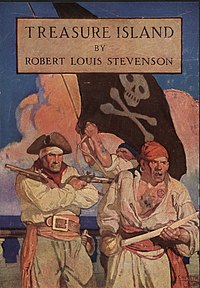
Treasure Island provided a prototype for countless pirate adventure tales to follow.  Treasure maps marked with an X and pirates with peg-legs and parrots have their origins in Stevenson's classic.  While I have seen film versions before, I had never read the book until this month. 

The story is, at its heart, very straightforward.  A treasure map is discovered.  A ship is acquired and a crew assembled to find the island depicted.  The crew, it turns out, largely consists of seasoned pirates.  Naturally, they mutiny, wanting the booty just for themselves.  The account is narrated mostly by Jim Hawkins, a twelve-year-old boy caught up in the adventure.  Standard pre-pubescent boyhood fantasy - it could happen!

This is, in fact, my second recent Robert Louis Stevenson novel.  In August, I read Strange Case of Dr. Jeckyll and Mr. Hyde (reflection here).  My gripe with that book was a lack of compelling characters - once you get past the whole transformation thing, that is.  Treasure Island, on the other hand, has one highly fascinating character, indeed: Long John Silver.

Silver is a prototype in his own right for the morally ambiguous antagonist.  He is indispensable ally at the beginning of the journey only to turn ruthless, greedy murderer.  Regardless of his place on the ethical spectrum, the story was always most interesting when he was involved.  I missed him whenever the narrative shifted focus to other characters.  I didn't care nearly as much about Jim or his supposed good guy friends.

Largely because of Silver, I preferred Treasure Island to Jeckyll and Hyde.   The text is richly detailed, especially in regards to setting - Stevenson's wheelhouse.  My nautical vocabulary is quite lacking so the description of the sea voyage was not as meaningful as it might have been.  As with Jeckyll and Hyde, I am glad to have read it for my own cultural literacy and will henceforth keep an eye out for Stevenson inventions in other pirate tales.

The Cephalopod Coffeehouse: January Blog List

Greetings to all!  I hope you'll join us for the next installment of the Cephalopod Coffeehouse, an online gathering of bloggers who love books.  The next meeting is set for Friday, January 31st.  If you're interested, please sign on to the link list at the end of this post.

The idea is simple: on the last Friday of each month, post about the best book you've finished over the past month while visiting other bloggers doing the same.  In this way, we'll all have the opportunity to share our thoughts with other enthusiastic readers.  Please join us:

Friday, December 27, 2013

The Cephalopod Coffeehouse: December 2013

Welcome one and all to the Cephalopod Coffeehouse, a cozy gathering of book lovers, meeting to discuss their thoughts regarding the tomes they enjoyed most over the previous month.  Pull up a chair, order your cappuccino and join in the fun.  If you wish to add your own review to the conversation, please sign on to the link list at the end of my post.

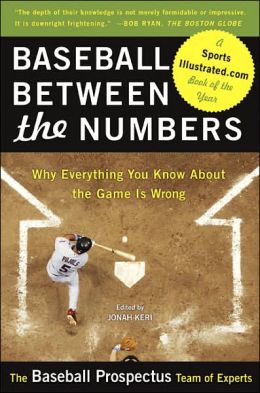
Title: Baseball Between the Numbers: Why Everything You Know About the Game Is Wrong
Authors: The Baseball Prospectus Team of Experts
Editor: Jonah Keri
via Barnes & Noble
In my experience, baseball is the most geek-friendly of all sports.  With each Major League team playing 162 games a year and detailed box scores available from the past century and beyond, the sample size for statistical data is enormous.  As such, the endless stream of numbers one can throw around provides the illusion of understanding for fans and journalists alike.  But since the 1970s, a growing legion of mathematicians have examined the game more closely and challenged the meaningfulness of such dearly held measures as batting average and RBI (runs batted in) in evaluating the effectiveness of individual players.  These number geek revolutionaries have developed new statistics known collectively as sabermetrics.  Their work was made famous by Michael Lewis's book Moneyball (reflection here) and the subsequent Brad Pitt film of the same name.

Baseball Prospectus is a stats website.  Its writers devote their energies to probing the mysteries of the game to determine what, in fact, makes a player valuable to his team.  The most well-known writer for Baseball Between the Numbers is Nate Silver who has since gone on to create the popular and astonishingly accurate political prediction blog, FiveThirtyEight (soon to move to the ESPN site so Silver can split time between his two loves).  The book is structured much like Freakonomics by Steven D. Levitt and Stephen J. Dubner: conventionally held beliefs are examined in relation to available data.  Some assumptions hold true: most free agents are overpaid and new stadiums are a shameful waste of public money.  Others don't weather the stat storm so well: clutch hitting, for instance, is essentially nonexistent.

Baseball Between the Numbers is probably not worth much to anyone who is not a baseball fan.   But for a sports and numbers geek such as myself, it's tremendous fun.  I've been an avid fantasy baseball player over the past few years and while I had been thinking of scaling back a bit on that hobby, this book has helped stoke the flame.  I'd love to toy around with the stats we use in order to be more saber-friendly.  Of course, I said the same after I read Moneyball and nothing ever came of it.

If you're still reading and are genuinely a baseball fan, Baseball Between the Numbers has a lot to offer.  On-field performance is explored in-depth, of course, but other topics are covered as well, including team finances and effective use of the amateur player draft.  James Click even offers a crash course on the ins and outs of statistical analysis - correlation v. causation, regression analysis, standard deviations, sample size, etc. - in his chapter "What Does Mike Redmond Know About Tom Glavine?"  If you're not a baseball fan but you are interested in what statistics can tell us about the world we live in, I highly recommend Freakonomics.

Please join us and share your own review of your best read from the past month.  This month's link list is below.  I'll keep it open until the end of the day.  I'll post January's tomorrow.  Meetings are the last Friday of each month.  Next gathering is January 31st.


Wednesday, December 25, 2013

Star Trek: Tomorrow Is Yesterday

Episode: "Tomorrow Is Yesterday"
Series: Star Trek: The Original Series
Season 1, Episode 19
Original Air Date: January 16, 1967
via Memory Alpha
"Tomorrow Is Yesterday" provides an opportunity to discuss what I consider to be one of Star Trek's great weaknesses: time travel narratives.  As mentioned in previous posts (like this one), I'm picky when it comes to time travel stories.  The Doctor Who franchise does it very well.  There are rules and even the Doctor, as powerful as he is, must abide.  Even he cannot interfere with anyone's personal timeline without pterodactyls swooping down to cleanse the universe of temporal wrong. The rules in Trek are not as well defined and, at least in my experience, the writers tend to be sloppy as a result.

That said, I quite enjoyed "Tomorrow Is Yesterday," definitely one of my favorite episodes so far.  I don't mean to say that there are no problems as far as the time travel is concerned.  We'll get to that in a bit.  First, the story:

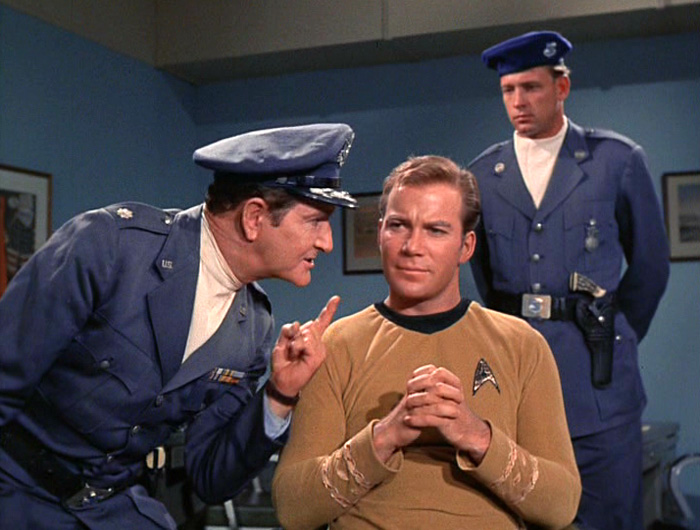
The Enterprise is thrown back in time to Earth, 1969.  When the ship is detected as a UFO by a US Air Force base, our heroes beam Captain John Christopher aboard just before the tractor beam destroys his plane.  The dilemma is clear.  Christopher can't be allowed to return for fear of corrupting the time line - cruel, though acceptable reasoning by my time travel standards.  But the crew discover they must return him because his future offspring are critical to the future of space exploration.  Combine this with the needs to clean up all other evidence of the Enterprise's appearance in the 20th century and return the ship to its own time and you've got a fantastic set up.

***SPOILER ALERT***

The trouble comes when Captain Christopher and an air policeman - who is also mistakenly abducted - are returned to their own timelines.  Basically, each is beamed back into their own selves at the moment immediately prior to their contact with the Enterprise crew with no apparent memory of their adventures.  It's the loss of memory that bothers me.  After all, our heroes maintain recollection of what happened.  Why wouldn't Christopher and the policeman?  Or do they remember, but without any concrete proof no one will believe them so the risk of paradox is negated? 

Too many questions.  Time travel stories need to be tidy and this one wasn't, even if it was highly entertaining anyway.

***END OF SPOILER***
via Memory Alpha
Roger Perry (Captain Christopher) was born May 7, 1933 in Davenport, Iowa.  Perry brought real world experience to his Trek role as he had served in the Air Force in the early '50s.  He made his television debut in 1958 in U.S. Marshal.  He played the son in Harrigan and Son, a sitcom which ran for one season (1960-61) on ABC.

Sunday, December 22, 2013

Family Movie Night: The Philadelphia Story

Title: The Philadelphia Story
Director: George Cukor
Original Release: 1940
Choice: My Wife's
My Overall Rating: 5 stars out of 5
via Wikipedia
I have three favorite movies: The Empire Strikes Back, The Usual Suspects and The Philadelphia Story.  Apart from my great affection for them, the three have very little in common. They represent different decades, different genres and very different parts of my own life.  ESB is my childhood.  The Usual Suspects is my first year out of college.  I watched The Philadelphia Story for the first time on my second date with My Wife and it has been "our movie" ever since.  We watch it every year in December.

The story, I have to admit, is very silly.  Tracy Lord, a Philadelphia aristocrat played by Katharine Hepburn, is getting married.  Unfortunately, her ex-husband (Cary Grant) has just turned up with a tabloid journalist (Jimmy Stewart) and photographer (Ruth Hussey) in tow.  The family has to let them stay because there's a dirty blackmail threat aimed at Tracy's philandering father.  While Tracy is certainly a strong female character, the sexual politics of the story are frequently obnoxious.

Not much of a sell.  What's so great about the movie, Squid?

The writing.  Oh my lord, the writing!  The Philadelphia Story is one of those films with dialogue that trips off the tongue and floats across the screen.  A small sampling:

Mike (Stewart): Doggone it, C.K. Dexter Haven. Either I'm gonna sock you or you're gonna sock me.
C.K. (Grant):  Shall we toss a coin?

***

Tracy: Thank you, Mike. I think men are wonderful.
Liz (Hussey): The little dears.

***

Tracy: South Bend, it sounds almost like dancing.

***

Liz: Wouldn't you know you'd have to be rich as the Lords to live in a dump like this?

The cast is rock solid, top to bottom.  Hepburn, Grant and Stewart are all in top form and Hussey (my favorite) ably matches the heavyweights swing for swing.  Stewart won his only Oscar for his role.  The screenwriter, Donald Ogden Stewart, also won, adapting Philip Barry's stage play of the same name.  Hepburn and Hussey were both nominated.

Multi-generational considerations:
  • I'm pretty sure Our Girl doesn't like the movie.  She never comes out and says that because I think she realizes how much we like it but she tends to squirm when we watch.  I expect most of the humor goes over her head but we're hopeful she'll learn to love it in time.