Tuesday, November 12, 2019

Squid Eats: Hatchet

Image result for hatchet richmond
via Facebook

It is with mixed feelings that we visit Hatchet in Richmond.  It's a perfectly acceptable restaurant but several years ago, it took over the space of what had been our family go-to: Bridge Street Cafe.  Bridge Street closed five years ago and we've only been to the new place twice now.  Mind you, Hatchet is definitely an upgrade in terms of decor, food quality and so forth.  But it's also an upgrade in price, not the easy on the budget choice for after work its predecessor had been.

Then again, it's been five years and the new place is still there and doing well.  My wife and I went on a recent Friday evening.  We got oysters for an appetizer.  Then I had the Section 119 Fried Chicken Sandwich, Korean BBQ style.  As a side note, I love the increasing popularity of Korean food aesthetics.  Koreans have been restaurant owners in the United States for decades but usually serve Japanese food because it's more popular.  I love Korean food and it's good to see it coming into its own in the United States.

I can't tell what the Section 119 business is about.  US Code 119 is a meals and lodging law.  Section 119 is also a clothing store in New York.  I have no idea what it has to do with fried chicken sandwiches.  The sandwich itself was tasty but enormous.  I had to knife-and-fork it.  Why pretend it's a sandwich if you can't actually eat it with your hands?  The fresh potato chips were excellent.  Good beer list, too - pretty much a requirement in Vermont.  No excuse when so much of the local product is so good.  Great service.  They have managed to maintain the family atmosphere of the previous establishment.

We still miss Bridge Street, much as I still miss the long closed Danny's Spaghetti House in Silver Spring, Maryland from my childhood.  Hatchet is too expensive to replace it.  But it's nice every once in a while.


Squid on the Vine

Château Musar, Musar Jeune 2015
My rating: 9.5
Dark chocolate nose
Cranberry
Starts spicy, fades to bitter
Lingering cherry aftertaste
Astringent
My wine ideal is a Château Musar from many years ago, as described here.  My wife had made sfiha for dinner so pairing Lebanese wine with Lebanese food was only logical.  This 2015 was lovely: big, spicy, exciting.  9.5 is the highest rating I've given so far.  What would I need to push higher?  Maybe a little more jamminess.  Chilean Cabernets and Argentine Malbecs have served well in the past.  Perhaps I should get back to those.  In the meantime, yes, I'll take more of the Musar, please and thank you. 

Clos de la Cerisaie, Anjou Rouge Cabernet Franc 2018
My rating: 7.5
A little sour
Light, fruity nose
Astringent
Starts fruity, finishes bitter
A little spice
This was a wine club wine for November.  As my wife pointed out, the wines have mostly been fine but nothing so amazing that we were dying to go out and buy six more bottles.  That's fine, though it is nice to be wowed from time to time.  This Cabernet was actually a bit disappointing.  The sourness was odd.  Maybe too young and needed to open up a little?  I don't know.  My lowest rating so far.

Monday, November 11, 2019

On the Coffee Table: First Bite

Title: First Bite: How We Learn to Eat
Author: Bee Wilson
Image result for first bite bee wilson
via Goodreads

First Bite explores how we acquire our eating habits, mostly as children but also as adults.  I didn't plan it this way but it's a really good book for me to be reading now as I have been putting a great deal of thought into my own consumption recently.  There's a lot of ground to cover so let's get cracking...

Taste test - My wife is a supertaster.  I am a non-taster.  That doesn't mean I don't taste food.  Rather, it means I am not as sensitive to certain flavors, particularly bitter, as she is.  There's a test you can take and as part of her job, not only did she get to take it but she was also able to bring the tasting strips home for me.  Anatomically, what it means is that she has more taste receptors per surface area on her tongue than I do, much as those who are color blind have fewer cones in their eyes than those who are not.  Simply put, we taste food differently from each other and that explains a lot about our preferences.

Interestingly, what it could mean, at least according to Wilson, is that she should be a pickier eater than I am.  If more food tastes more bitter and bitterness is a turn off for most people, she should be less enthusiastic about a lot of food than she is.  In reality, I am the pickier eater.  In particular, this difference between us has interesting implications regarding wine, an example of a food that likely tastes a lot more bitter to her than it does for me.  Yet, she is definitely more enthusiastic about wine than I.  On the other hand, it does provide insight into our beer preferences.  I like it hoppy, which implies higher bitterness.  She likes the sweeter and more floral varieties, like a gose.

Sibling rivalry - Once past physiology, Wilson covers the many ways in which our families influence our food habits: our parents, certainly, but also, interestingly, our siblings.   My sister and I would drive our parents crazy.  She liked spaghetti and hated pizza.  I loved pizza and hated spaghetti.  She would only eat the flowers of the broccoli.  I would only eat the stalks.  Typical, right?  We both grew out of this fortunately but apparently a lot of people don't, such childish squabbles influencing their tastes for life.  According to Wilson, it has more to do with our rivalry with each other than any sort of deliberate power play with our parents.  My sister and I get along better now in general, too.  Perhaps that's not a coincidence!

Wilson also addresses the food "preferences" we generally impose on kids as they enter adolescence and how that breaks down by gender.  Girls eat less protein and boys fewer veggies at the very biological moment when both should be doing the exact opposite.

The power of soup - As I rethink my meals in general, I am in search of foods that will help me feel fuller longer.  Wilson suggests soup.  Apparently the Campbell's commercials are right and the stuff truly is magic!  It's the warm liquid that casts the spell.  Soup doesn't have more calories than other food - in fact, it often has less - but the brain registers the stuff as more filling.  According to Wilson.  I'm not actually sure it's true for me - might be a worthy experiment anyway.

Eating disorders - My high school girlfriend was bulimic.  We had an unusual relationship after we broke up in that we genuinely became friends after the dust settled - good friends.  I learned from her the importance of having one person in your life who isn't afraid to be completely honest with you.  Things were never going to work out for us long term but her friendship has always remained important to me.

About a year after I left for college, I got a letter from her telling me about her eating disorder.  I was shocked.  I always saw her as so stunningly beautiful that I couldn't imagine self image being a self-destructive concept in her life.  A couple years later, she called me from a treatment center, just wanting to hear a friendly voice.  The revelation changed every assumption I ever had about women, body concept and food.  Yes, I know men have eating disorders, too, but bulimia sufferers are overwhelmingly female.  I still feel the shockwaves in my parenting, breathing a sigh of relief when my daughter gave up ballet in favor of music and steering away from sports where one has to make weight or where delayed puberty is prized.  I panic a little whenever her generally healthy habits exhibit any sort of change.  Fortunately or unfortunately, Wilson asserts that parenting has very little to do with it except in cases of abuse or neglect.  In hindsight, I'm grateful my girlfriend wasn't anorexic.  Both the recovery and survival rates are much higher for bulimia.

Wilson goes beyond the usual suspects of anorexia, bulimia and overeating.  Disordered eating comes in many forms, including those who are disastrously picky to the point of starving themselves.  Disorders correlate with other issues: depression, anxiety and, surprisingly to me, autism.

Japan - Looking back over posts, I have written about Japanese cuisine quite a lot.  Whether or not I would claim it as my favorite - Thai food is in close contention - there is no denying the impact Japanese food has had on my life, from birth onward.  Wilson, as many food writers do, presents Japanese food culture as an ideal: low fat, moderate, balanced.  However, she brings a new perspective for me:  Japanese cuisine as known to the world has not existed in its current form for very long.  In fact, during the first half of the 20th century, much of the population lived on the brink of starvation.  Things now seen as staples - ramen, tempura, curry rice - only became popular and accessible after the War.  Sushi and sashimi were delicacies exclusive to the well to do.

Wilson's real point with Japan is that entire cultures can change for the better when there is collective will to do so.  While it may seem we are trapped in our current habits, either individual or societal, there is hope.

Sapere - Speaking of personal habits, there is still a bit of the picky eater in me.  I'm a lot more open than I was as a child but there are still blocks.  Wilson offers Sapere, a tasting program designed in France, naturally, and implemented in Finland, naturally, as standard curriculum in early childhood education.  The goal is to increase the number of things a person is willing to eat.  The process has shown some promise with adults, too.  For me, it might be a good way to tackle beans.  I'm not big on legumes.  One adjustment I should probably make to my own diet is eating less meat, or even occasionally none.  I have no desire to go completely veg but I know I should be more open to veg dishes.  Liking beans more would help.

My apologies.  That was a bit of a notebook dump.  Thanks for sticking with me if you made it to the end.  Obviously, First Bite has given me a lot to think about.  You should read it, too.

Friday, November 8, 2019

Star Trek: Justice

Episode: "Justice"
Series: Star Trek: The Next Generation
Season 1, Episode 8
Original Air Date: November 9, 1987
This week, the Enterprise visit Rubicun III, evaluating its potential as a suitable shore leave planet.  All of the inhabitants, the Edo, are young, fit and clothed in the typical Bill Theiss costumes which seem practically designed for "wardrobe malfunction."  They are also eager and willing to have sex with pretty much anyone who happens by including, of course, our lucky heroes.  In temperament, the Edo remind me of the Eloi from H.G. Wells's classic The Time Machine.

Naturally, it's all too good to be true.  The lovefest society is marred by a brutal and essentially arbitrary penal system.  Anyone caught breaking any law is immediately put to death.  Wouldn't you know, practically the instant the away team learns of this, silly ol' Wesley goes and crosses a fence he shouldn't have.

While the story is both hokey and predictable, it presents a good Prime Directive dilemma.  How does Picard weigh obeying policy against protecting his crew?  He also has to manage the obvious and understandable anxieties of the boy's mother, Dr. Crusher, his friend and colleague.

There's also some good development between Picard and Data.  The relevant exchange:

Data: It was probably unwise of us to attempt to place a Human colony in this area. Of course, there are three thousand four other planets in this star cluster in which we could have colonized. The largest – and closest –
Picard: Data! Don't babble.
D: Babble, sir? I'm not aware that I ever "babble", sir. It may be that from time to time I have considerable information to communicate, and you may question the way in which I organize it –
P: Please – organize it into brief answers to my questions. We have very little time. Do they... accept our presence at their planet?
D: Undecided, sir.
P: ...
D: ...
P: Data... please... feel free to volunteer any important information.


Later...


D: You sent for me, sir?
P: Let's have more talk, Data.
D: Yes, sir.
P: Sit down.
D: What level of communication, sir?
P: Any. My apologies for saying that you babbled.
D: But I do, sir.
P: You also see things in a way we do not, but as they truly are. I need help, my friend. 

That, my friends, is strengths-based leadership (see here) and that is how Jean-Luc Picard, at his best, leads the Enterprise.  It is a theme I'll come back to a lot in this exploration of the series: whereas TOS emphasized a more enlightened approach to engaging with the unknown, TNG expands upon that idea with a more enlightened approach to working with each other.  As we shall see, Picard's Enterprise is a great place to work and it all starts with the guy at the top.


Acting Notes

Image result for young marina sirtis
via Wikipedia

Marina Sirtis (Deanna Troi) was born March 29, 1955 in London.  While in secondary school, she secretly auditioned for drama school against her parents' wishes.  Luckily for her, and for us, she was accepted to the Guildhall School of Music and Drama.  After a reasonably successful early career in Britain on stage and television, she dipped her toes in the Hollywood film waters, finding small roles on The Wicked Lady, Death Wish 3 and Blind Date.  She emigrated to the US in 1986 at age 31 and would eventually become a naturalized citizen.

The offer for Star Trek came just in time.  Her visa had run out and she was already packing for a return to the UK.  Roddenberry had asked Sirtis to audition, inspired by the Vasquez character in Aliens to create a Latina character for TNG - apparently undeterred by the fact that Sirtis is Greek, not Latina.  As noted in this post, Sirtis and Denise Crosby initially auditioned for what would be each other's parts.  Macha Hernandez became Tasha Yar and the actresses were switched.

I trust Sirtis's parents are satisfied with the success of her career by now.  

Tuesday, November 5, 2019

Squid Eats: Halyard

Halyard, admittedly, is not much of a restaurant.  It's a brewery with a tasting room in South Burlington and, as this is Vermont, they are legally required to serve food.  Typical of such establishments, they offer the bare minimum: two kinds of popcorn and and two kinds of dumplings.  My friends and I have gone, I believe, three times, and tried all of the food on the menu.  The brew is alcoholic ginger beer - several varieties on tap and included in cocktails. 

All of the food and drink is fine but it's not why we go.  Halyard has large, sturdy tables, small crowds and a patient staff who have no problem with us sticking around for hours playing board games!  We used to go to a mead hall where we and many others would do the same but they closed that space (fortunately soon to reopen in a different location, unfortunately further away).  So we, as a game-playing collective, have been adrift for a few months. 

We are a consistent quartet: Mock, Blue Liner and I are joined by a new character to The Squid.  We shall name him Young Buck as he is a decade-plus younger than the rest of us.  He's an old soul, though, so he fits in just fine.  We try to get together every month or so.  Our games from this latest gathering:

Dragonwood (from Mock's collection) - You collect cards which earn you dice which you roll to win other cards, some of which have special powers, some of which have points.  Whoever has the most points at the end of the game wins.  Simple concept, easy to learn, quick, subtle strategy, great artwork - a winning combination.

5-Minute Dungeon (Mock's)  - A marriage of D&D and speed chess.  This one's a cooperative card game.  Your party must defeat a set number of opponents in each round.  Each round lasts five minutes as timed, if one wishes, by a phone app with various voice options.  We liked Spooky and Scottish best.  Incorporating phone apps into tabletop games seems to be the new thing.  This was my first time playing.  It's fun - a bit confusing given the time constraint but definitely fun.  As with Dragonwood, great artwork.

Codenames (mine) - One of my favorites.  It's sort of like $64,000 Question.  A 5x5 array of word cards are laid out.  You give your partner clues as to which cards are meant for your team, while avoiding those of the other team and the one, game-ending bomb card.  There is also a picture version which we don't like as much.  I have the Marvel expansion but that's a tricky one when some people (Mock and Young Buck) know a lot about the comic books while others (Blue Liner and I) know far less.  One can play it is a cooperative game.  I wonder if the Marvel version might work better that way. 

Frag (Young Buck's) - Another of the mainstays in our rotation, best described as a first person shooter game in tabletop form.  I am always keenly aware that my companions enjoy this game a lot more than I do, though I do manage to win occasionally.  Generally speaking, I don't enjoy games as much when success comes so obviously at another's expense.  Ticket to Ride is my ideal: even if you lose, you've still built something and building things is fun.  In Frag, you win by killing each other.  Players regenerate almost immediately so no one is knocked out permanently.  Even so, it doesn't quite sit well.


Happy, Healthy Squid

From my walks:


Friday, November 1, 2019

Star Trek: Lonely Among Us

Episode: "Lonely Among Us"
Series: Star Trek: The Next Generation
Season 1, Episode 7
Original Air Date: November 2, 1987

Image result for tng lonely among us
Antican via Memory Alpha

The Enterprise crew juggles two simultaneous challenges this week.  First, they must transport members of two adversarial races, the Selay and the Anticans, to an interplanetary conference while preventing them from eating each other - no exaggeration.  Second, while passing an energy cloud, our heroes accidentally pick up a stowaway, a non-corporeal entity who takes possession of several members of the crew in turn, ending with Captain Picard.

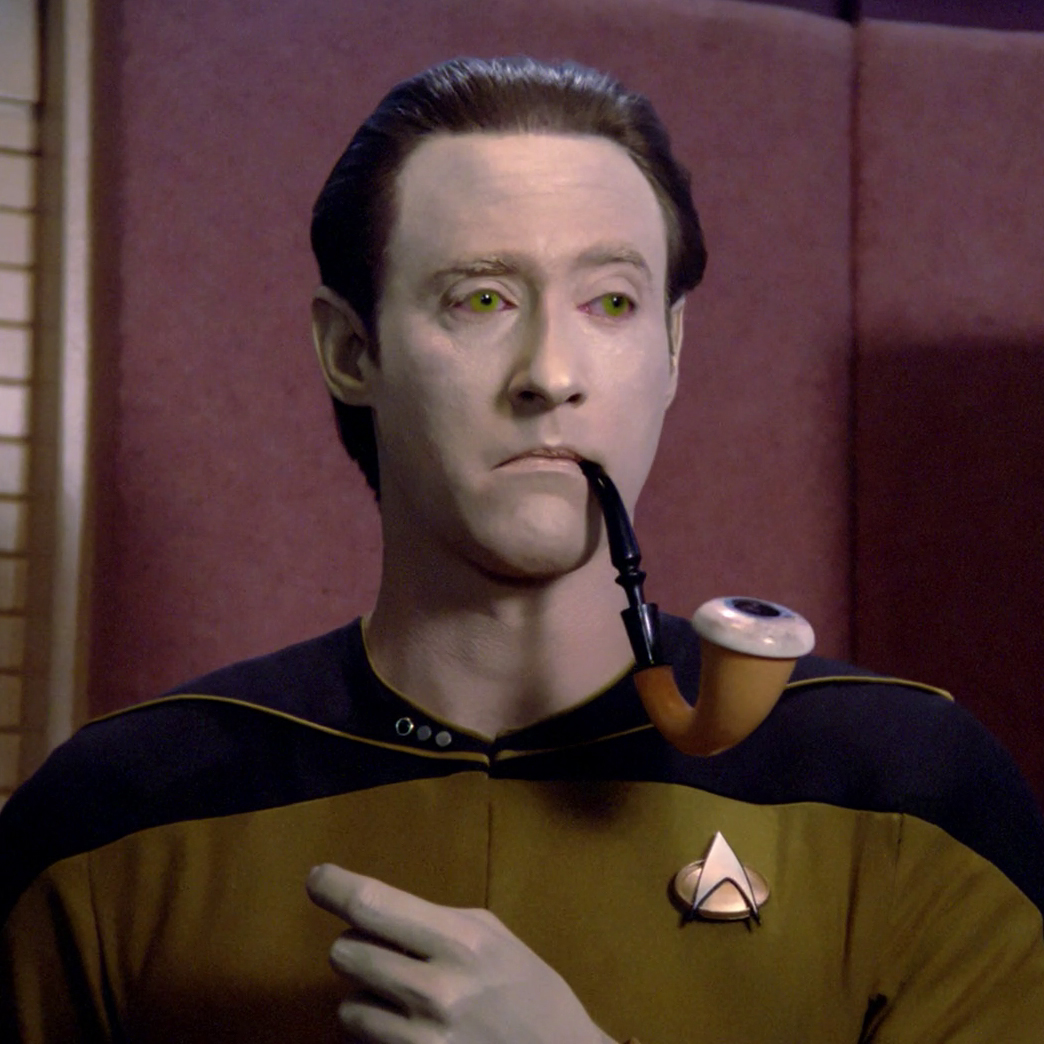
In this episode, we get a clear signal of an important difference between Captains Kirk and Picard.  In "The Man Trap," TOS's first episode to air, Kirk states that he hates mysteries - highly amusing as so many Trek stories are, at heart, mystery tales.  In "Lonely Among Us," Picard states the very opposite.  He loves them and inspires Data to research Earth's most famous fictional detective, Sherlock Holmes.  Holmes was a prominent motif in the TNG run.

Image result for data sherlock pipe
via Memory Alpha

We also get some insight into the future of food as idealized by Gene Roddenberry and company.  In discussion with the Anticans, Riker tells them "We no longer enslave animals for food purposes," further explaining that what appears to be meat at their meals is produced inorganically by the replicators.  Indeed, Roddenberry himself was a vegetarian and it's interesting to see how that choice influenced his vision for Trek.
  

Acting Notes

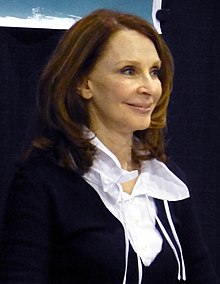
Image result for young gates mcfadden
via Wikipedia

Cheryl Gates McFadden (Dr. Crusher) was born in March 2, 1949 in Cuyahoga Falls, Ohio.  She graduated from Brandeis with honors as a theatre major.  

Early on, her choreography work outpaced her acting, wisely hooking up with The Jim Henson Company.  She was choreography director for both Labyrinth and The Muppets Take Manhattan.  She also makes a brief on-screen appearance in the latter film.  She is usually, though not always, credited as Cheryl in choreography and Gates in acting so as to delineate between the two. 

McFadden was pregnant during TNG's fourth season.  The pregnancy was never written into the story.  Crusher always wore a lab coat to conceal it.  Her son James was born in 1991.  Brent Spiner (Data) is the godfather.

Tuesday, October 29, 2019

Squid Eats: Sotto Enoteca

Image result for sotto enoteca
via Sotto Enoteca
 
I appreciate any restaurant that embraces the intimate feel of a quiet, back alley, European bistro.  Such is the case with Sotto Enoteca, technically a wine bar sharing a kitchen with Trattoria Delia.   Sotto Enoteca feels like the sort of place in Palermo you'd only hear about through word of mouth but once you get there, you realize everyone else is in on the secret, too.  Tables are scarce but service is friendly and sincere. 

The food's nice, too.  We started with a salad, then pork belly with Vermont-grown rice.  For the entree, we split a mussels pasta dish followed by an enormous and delicious tiramisu for dessert.  Obviously the wine list is impressive.

It was date night for us, something I'm hoping we'll do more often.  As our daughter gets older and more independent, I would like to invest some time in enjoying each other as a couple.  As I told my wife recently, I don't want to be the couple who waits until the kids are gone to get to know each other again.  I don't think we are that couple but I want to enjoy not being that couple now.  After dinner, we made a stop at the bookstore for a leisurely browse, then home. 


Squid on the Vine

Paul Nicolle, Chablis Vieilles Vignes Chardonnay, 2017
My rating: 8.0
Apple
A touch of bitter
Pale yellow
Our most recent wine class was about Chablis.  The shop, Dedalus in Burlington, was quite generous in the bottles they shared for the class, allowing us samples from vintages way out of our usual price range.  It was nice to be able to witness the differences though, at least for me, it wouldn't be enough to justify the cost.  Mind you, still fun to try them.  The Paul Nicolle was a Dedalus Thirst Club wine for us.

Château Jouclary, Cuvee Tradition Cabardès Red Blend, 2017
My rating: 8.5
Dark chocolate
Starts fruity, finishes bitter.
Medium purple
Our second Thirst Club wine for the month, a highly promising red.

La Spinetta, Il Rosé di Casanova Rosé Blend
My rating: 8.5
Apple nose
Watermelon bubblegum
Astringent
Dark yellow, almost amber
"You know it's a rosé, right?" My wife asked after I ordered it.  She knows I don't generally care for rosés.  They feel like an unreasonable compromise for me.  I guess I didn't realize it.  I just liked the description in the Sotto Enoteca menu.  I'd decided that I wanted to try one white and one red on the evening.  Rosé was not what I had in mind and, in truth, it wasn't especially pink.  Nice - bright, refreshing but with some dimension.  The menu suggested the watermelon hints.  I didn't pick it up until I thought of bubblegum - odd but pleasant.

Graci, Etna Rosso Nerello Macalese, 2017
My rating: 8.0
Recommended with the mussels
Smells sweeter than it tastes.
My red for the evening.  I had some buyer's remorse with this one.  It was okay but nothing earth-shattering.  Earlier, I'd had my eye on a different red - one described as "immense" which seemed a promising adjective - but I went with our waiter's recommendation.  He was right.  It did go nicely with the mussels.  I still wish I'd stuck with my original plan.

Friday, October 25, 2019

Star Trek: Where No One Has Gone Before

Episode: "Where No One Has Gone Before"
Series: Star Trek: The Next Generation
Season 1, Episode 6
Original Air Date: October 26, 1987

Image result for where no one has gone before
via Wikipedia
An arrogant jerk engineer, Kosinski, comes aboard the Enterprise to run a test of his new propulsion system per Federation orders.  The more mysterious and significantly friendlier guest is Kosinski's assistant who states his name is unpronounceable by humans.  The test goes horribly wrong, sending the Enterprise to the extreme edge of time/space where thoughts - hopes, dreams, fears, anxieties - become reality.  Kosinski is proven a hack and the assistant turns out to be far more interesting than initially suspected.  Meanwhile, will our friends ever make it back?

I confessed to my wife that these stories about getting lost seemingly beyond retrieval make me especially nervous.  Thank goodness it all works out.

"Where No One Has Gone Before" marks the first appearance of The Traveler, the name by which Kosinski's assistant comes to be known.  He's essentially the stated mission of the Enterprise in superior being form.  The episode is also an important Wesley Crusher story.

Wesley is the first to recognize The Traveler's extraordinary capabilities and the visitor, in turn, is similarly impressed with Wes, sharing his predictions for the boy with Picard.  In so doing, he assigns a "Chosen One" narrative to the lad, a bit hard to take for the fans who were already finding Wesley painfully annoying.  Worth remembering: executive producer Gene Roddenberry saw the character as a projection of his own younger self.  What awkward youth would not want to be granted knowledge of his/her own exceptional future?  Hogwarts fantasy, anyone?

I think half of the problem with the Wesley character may be his sweaters.  The one for this episode is especially awful.  So again, don't blame Wil Wheaton.  In this case, it's Bill Theiss's fault, he of the memorable and often questionable costume designs of TOS, brought back on board for the new series (read more here).  If you'd care to enjoy more of the honorary ensign's pullover collection, see here.


Music Notes

One crew member's fantasy come to life is playing second violin in a string quartet, his fellow musicians decked out in late-18th century period costume.  The crewman is played by Byron Berline, an uncredited professional violinist.  The piece is the first movement from Mozart's Eine Kleine Nachtmusik.


The ballerina in another fantasy is credited: Victoria Dillard.  Her piece is called "Waltz of the Chocolate Donut," composed for the episode by Ron Jones.


Acting Notes

Image result for young michael dorn
via Wikipedia

Michael Dorn (Worf) was born December 9, 1952 in Luling, Texas and grew up in Pasadena, California.  After two years at Pasadena City College, he briefly pursued a music career with rock bands.  His biggest acting role before Trek was a three-year run on CHiPs as Officer Jebediah Turner.  Dorn has more Trek appearances to his name than any other actor: 272 television episodes and five films.  He has also directed four episodes.