Showing posts with label Showa. Show all posts

Monday, September 18, 2017

On the Coffee Table: Showa 1953-1989

Title: Showa 1953-1989: A History of Japan
Writer and Artist: Shigeru Mizuki
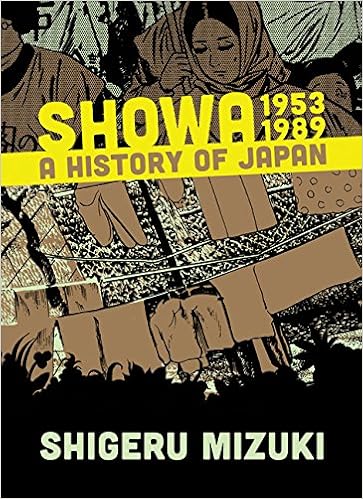
via Amazon
This is the fourth and final volume of Mizuki's outstanding Showa comic book series.   My reflections on the first three books can be found here, here and here.  Japan's Showa era was defined by the reign of Emperor Hirohito: 1926-1989, a period of extraordinary national transformation.  Mizuki lived through it all and his books weave historical events with his own personal experiences.

This installment covers by far the longest time span of the four volumes, well over half of the Showa period.  It's a particularly important era for me personally because it includes the time when Japan became a vital part of my family's life.  My parents first moved to Japan in 1969 and stayed for seven years (Showa 44-51).  Both learned far more Japanese than I ever did.  My older sister and I were both born in Tokyo.  The book even includes an event with which my father was directly involved: Emperor Hirohito's visit to the United States in 1975.  My parents have never talked much about the student protests and political corruption that were going on during their time in Japan.  Maybe with the relative isolation of diplomatic life, it didn't affect them too much.  Maybe after two years in Laos, Japan was relatively stable.  Maybe it's just not the sort of stuff you talk about with young children. 

As the book and the Showa era close, my own time in Japan is nearing.  I went back to teach for two years, 1996-98 (Heisei 8-10).  As such, the Japan in the book comes to look a lot more like the Japan I knew.  Japanese cities aren't exactly beautiful but familiar sights tug at the heartstrings nonetheless.

What I appreciate most about the Showa series is Mizuki's attention to cultural history in addition to all of the military, political and economic details.  He shares the TV shows, movies, fashion magazines and songs that were popular.  He seems especially interested in crime tales, going into too vivid detail with several headline grabbing stories.  In fact, if I have one criticism, it's that sometimes, the book's a little gross.  Mizuki loooooooves potty humor. 

That said, I am now half-tempted to go back and re-read Mizuki's other work, especially GeGeGe no Kitaro, his most famous comic.  I probably won't but I would have a greater appreciation now that I know more about the author's life.  I am also grateful for the history lesson about a country that has been so important to me.

Thursday, June 30, 2016

On the Coffee Table: Showa 1944-1953

Title: Showa 1944-1953: A History of Japan
Writer and Artist: Shigeru Mizuki
via Goodreads
This is the third volume of Mizuki's outstanding Showa comic book series.   My reflections on the first two books can be found here and here.  Japan's Showa era was defined by the reign of Emperor Hirohito: 1926-1989, a period of extraordinary national transformation.  Mizuki lived through it all and his books weave historical events with his own personal experiences.

The war was not going well for Japan in 1944.  After scoring early, dazzling victories over the Allies, deficient supply lines were taking their toll.  Defeat was essentially inevitable but no one within the military establishment was willing to admit it.  Surrendering was not considered an option.  Instead, thousands of Japanese soldiers and sailors scattered about the Pacific - the author included - were expected to go "onward toward their honorable deaths."  The lives of individuals were worth nothing compared to the honor of the nation.  Under-supplied and with no hope of reinforcements, they fought disease and starvation as much as the enemy.

By his own admission, the author survived it all through sheer luck, though hardly unscathed.  He lost his left arm and endured violent bouts with malaria.  When he finally returned home to Japan, his homeland was physically, emotionally and economically devastated, hardly in a position to absorb legions of servicemen back into society.

The post-war occupation of Japan by the United States had as much to do with the forming of the modern nation as the war did.  With the country's own military leaders defeated and disgraced, the Japanese looked to General Douglas MacArthur as the new father figure.  Even when I was in Japan 50 years later, MacArthur was still held in high reverence by those who remembered.  Not all American decisions were popular or effective but their presence allowed the newly demilitarized Japan to build an economic foundation for the future.  Prosperity came sooner than expected.  When the United States entered the Korean War in 1950, Japan provided a staging ground and vital supplies.  The economy boomed.

Meanwhile, the author struggled to find his own place in the world.  The genius of the series is the effective interweaving of Mizuki's story with that of the nation.  For all of his troubles, his suffering was minimal compared to millions of Japanese.  The Showa series is a powerful reminder of the extraordinary journey the country has been on over the past three generations.

Wednesday, February 24, 2016

On the Coffee Table: Showa 1939-1944

Title: Showa 1939-1944: A History of Japan
Writer and Artist: Shigeru Mizuki
via Amazon
This is the second volume of Mizuki's outstanding Showa comic book series.   I reviewed the first volume here.  Japan's Showa era was defined by the reign of Emperor Hirohito: 1926-1989, a period of extraordinary national transformation.  Mizuki lived through it all and his books weave historical events with his own personal experiences.

Obviously the years 1939-1944 were dominated by the Second World War.  Japan's weak democracy had become, in effect, a military dictatorship.  Domination of Asia and the Pacific was seen by those in power as the nation's destiny.  The event best known to Americans is the attack on Pearl Harbor but in fact that strike was only one part of a much broader offensive executed in several corners of the Pacific simultaneously.  Over a seven-hour period, Japan also attacked the Philippines, Guam, Wake Island, Malaya, Singapore and Hong Kong.  All were resounding victories for the Japanese.  So began the most extensive and destructive naval war in human history, of course just one chunk of the greater, all-absorbing global conflict.

That much history is easily gleaned from textbooks.   Mizuki provides a more intimate view.  Not only does his stunning artwork bring us closer to the action but his own experiences in the Japanese army offer a sobering perspective on the conflict.  He himself has no sympathy for Japan's war objectives but as a grunt soldier, his personal opinions were immaterial.  His life was in constant peril.  In truth, it's amazing he survived to tell his story.

In some ways, the book encourages one to learn more but even in a sequential art medium, the details of naval battles tend to run together.  I will leave it to others to judge the work's historical accuracy.  Every once in a while, Mizuki lapses into hypotheticals: how the world might be different if the Japanese had won the Battle of Midway, for instance.  But he also brings us back to the underlying realities of the conflict: the Pacific Theater hinged ultimately on American superiority in both military intelligence and supply lines.

Showa is top notch.  Anyone with an interest in Asian history or the power of what is still seen by most in the English-speaking world as a frivolous medium should give it a look.  The next volume, 1944-1953, covers the American occupation, every bit as important to the shaping of modern Japan as the War was.