Showing posts with label comics non-fiction. Show all posts

Wednesday, July 2, 2025

On the Coffee Table: The Sculptor

Title: The Sculptor
Writer and Artist: Scott McCloud

via Amazon

Struggling professional sculptor David Smith makes a deal with Death.  Over the next 200 days, his hands will create - as if by magic - anything his creative mind can conjure.  However, at the end of 200 days, he will die.  To complicate matters further, soon after, he falls in love.

I first became aware of Scott McCloud through his extraordinary non-fiction work.  His books Understanding Comics, Reinventing Comics and Making Comics offer a fascinating behind-the-scenes tour of the sequential arts medium.  They were an essential part of my own orientation to the comic book world.  The books themselves also reveal a great deal about their creator.  McCloud is as fascinated by the artistic process as he is by the product.  

The Sculptor reflects this, too, though rather than focusing on the technical aspects - especially since with his new "powers," David instantly creates whatever he wants by simply touching the material - the story follows the artist's emotional journey.  The narrative itself, particularly the love story, is engrossing.  But the deeper explorations of inspiration, motivation and the relationships between creator, consumer and critic are the more interesting drivers.  

A few years ago, I had a memorable conversation with an art teacher colleague about the role of "the audience" in creating art.  I asserted, naïvely as it turns out, that one should always consider the perspective of the consumer in the creation of a piece.  She furrowed her brow at me and responded, "No.  Some of the most important work you'll ever do as an artist is what you create for yourself - only for yourself."

I can say from decades of experience that musicians, like me, hardly ever see things that way.  Our training is built entirely around what we project to the listener.  Yes, we should internalize the work as much as we can so we embody it.  But still, that is for the sake of the performance.  Until that conversation, I took for granted that everyone in the arts felt the same way.  

While The Sculptor doesn't explore this matter explicitly, much of David's journey revolves around reconciling what is meaningful to him with what is meaningful to the consumer.  He is, after all, trying to make a living so finding buyers is important.  But as the literal deadline approaches, the financial motivations fall away.  It's the legacy that matters.  How will he be remembered?  Eventually, even that becomes less important than the honesty of his work.  

My own visual art talents don't extend very far past stick figures.  I envy anyone who can convert a mental vision into a concrete reality.  McCloud's talents are considerable.  He's a master of black-and-white, bringing rich depth and texture to his drawings.  The Sculptor was published in 2015 and I haven't seen anything new from him since.  His work is so detailed that I'm not surprised he doesn't crank out books more quickly.  Still, I hope we see more from him before too long.

Wednesday, August 8, 2018

On the Coffee Table: Tony Isabella

Title: 1000 Comic Books You Must Read
Author: Tony Isabella
I have an inscribed copy of this book, gifted to me by Mock and Drama Guy for my birthday five years ago - just for a glimpse into how deep my TBR shelves run these days.  Isabella has been working in comics, mostly as writer and critic, for decades.  His proudest creation is the DC superhero Black Lightning, intended to address the lack of positive Black characters in the comics of the late '70s.  He was inspired, in part, by television's Welcome Back, Kotter, also a comic series for which Isabella had written.

I doubt this book will turn me into a collector.  Having dabbled in the genre for a few years now, I've got a pretty good idea of what I like.  That said, the history presented here is excellent and a lot of it new to me.  The titles are categorized by decade and each chapter begins with the historical context.  The first book listed is Action Comics #1, the first appearance of Superman, June 1938.  While Isabella acknowledges the existence of sequential art for millennia preceding, he submits Superman as the launch point of the industry as most American consumers know it.  The most recent publication featured is Bruce the Little Bruce Spruce, December 2008.

There's a decent variety on Isabella's list, though a more Squid-friendly selection would have featured more international titles, especially Japanese.  I have read several in his compilation and have a couple more on the shelves waiting for me.  I expect the book will be a good reference and will also be good for ideas should I decide to expand my horizons. 

Monday, August 1, 2016

On the Coffee Table: Bill Watterson

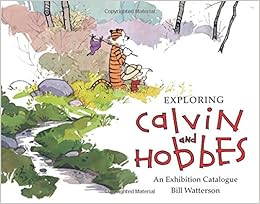
Title: Exploring Calvin and Hobbes: An Exhibition Catalogue
Author: Bill Watterson
via Amazon
For many reasons, I believe I was born into a great era for pop culture, a time when telecommunications would transform the world, giving us all greater access to more media (if not always better media).  I was four years old when Star Wars first hit theaters, the perfect age for growing up with the franchise.  I was at just the right age when Dungeons & Dragons took hold.  True, I missed the Beatles but overall, I did well.

There is one medium I know I hit during a golden age: newspaper comic strips.  In the mid-1980s, I started each morning at the breakfast table with a bowl of raisin bran and the Washington Post's sports and comics sections.  Every day, I was treated to the three greatest strips that have ever graced the page: Bloom County by Berkley Breathed, The Far Side by Gary Larson and Calvin and Hobbes by Bill Watterson.  By 1995, all three were gone (thank goodness, Bloom County is back via Facebook).  The daily comics have never been the same.

In 2014, the Billy Ireland Cartoon Library & Museum at Ohio State University presented an exhibition of Bill Watterson's work, primarily devoted, of course, to Calvin and Hobbes.  In conjunction with the exhibition, Watterson released Exploring Calvin and Hobbes which included examples of his work and a thoughtful interview conducted by Jenny Robb, museum curator.  The interview is wonderfully thorough, covering Watterson's childhood, his influences, his early days playing around in the medium, the tough road to syndication and, of course, his unexpected but enormous success.  I always enjoy an exploration of the creative process so his thoughts on craft, from his work schedule to his preferred pen, are fascinating to me.

There are a couple of controversial questions that have long dogged Watterson and Robb did not shy away from them.  One has to do with licensing.  Watterson left millions on the table by declining to allow his characters to be licensed for toys, lunchboxes and such.  He explains that he wanted artist control over how the images would be used and since no one would give him that, he refused to sign over the rights.   Mind you, the continuing strong sales of Calvin and Hobbes books have preserved the considerable cash flow for the Watterson household.

The other question, more dear to my own heart, is why he abandoned the strip in '95, seemingly at the height of his game.  Watterson provides a lawn mowing metaphor as explanation.  He didn't want to continually mow over the same stripe of ground for decades.  He felt he had taken Calvin and Hobbes as far as he could without resorting to retreads.  It's still sad but, from a creative standpoint, understandable.

The most interesting discussion centered on the current state of the industry, Watterson expressing his concern that it is no longer possible for anyone to have a career in comics like the one he had.  When I wrote that the comics have never been the same, I wasn't just waxing nostalgic.  It's true, and for a startlingly simple reason: people don't buy newspapers anymore.  The image of a family sitting around the living room, each member enjoying his/her favorite section of the local daily is downright Rockwellian at this point.  Through the miracle of newspaper distribution, Watterson's strip - along with Breathed's, Larson's and Schultz's - had a readership many multiples of what one could expect today.

Best of all, the book includes a number of the old strips.  I'd forgotten just how funny Calvin and Hobbes was, beyond its basic existential brilliance.  Quite a few of them had me in stitches.


Friday, April 24, 2015

The Cephalopod Coffeehouse: April 2015

Welcome one and all to the Cephalopod Coffeehouse, a cozy gathering of book lovers, meeting to discuss their thoughts regarding the tomes they enjoyed most over the previous month.  Pull up a chair, order your cappuccino and join in the fun.  If you wish to add your own review to the conversation, please sign on to the link list at the end of my post.

Title: The Who, the What, and the When: 65 Artists Illustrate the Secret Sidekicks of History
Authors: Jenny Volvoski, Julia Rothman and Matt Lamothe
via Chronicle Books
Perhaps no one can claim to have achieved greatness without help from someone along the way.  The Who, the What, and the When celebrates the men, women and a dog behind some of history's legendary figures.  Each chapter is written by a different author and illustrated by a different artist.  Among the highlights for me:
  • Lulu Peyraud, mentor of Alice Waters, chef and restauranteur
  • Hiroshi Arakawa, coach of Sadaharu Oh, Japanese baseball legend
  • Michel Siegel, father of Jerry Siegel, Superman's co-creator
  • Jack Sendak, brother of Maurice Sendak, children's author extraordinaire
  • Frank Wild, right-hand man of Ernest Shackleton, explorer
  • Alma Reville, wife of Alfred Hitchcock, film director
  • Ian Stewart, the Rolling Stones' sixth man
Some of the sidekick's featured are reasonably well-known: Anne Sullivan Macy, for instance, Helen Keller's miracle worker.  For many others, I didn't even know about the front (wo)man before.  With all of the artwork, it's an extremely pretty book.  It's not the sort that makes me want to run out and learn more about all these folks but it is an easy, enjoyable read.

Please join us and share your own review of your best read from the past month.  This month's link list is below.  I'll keep it open until the end of the day.  I'll post May's tomorrow.  Meetings are the last Friday of each month.  Next gathering is May 29th.


Sunday, March 17, 2013

On the Coffee Table: Gerard Jones

Title: Men of Tomorrow
Author: Gerard Jones
Image via Goodreads

Men of Tomorrow provides a sweeping history of the comic book industry in the 20th century.  While Jones covers material far beyond Superman, the primary focus is on the Man of Steel and the men responsible for his creation and emergence as a cultural icon.  Writer Jerry Siegel and artist Joe Shuster are both profiled, as are Harry Donenfeld and Jack Liebowitz, the publishers who first brought the character to the public.

The book is more than just a blow-by-blow account.  The industry's evolution is always tied to external cultural forces - the tenement slums of the early 20th century, the rise of organized crime during Prohibition, Depression, war, the moral anxiety of the 1950s and so on.  Men of Tomorrow also documents the rise of geek culture, born in the pulp fiction fan magazines of the '20s and '30s - a culture which comics nurtured for decades and which ultimately spawned comics creators. 

The unifying theme of this broad history is the rights of comic book artists and writers to profit from their creations.  Grunts like Siegel and Shuster were exploited for years while publishers made millions.  Today, the most successful creators are genuine celebrities in the comics world.  It's difficult to appreciate the years of painful and frequently humiliating litigation Siegel and Shuster had to endure just to be credited in the Superman movies and other such products.

Sunday, October 28, 2012

On the Coffee Table: Comic Books 101

Title: Comic Books 101
Authors: Chris Ryall and Scott Tipton


Image via RyallTime Blog

This book is much as the title advertises, an overview of the basics of the American comic book industry.  While it's not quite as clever and engaging as Scott McCloud's books, Comic Books 101 covers a lot of ground - even explaining the effects of various colors of kryptonite.  Ryall and Tipton offer profiles of publishers, major characters and influential creators as well as a history of the business.  Most helpful to me are the recommended reading lists, of which there are several.  Interspersed are the reflections of various industry insiders.  The introduction is written by Stan Lee himself.

The book's tone is very light and also highly reverent as the authors recount the triumphs of their various heroes.  My favorite section is the last, Part VII: Hooray for Hollywood, in which the many comic book screen adaptations are reviewed - both movies and televisions.  Here the authors get a lot more snarky.  I like snarky!

Comic Books 101 was definitely a fun read.  I feel much better equipped for my own explorations of the medium.  In particular, I find myself extremely curious about pre-code comics of the 1950s and earlier.  A good book makes you want to read other books - mission accomplished here.  As with McCloud's books, I expect I will be referring back to Comic Books 101 often.