Sunday, August 18, 2013

On the Coffee Table: Neil Lanctot

Title: Negro League Baseball
Author: Neil Lanctot
via Baseballisms

Negro League Baseball: The Rise and Ruin of a Black Institution is the result of an ambitious project to provide an honest, nuanced history of African American baseball, specifically that of the teams in the Negro National League (NNL) from the early 1930s onward.  When told from the 21st century perspective, the story of the Negro leagues is that of six decades of exclusion from white professional baseball, generations of athletes denied the opportunity to exhibit their skills on the grandest stage.  While such portrayal is certainly historically accurate, it only tells part of the story.

There aren't a lot of balls and strikes in Lanctot's book.  In depth profiles of such star players as Satchel Paige, Josh Gibson and even Jackie Robinson should be sought elsewhere.  Instead, the author focuses more on the business of baseball.  Before televisions invaded nearly every home in America, independent professional and semi-pro baseball teams - both black and white - were ubiquitous.  Baseball teams, like many other black-owned and operated institutions, were culturally essential to African American communities throughout the United States during segregation.  Such teams were symbolically important to those cultural leaders who supported the idea of self-sustaining black institutions.  Black baseball was not an industry in a vacuum either.  It suffered through the Great Depression, boomed during the war years, then suffered a slow, inevitable decline once the Major Leagues started to integrate in the late 1940s.  Lanctot's tome covers all of it evenhandedly, celebrating the successes but also critical of the mismanagement which contributed to the industry's demise.

I learned plenty I didn't know before.  Most intriguing, though also the most troubling depending on your perspective, were the Indianapolis Clowns, a baseball version of the Harlem Globetrotters.  Many saw clowning sports teams as detrimental to integration efforts, compromising the image of African Americans in the broader culture.  The Clowns, to be fair, took the act quite a bit further than the basketball squad, posing for team photos in war paint and grass skirts, for example.  Both the eastern-based NNL and western/southern Negro American League (NAL) banned their member teams from scheduling exhibitions with the Clowns for many years.  However, the Clowns were ultimately admitted into the NAL in 1943 and were the only affiliated team to remain profitable into the 1950s.  The Clowns didn't even officially disband until 1988.  Despite their controversial history, the Clowns do lay one undeniable claim to baseball legacy: they were the first team to sign Hank Aaron to a professional contract.

The book is a bit academic for my tastes, certainly informative but dry for light summer reading.  I need pure escape in August with a return to the mines imminent.  On the other hand, I might not even have finished reading it if I'd tried during the school year.  I certainly feel better-informed and will likely refer back to the book from time to time.

Monday, August 12, 2013

Baseball Tunes: Don't Stop Believin'

Millennia from now, cultural historians will ponder the eternal appeal of two songs released in 1981.  The first they will know because it never truly died.  As long as there are dance clubs in the universe, Soft Cell's "Tainted Love" shall live forever (Dr. Who fans know this to be true but I actually had the theory first - wife will confirm). The second one they'd forgotten about for a time.  In fact, it had a funny habit of disappearing for years, even centuries at a time.  Then it would emerge again to capture the imagination of a new era.  It is a song of hope, of determination, of destiny used to inspire athletic heroes and angst-ridden preteens alike.  Even the name of the band suggests epic adventure.  That second song, of course, shall be...

"Don't Stop Believin'" by Journey


As far as sports go, my strongest association with the song is Detroit Red Wings hockey games.  The sound system cuts out so the crowd can yell the "born and raised in south Detroit" line.  Never mind the fact that there is no south Detroit.  Or, there is but it's more commonly known as Windsor, Ontario.

Other teams frequently co-opt the song, though.  In recent years, baseball's Chicago White Sox, Los Angeles Dodgers and San Francisco Giants have all used it as an inspirational anthem.  Lead singer Steve Perry is himself a native Californian and a die-hard Giants fan.  Apparently, he didn't like the Dodgers using it one bit!

"Don't Stop Believin'" was one of three top 10 singles released from the band's most successful studio album, Escape.  Both "Open Arms" and "Who's Crying Now" charted higher but 32 years on, there's little doubt as to which track has the strongest legacy. 

I must credit Suze with finding this one a while back - definitely worth sharing:


Some will win.
Some will lose.
Some were born to sing the blues.
Oh, the movie never ends.
It goes on and on and on and on...


My Baseball Fantasy

Vermont League: won, 9-1 (105-64-11 overall, 1st place out of 12 teams)
Maryland League: lost, 4-5-1 (94-76-10, 4th of 10)
Public League: 82 Rostisserie points (4th of 12)
My Player of the Week: Anibal Sanchez (Starting Pitcher, Tigers) with 1 win, 19 strikeouts, a 2.45 ERA and a 0.75 WHIP
via Wikipedia

Sad tale: I lost to my daughter in the Maryland league this week - my daughter who stopped paying attention to her team almost the same instant she started, back in March.

Family Movie Night: Stop Making Sense

Title: Stop Making Sense
Director: Jonathan Demme
Original Release: 1984
Choice: My Wife's
My Overall Rating: 4 stars out of 5
Image via Wikipedia

When our daughter first became aware of specific bands, the first she could identify readily was The Beatles, known for a long time as simply "Daddy's Favorite Band."  It wasn't much of a shock.  The Beatles are a pretty easy sell.  The second band she was drawn to, though, was more of a surprise: The Talking Heads.   I never would have thought of them as a kid-friendly band but she loves them.  My Wife has a theory: David Byrne (lead singer) dances kind of like a seven-year-old.  Our Girl was about that age at the time.


As such, the 1984 concert film Stop Making Sense was an excellent choice for Family Movie Night.  I had never seen it before and thoroughly enjoyed it.  The Talking Heads were a fun, high energy band and I'm sure they were great to see live.  The film is considered by many critics to be the finest rock concert movie ever made - not much in the way of gimmickry, just a solid presentation.  There are lots of wide shots of the band and individual performers, including Byrne, are generally framed in full-body or waist-up allowing the quirky charm to shine through.

Once the movie was over, I asked Our Girl what she thought.  "I loved it," she said. "Too bad we have to wait another year to watch it again!"  (FMN rule: once a year limit for each film)

Monday, August 5, 2013

Baseball Tunes: Build Me Up Buttercup


"Build Me Up Buttercup" was written by Mike d'Abo and Tony Macaulay and released as a single by the Foundations in 1968.  The song made it to #3 on the Billboard charts.  Side note: d'Abo is most famous as the lead singer for Manfred Mann but he's also the father of Olivia d'Abo, whom Wonder Years fans will remember as Karen, Kevin's older sister.

"Build Me Up Buttercup" is the seventh-inning stretch song for the Los Angeles Angels of Anahaeim (most cumbersome name in American sports?).  It is played right after "Take Me Out to the Ballgame."


My Baseball Fantasy

Vermont League: won, 7-3 (96-63-11 overall, 1st place out of 12 teams)
Maryland League: lost, 4-6 (90-71-9, 4th of 10)
Public League: 83 Rotisserie points (tied for 2nd of 12)
My Player of the Week: Dustin Pedroia (Second Baseman, Red Sox) with 2 home runs, 8 RBI, 5 runs and a .233 batting average
Photo via BlackSportsOnline

Sunday, August 4, 2013

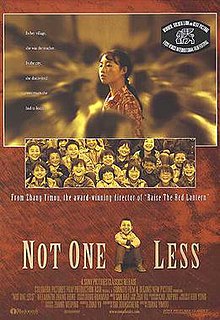
Family Movie Night: Not One Less

Title: Not One Less
Director: Zhang Yimou
Original Release: 1999
Choice: Mine
My Overall Rating: 3 stars out of 5
Image via Wikipedia

The Chinese film Not One Less is a fictional account of a 13-years-young substitute teacher trying to hold onto all of her 28 pupils while their regular teacher is away for a month. When one of her charges leaves the rural village to find work in the city, Teacher Wei goes after him. Her search feels a bit like an anxiety dream at times but the culmination is predictably inspiring.

In order to preserve a strong sense of reality, Zhang cast the parts with amateur actors whose real-life jobs reflected their characters.  The man playing the town mayor truly is the mayor of a small village, the TV show host really is a TV show host and so forth. The film coincided with a strong push by the Chinese government towards education reform. Government censors oversaw production closely so nothing in the film is overly critical.  The film suffered on the international festival circuit for its perceived political leanings but still did pretty well, winning The Venice Film Festival's Golden Lion among other accolades.

Wednesday, July 31, 2013

On the Coffee Table: V for Vendetta

Title: V for Vendetta
Writer: Alan Moore
Artist: David Lloyd
Image via Wikipedia

I was first introduced to the extraordinary work of Alan Moore through the film version of V for Vendetta.  For me, the movie was a wonderfully pleasant surprise - can't say I was expecting much, then was completely blown away.  Since getting into the comics hobby a few years back, I have found Alan Moore to be just about the most dependable name in the medium.  The Watchmen, Top 10 and The League of Extraordinary Gentlemen have all ranked among my favorites.

Given all that, I really should have been better prepared for the original comic book version of V for Vendetta.  Mind you, I expected it to be good.  I did not expect what I would call the most satisfying graphic narrative work I have encountered thus far.  I've been on the lookout for a benchmark against which I could measure all others.  I believe I have found it.

First published in the early 1980s, V for Vendetta is set in a near-future England.  Nuclear holocaust has destroyed much of the world and Britain is a fascist police state.  V is a masked, anarchist terrorist staging his own private revolution.  While he is certainly the central character and driving force of the narrative, most of the story is told from the perspective of others: Evey, the girl V rescued from the streets, as well as those within the establishment who are baffled in their efforts to stop V's attacks.

So, what is Alan Moore's genius?  I am far from the only one who considers him the best comic book writer ever.  What is his certain something?  Attention to detail is a very big part of it, I think.  Moore's approach seems that of a great screenwriter.  The big story is built upon the strength of individual scenes.   Words matter - all of them.  Characters matter - all of them.  Taking the broader scope, Moore is able to apply a human face to meaty political considerations.  Moore wrote V for V as a response to Thatcherism but rather than simply ranting as most of us would, he created a metaphorical reality with breath, blood and flesh.  He's far from the first to do so but few have managed it so effectively.

Moore's understandable objection to the film adaptation was the fact that his political message was twisted to suit a 21st century American audience.  The book pits anarchy against fascism.  In the movie, it's liberalism vs. neo-conservatism.  The impact on the audience is comparable but the creator's intent is irrevocably altered.  I still love the movie and am eager now to watch it again, but I must concede it's not quite the same story.

Monday, July 29, 2013

Baseball Tunes: Cleveland Rocks


Ian Hunter rose to fame as lead singer of the glam rock band Mott the Hoople.  The band split in 1974 but Hunter kept writing songs.  He wrote "Cleveland Rocks" in tribute to a city he felt was undeservedly the butt of jokes.  An earlier version was called "England Rocks" in order to get the song released as a single but Hunter claims it was always Cleveland's song.  "Cleveland Rocks" is best known to those outside of Ohio as the theme song for The Drew Carey Show (covered in this case by The Presidents of the United States of America).


Almost immediately upon its release in 1979, "Cleveland Rocks" became the city's unofficial anthem.  All of Cleveland's professional teams, including baseball's Indians, use the tune as a victory song.  Then-mayor Dennis Kucinich gave Hunter a key to the city in 1979. 

Full disclosure: my mother is from Cleveland so while I've never lived there myself, I do have some affection for the old rust belt town.  I haven't been back since my grandmother died in '97 and have never visited either the Rock and Roll Hall of Fame or Jacobs Field, the two crown jewels of the city's modern renaissance.  There are quite a lot of other places I'd like to visit first but a pilgrimage might be in order someday.


My Baseball Fantasy

Vermont League: won, 7-3 (89-60-11 overall, 1st place out of 12 teams)
Maryland League: tied, 5-5 (86-65-9, 4th of 10)
Public League: 83 Rotisserie points (3rd of 12)
My Player of the Week: Jon Lester (Starting Pitcher and Cancer Survivor, Red Sox) with 2 wins, 16 strikeouts, a 1.35 ERA and a 0.98 WHIP
Photo via PlayerWives.com