Sunday, March 9, 2014

On the Coffee Table: H.G. Wells

Title: The Invisible Man
Author: H.G. Wells
via Barnes & Noble
Like many of the early science fiction writers, H.G. Wells was himself scientifically trained.  His field was biology.  In The Invisible Man, he considers the genuine potential for achieving invisibility and also the moral implications of such a possibility.  The title character, a man called Griffin, dreams of the power invisibility would gain for him but lacks the foresight to weigh its limitations.  As a morality play, The Invisible Man is not entirely unlike Frankenstein, though in this case the mad scientist's monster is himself.

I expected the story to be dark and creepy.  However, I did not expect Wells's highly satirical depiction of those who people the English countryside.  The tale is as much about the speed of gossip as it is about the arrogance of playing God.  The story begins with a mysterious stranger, covered in bandages, checking into a country inn.  Eventually, as a result of his own arrogance but also the townspeople's curiosity, his secret is exposed.  A mad chase ensues.  He stumbles upon the house of a former colleague, to whom he reveals all.

As with Robert Louis Stevenson's Jeckyll and Hyde (review here), I was inspired to read The Invisible Man by The League of Extraordinary Gentlemen by Alan Moore and Kevin O'Neill.  Griffin is one of the five League members.  Whereas the comic book depiction of Hyde is tweaked a little, Griffin is spot on: full-blown psychopath.  The League story also incorporates Griffin's Reign of Terror concept.  In the comic, he is given a first name, a luxury denied him in the novel: Hawley.  In fact, it is revealed in the end that Hawley Griffin is not even the original Griffin but only a guinea pig of the original scientist.  I suppose this is intended to work around the fact that Griffin (SPOILER) is killed at the end of the novel, though I think the change is unnecessary.  The name Hawley is derived from the real-life murderer Hawley Crippen.

The Invisible Man is a good novel, well-worth reading for cultural literacy and geek cred.  While there are certainly dark elements, the book has more humor than other Wells novels I've read: The Time Machine and The Island of Dr. Moreau.  The obligatory techno-babble slows things down a bit for me but overall, it's a fun read.

Saturday, March 8, 2014

On the Coffee Table: Lois Lowry

Title: Gooney the Fabulous
Author: Lois Lowry
via Amazon
Our daughter's school is hosting a "Family Adventures in Reading" event in a few weeks time.  It's really a great idea: the librarian provides a list of books for families to choose from, we read them, then come to the school on the appointed night to discuss them.  Sure, fine.  Now I have to figure out how to be diplomatic about the fact that I don't like the book.

Gooney the Fabulous is the third of four books in the Gooney Bird series.  Gooney Bird is an ultra-precocious second grader.  One day, as her teacher Mrs. Pidgeon is reading Aesop's Fables to the class, GB comes up with a plan: all of the students should write their own fable and share them with the class.  Mrs. Pidgeon loves the idea, and naturally all of the students do, too.  Faburiffic!

Ms. Lowry is a very accomplished author, with two Newberry Medals to her name.  There is certainly nothing technically wrong with her writing.  I just don't find the elementary school world she created to ring true.  Full disclosure, I teach elementary school as well as middle school and have done so for many years.  While I realize not every grade school is like the one I know best, I find it difficult to believe there are any like the one idealized in this book.  All of the students are pigeon-holed within the first two chapters - the shy girl with the lisp, the boy who's memorizing the dictionary and the African-American boy who raps everything he says... Really?  He did a back spin during his fable, too.  Oh, boy...  Between them, Mrs. Pidgeon and her mini-me, Gooney Bird, always seem to have the right answer to any problem that crops up.  There's hardly anything an arm around the shoulder won't fix!

The book is cute and fun and I'm sure it teaches valuable lessons about how schools should be but it's not a world I believe.  Our Girl liked the book.  I need to find ways to explain why I didn't while still respecting the fact that she did.

Friday, March 7, 2014

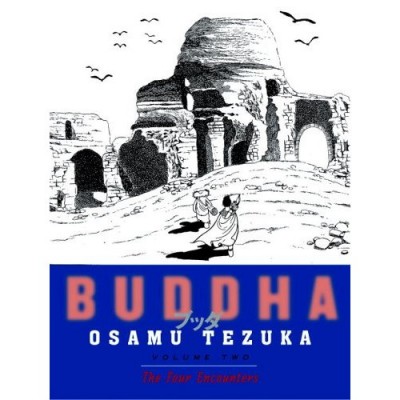
On the Coffee Table: The Four Encounters

Title: Buddha, Volume 2: The Four Encounters
Writer and Artist: Osamu Tezuka
via WorldLanguage.com
As I lay in bed last night with a charming new stomach bug, My Wife brought me a delightful gift: the second book in Tezuka's Buddha series (Volume 1 reviewed here).  I knew she'd ordered it but didn't realize it had arrived.  Being sick stinks but it is a reasonable excuse to stay in bed and read.

While Volume 1 primarily developed fictional side characters, Volume 2 is entirely devoted to the early life of Siddhartha, the man who would become Gautama Buddha.  Siddhartha, born into royalty, is a misfit from the beginning.  Perceived as weak, he shows neither interest nor aptitude for becoming a warrior.  From an early age, he demonstrates disdain for India's caste system and great sympathy for all humans and animals as well.  His curiosity about death leads him to ask questions and no one in his immediate sphere is able to provide satisfying answers. The Four Encounters follows his efforts to break away from the world of his parents in order to pursue a monastic life.

The strengths of the first volume all carry over for the second.  The artwork is stunning.  I'll admit, as a comic reader, I don't spend as much time on each individual frame as I probably should.  I'm a text guy.  But with Tezuka's work, it's impossible not to linger over a panel from time to time.  Landscapes are his greatest strength, not unlike Hayao Miyazaki, a film director who was greatly influenced by Tezuka. 

I'm looking forward to Volume 3.

Wednesday, March 5, 2014

Star Trek: Operation: Annihilate!

Episode: "Operation: Annihilate!"
Series: Star Trek: The Original Series
Season 1, Episode 29
Original Air Date: April 13, 1967
via Wikipedia
"Operation: Annihilate!" was the final episode of Star Trek's first season.  In this story, we get to meet part of Captain Kirk's family, though the reunion is a tragic one.  His brother Sam is a scientist on a planet in the path of a mass insanity which is sweeping its way through the galaxy, destroying civilizations as it goes.  The Enterprise crew arrives too late, Kirk's brother dead, his nephew unconscious and his sister-in-law in the throes of madness.  The rest of the planet is losing it, too, though the cause is not immediately apparent.  Eventually, predatory parasites are discovered to be the culprits and one of them infects Spock before the landing party is able to return to the ship.

I didn't care for the episode in the early going as everyone infected screams incoherently.  However, the story gets more interesting as solutions are explored.  First, Kirk must grapple with the possibility of having to destroy the planet and its million inhabitants just to keep the creatures from spreading further.  Then, when the parasites' vulnerability to intense light is discovered, Spock submits himself as a test subject with dire consequences.  He is left blind.

Immediately after the test on Spock, Nurse Chapel reveals that the creatures are only vulnerable to ultraviolet light - great news for the population on the planet but not so great for Spock who was blinded needlessly.  Spock takes it like a Vulcan, of course, but both Kirk and especially Dr. McCoy are racked with guilt.  Considered independently, the story might have been better if it had ended there.  But this is television and the series must go on, a blind Spock too much of a limitation for the screenwriters going forward.  Due to a peculiarity of Vulcan eyelid anatomy, Spock's condition is only temporary and his sight is restored.  Kirk and Bones are off the hook.

*****

Thoughts on Season 1

 General Impressions

I was very impressed by the first season of Star Trek.  A more casual fan of the series growing up, I thought of Trek as stilted and formulaic.  Exploring in-depth, I was more impressed by the acting than I expected to be, particularly that of William Shatner.  Yes, he can chew the scenery from time to time but his investment in character is total from Day 1, as if he had been Jim Kirk his whole life.  That's a lot harder than most people realize and contrasts with the stiffer performance of other cast members in the early going.

As to formula, I know that becomes more of an issue in the next two seasons but the writers did a respectable job of mixing things up in the initial run.  A lot of their story lines became franchise staples over the decades to follow.  All of those cliches had to start somewhere.


Favorite Episode: "Balance of Terror"

The episodes I enjoyed most in Season 1 were the ones in which Kirk engaged in mental sparring with a well-established adversary: Khan in "Space Seed" or Kor in "Errand of Mercy."  The Romulan Commander in "Balance of Terror" is unnamed.  He and Kirk bear no hatred toward one another - merely soldiers, playing their parts, seeing to their duties.  Mark Lenard's performance in the role is subtle, convincing and thoroughly chilling.  Other episodes have garnered more praise over the years but for me, this was the best of the batch.


Least Favorite Episode: "Mudd's Women"

Perhaps it is not fair to judge a story from the 1960s by the moral standards of the 2010s.  But for a television producer who made admirable efforts at social progressiveness, Gene Roddenberry dropped the ball with this one.  Harry Mudd is essentially a pimp who keeps his interstellar mail order brides beautiful with drugs.  When off the meds, they're not so much ugly as ordinary and all of the men are horrified.  This episode left me feeling icky.


Favorite Guest Star: Mark Lenard as Romulan Commander in "Balance of Terror"

See above.


Onward?

This would be a logical jumping off point if I were to discontinue my weekly Star Trek posts but I'm definitely up for more.  The months in between the two seasons were certainly interesting times in world culture.  In June of '67, The Beatles would release Sgt. Pepper's Lonely Hearts Club Band, an album that transformed the music industry.  The Summer of Love was soon to follow.  The audience had been through a lot by the time the series resumed in September.  I don't expect similar upheaval between now and next Wednesday, but you never know.

Set a course, Mr. Sulu...

Monday, March 3, 2014

On the Coffee Table: Buddha

Title: Buddha, Volume 1: Kapilavastu
Writer and Artist: Osamu Tezuka
via Jeffrey M Brackett
Once again, I must break my self-imposed rule of avoiding discussions of politics and religion on my blog.  Once again, it is the quality of the work in question that drives me to do so.  Osamu Tezuka's manga Buddha tells the story of the life of Gautama Buddha, the founder of Buddhism.  The series was first published in Japanese from 1972-83.  Vertical Publishing launched an English translation in eight collected volumes, beginning in 2003.

Tezuka is the biggest name in manga, credited by many as the artist who brought the form to the Japanese mainstream.  His most famous creation was Astro Boy, which ran from 1952-68.  Religious historical fiction would seem an unusual choice for the medium but Tezuka's stunning artwork and masterful storytelling make it work.

Kapilavastu is mostly about characters other than Buddha.  Siddharta is not even born until the latter half of Volume 1.  The two characters who drive the narrative in the beginning are Chapra, a boy from the slave caste who aspires to a better life, and Tatta, a thief from the very lowest pariah caste who does not.  Both are entirely fictional but help to establish the world of Ancient India and its social system. Also Tezuka-invented is the character Naradatta, a monk who is condemned for violating a newly emerging morality.  The stage is set for a new spiritualism.

The tone is often different from what one would expect given the subject matter.  At least in the early going, story is far more adventure tale than religious fable.  But even within that context, Tezuka injects humor at odd moments: cameos for himself and Astro Boy characters as Chapra lies dying in his bed, for instance.  Perhaps it is the writer's wink to the readers to let us know that Chapra won't die... yet.

The artwork is outstanding, particularly the landscapes.  The very first panel is a breathtaking view of the Himalayas.  With strong investment in character and a curiosity to see how the introduction of Buddha is developed, I can definitely see this series holding my long-term interest.

Sunday, March 2, 2014

On the Road: Montreal

This past week was school vacation for my daughter and me.  My Wife also took a few days off of work so that we could make our first family overnight trip to Montreal.  The city is less than two hours from our home in northwest Vermont but most of the time you'd never know it.  Despite the prevalence of French last names in our area, folks around here are more likely oriented toward Boston or New York even though both cities are further away.  Particularly with more frequent visits over the past few years, we've grown quite fond of Montreal.  Small town living is great but what it lacks is variety.  Montreal's got that in spades.

Each of us got to pick one activity for the trip.  My Wife's was dinner at Au Pied de Cochon on Wednesday night.  One of the city's most famous restaurants, Au Pied de Cochon specializes in the finest Quebecois cuisine.  Our reservation was for 6 o'clock, a good choice as it turned out as the place was quite crowded when we left two hours later. 

Our hand towels, before and after saturation.  Our waitress, noting our curiosity when they were first set on the table, warned, "Please don't eat them!":


The food is indeed fabulous.  All of our choices were excellent: the duck wing special, foie gras 'tout nu', beef tartare (a sentimental favorite for My Wife and me) and poached pear with vanilla ice cream for dessert.  Our Girl found a winner for herself, too: a tortellini special.  We skipped the restaurant's most famous dish: canard en conserve or "duck in a can."  The duck is cooked in an aluminum can, then opened and served at the table.  Apparently, it's fabulous but also expensive - next time.  I want to try the duck carpaccio, too.  Service was excellent.  The restaurant was certainly noisy but it hardly mattered as we were so busy eating.
via Pointe-à-Callière
My choice was "The Beatles in Montreal" exhibition at the Montreal Museum of Archaeology and History, celebrating the 50th anniversary of the band's only public concerts in town.  As written previously (here), the Beatles are an essential part of my own musical journey.  In addition to a few multi-media displays, there was plenty of memorabilia on offer.  The centerpiece was John Lennon's Rolls Royce, tricked out psychedelically. 
via Wikipedia
There were also plenty of old record covers, concert posters and such.  The instrument room was disappointing: all replicas.  One display was set up like a teenager's bedroom with loads of old junk: Beatles wigs, trading cards, figurines, etc.  I say junk but in pristine condition, each trinket was probably worth thousands.  There was also an amusing section on the French-language imitation bands of the era.

Overall, I found the exhibition underwhelming, though I'm not entirely certain what I was expecting.  It occurred to me afterward that part of my problem is that, as much as I love them, the Beatles' story always leaves me a little sad.  The band broke up before I was born so nostalgia is not the right word for what I feel.  As a kid, hoping that I might someday be as good at anything as the Beatles were, I couldn't understand why they would have wanted the dream to end.  In the last room was a looping film of the band's very last public performance, not in any huge stadium or grand concert hall but on the roof of their recording studio in downtown London.  The Let It Be recording sessions were the height of dysfunction in the band's history but they played one day on the roof just for the heck of it, to the delight of some and the annoyance of others going about their daily lives on the streets below.  My daughter and I sat for a while happy as clams watching the film - the best part of the exhibit.
via Tourism Montreal
Our Girl's choice was the Montreal en Lumiere festival at the Place des Arts downtown.  In addition to open air concerts and the like, there was some free stuff for families.  The ladies convinced me to overcome my fear of heights to join them on the Ferris wheel - TWICE!  The ice flume was fun, too.  Apart from the seriously bitter cold, the festival was most enjoyable.  Predictably, both my wife and daughter made better choices than I.

In my experience, the most annoying part of visiting any city is driving and, worst of all, parking.  So our plan for this trip was to find a hotel where we could leave the car for the entire visit, then explore the city via public transit.  The Auberge de la Fontaine suited our needs almost perfectly, though as My Wife pointed out, a spot closer to a subway station would have been nice.  I love city subways and Montreal's is excellent.  Negotiating the system in French was a little tricky at first but we got the hang of it quickly.  We'll have a better sense of what to do next time. 

Visiting in winter was humbling.  Montreal really isn't much further north from where we are but it sure felt a lot colder.  Even so, if you want to know a place, I believe visiting at different times of year is important.  The area where we stayed was not touristy at all - at least not in February - so most of the people we saw were just going about normal business, walking their kids home from school and such.  Staying in town for more than a few hours, I did start to develop a strong sense of otherness not knowing the language.  Montreal is genuinely bilingual so most people - and certainly those in the service industry - speak both French and English fluently.  Still, most start with French and only switch once they realize you're not understanding.  They're nice about it but I'd feel better if I could meet them halfway.  That said, I think Montreal would be a great place to learn French.  With most signs in both languages, one would build vocabulary in a hurry with minimal effort.

Even with the stresses of winter and city traffic, it was a fun trip.  I hope we'll do it again sometime soon.

Saturday, March 1, 2014

The Cephalopod Coffeehouse: March Blog List

Greetings to all!  I hope you'll join us for the next installment of the Cephalopod Coffeehouse, an online gathering of bloggers who love books.  The next meeting is set for Friday, March 28th.  If you're interested, please sign on to the link list at the end of this post.

The idea is simple: on the last Friday of each month, post about the best book you've finished over the past month while visiting other bloggers doing the same.  In this way, we'll all have the opportunity to share our thoughts with other enthusiastic readers.  Please join us: