Friday, March 21, 2014

On the Coffee Table: Rafael Nadal

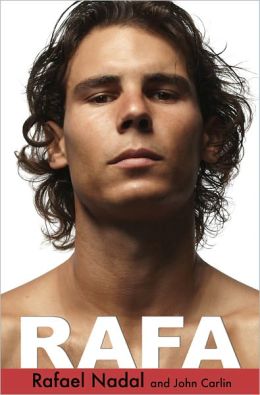
Title: Rafa
Authors: Rafael Nadal and John Carlin
via Barnes & Noble
If you are a sports fan, Rafael Nadal requires no introduction.  The world's current top-ranked tennis player is one of the most mesmerizing athletes you'll ever see.  He is a ferocious, irresistible warrior when the match is on and a humble, gracious gentleman the instant it's over.  Still only 27 years old, he is on a very short list of the greatest players of all time.  I would happily wax poetic about the man myself for paragraphs on end but for this post, I shall endeavor to stick to the book.

The book is written mostly in first person from Rafa's perspective but interspersed are sub-chapters in third person, usually about his home life in Mallorca.  Nadal, for all of his unfathomable wealth, fame and success, still lives with his parents in Manacor.  His family, especially his parents and his uncle/coach Toni, have worked hard to maintain a normal life for him when he is not on tour.  In Mallorca, he is nothing special - just a guy with a job that pays him handsomely.  His family and his neighbors never gush, by design.  The book asserts that without this solid rooting in the everyday, Rafa's extraordinary success - as both player and human being - would not be possible.

The story begins in medias res at the 2008 Wimbledon final with Roger Federer on the opposite side of the net, certainly the turning point of Nadal's career and arguably the most important tennis match of the current era.  From there, Rafa reflects back to earlier stages in his life, but always returns to the match at Wimbledon.  I have to admit that this structure was a bit disappointing since, in a sense, I have already read that book.  L. Jon Wertheim's excellent Strokes of Genius (review here) examines the match thoroughly with flashbacks for both combatants.  Of course, the perspective of a player is not that of a journalist so Nadal's thoughts are still valuable.  Still, I would have appreciated a different structure.  The second half of the book takes a similar approach to the 2010 US Open final against Novak Djokovic, a less interesting match but equally important to Rafa's career arc.

In the world of megastar athletes, one would be hard pressed to find one more admirable than Rafael Nadal.  The book only enhances his public persona.  That said, Rafa's not as much fun as Andre Agassi's Open (review here).  Agassi has lived a more colorful life but I'd say his book is also better written.  A non-tennis fan could still enjoy Open.  I'm not so sure about Rafa.  If you are lucky enough to be a tennis fan, it's a must read.

Wednesday, March 19, 2014

Star Trek: Who Mourns for Adonais?

Episode: "Who Mourns for Adonais?"
Series: Star Trek: The Original Series
Season 2, Episode 2
Original Air Date: September 22, 1967
via Memory Alpha
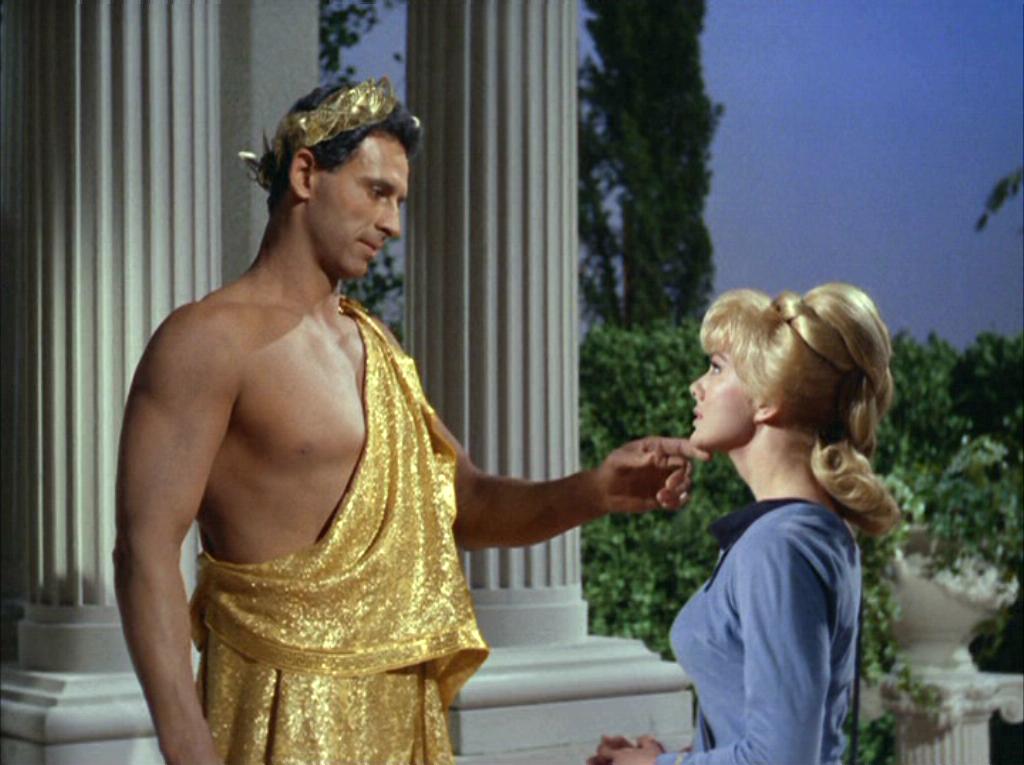
Another story on the road from Charlie X to Q, "Who Mourns for Adonais?" recounts the Enterprise's showdown with the actual Greek god Apollo.  The sun god, along with all of his Olympian colleagues, is revealed to be an extra-terrestrial being who so impressed ancient humans that they could only have been regarded as divine.  Apollo tries to recruit the crew to worship him but, apart from anthropologist/archaeologist Lt. Carolyn Palamas, they're not interested.

It's a good episode but there are some troubling spots.  At one point, Kirk argues that humans have progressed spiritually since ancient times and "one God" is good enough for them now.  Apparently, Hinduism has fallen out of favor by Trek's era.  Also, late in the story, Apollo roughs up Palamas a bit when she spurns his advances, then we're expected to feel sympathy for him at the very end.  Maybe he didn't really hurt her but he certainly meant to scare and intimidate her - a bit icky.

*****
via Wikipedia
Michael Forest (Apollo) certainly looks the part.  He was born Gerald Michael Charlebois, April 17, 1929 in Harvey, North Dakota.  Somewhat surprisingly, given his appearance as a younger man, Forest has built an impressive career mostly as a voice actor, especially for anime.  Most notably to this blogger, he performed "additional voices" in Miyazaki's The Castle of Cagliostro.

Sunday, March 16, 2014

On the Road: Smugglers' Notch

via Smugglers' Notch Vermont
My Wife's employer has a well-established relationship with Smugglers' Notch, one of the most popular ski resorts in northern Vermont.  As part of that relationship, Smuggs donates several vacation packages a year for the company to use for VIPs and the like.  Every once in a while, though, the company throws a few of the packages to their employees and we were among the lucky ones this time!

We have lived in Vermont for twelve years and have somehow managed to avoid the ski culture almost entirely.  As I have a fear of heights, downhill skiing has never held much appeal.  My feeling is that while mountains are pretty, they are best appreciated from a distance.  But there's no denying that skiing is a major source of tourist revenue here.  When one moves to Vermont from out of state, the locals reflexively make the assumption that skiing was the draw.  Why else, they wonder, would anyone willingly endure the long, brutal winters?  Smuggs is one of the more affordable ski areas in the area and the most popular with the locals as a result.  So I wasn't surprised to run into a few familiar faces over the weekend.

While we haven't done it much, I am open to the idea of cross-country skiing.  So, rather than jumping at the free lift tickets, we opted for a cross-country lesson as our outdoor activity for the weekend.  Our lesson was excellent, our instructor Kara knowledgeable, patient and encouraging.  Cross-country skiing is hard work, though.  While a significantly cheaper hobby than downhill, it's more taxing than snowshoeing which is near idiot-proof.  Going down even a modest incline in skis is still anxious for a wimp like me.  I recommend the instruction highly but long term, it's not a hobby I'm likely to pursue.  Of the three of us, Our Girl was easily the most confident.  She gets to ski in PE, the lucky kid

A ski resort is like a tiny, self-contained city.  In addition to the numerous lodging options, there's a central area with a general store, restaurants, outfitters, an indoor pool and so forth.  Our condo was a decent distance from the village center, which was fine by me.  In fact, my favorite part of the vacation was the free shuttle service.  I have found that, in general, my ideal holiday involves as little driving as possible and Smuggs was most accommodating.  We had plenty of space - probably more square footage than we have on the main floor of our house.  We could almost live there if not for the troubling lack of bookshelves.

The low-light of the experience was the resort's mid-range restaurant, the Morse Mountain Grille.  We went the first night with a big group and it was disastrous.  Our order took forever, even the drinks.  We all stared at an empty table for nearly an hour.  The numerous children with us, including our daughter, were amazingly patient but the adults got restless, then irritated, then angry.  The food itself, once it came, was fine.  But the piss-poor service ruined the meal.

The weekend was very nice, though I'm not sure there's much point in spending a weekend at a ski resort if one doesn't ski.  If we should be offered the opportunity again, I'd vote for bringing our snowshoes and exploring the numerous trails on offer.  It was fun to observe the skiers bustling about, an entire subculture that runs parallel to our everyday experience living nearby.  Other resorts - namely Stowe - cater to the international crowd but I saw license plates from as far away as Ontario and Maryland.  It's certainly tough to complain about a vacation when someone else is paying!

On the Coffee Table: Osamu Tezuka

Titles: Buddha
- Volume 3: Devadatta
- Volume 4: The Forest of Uruvela
- Volume 5: Deer Park
Writer and Artist: Osamu Tezuka

My reviews for the first two volumes of this series can be found here and here.
via WorldLanguage.com
We had a rare couple of snow days this past week which afforded me time to make further progress in Buddha, Osamu Tezuka's excellent manga series.  Volume 2 ended with Siddharta leaving home to begin his spiritual journey.  The next three books cover the various paths he pursued - gurus he sought who failed to meet his needs, painful ordeals he endured which left him unfulfilled and ultimately embittered.  Finally, he attains enlightenment one day while sitting under a tree.  Brahma, whom he meets him in his dreams, renames him Buddha and a world religion is born.
via Atomic Books
Unlike most comic book series which tend to start strong, then drop off in quality, I'm finding Buddha gets better as it goes along.  In Volume 5, especially, the basic ideas of the new philosophy are thoroughly explored, often in sermons given to deer, the only beings around to listen.  I read the story of Buddha in a Major Eastern Religions class in college and was less than enthralled.  If these comics had been around at the time, my experience with the subject might have been quite different.  There is occasional levity in Tezuka's presentation but overall, the religious ideas are treated thoughtfully and respectfully.  I'm definitely up for more.
via WorldLanguage.com

Wednesday, March 12, 2014

Star Trek: Amok Time

Episode: "Amok Time"
Series: Star Trek: The Original Series
Season 2, Episode 1
Original Air Date: September 15, 1967
via Memory Alpha
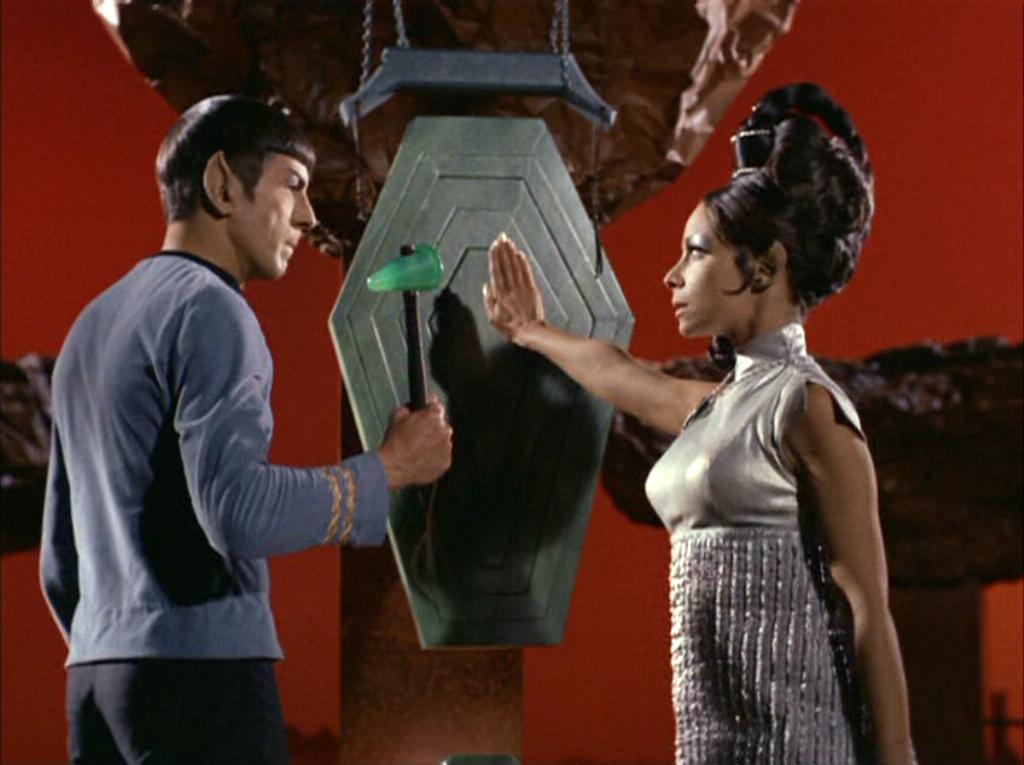
For its second season, Star Trek was moved to a new time slot: 8:30 ET on Friday nights.   "Amok Time" is a significant episode for many reasons.  Most importantly, the regular cast got its final member with Walter Koenig playing the role of navigator Pavel Chekov.  Also, it is the only original series episode to offer a glimpse of Spock's home world, Vulcan.  The story introduced both the Vulcan hand salute and the "live long and prosper" blessing.

Compelled by biological urges, Spock must return to Vulcan for his marriage to a bride arranged for him as a child, T'Pring.  T'Pring demands that he win her in a challenge.  Surprisingly, she picks Kirk as the opponent.  Kirk agrees, figuring he can throw the match, only to discover that it is a fight to the death.  With Dr. McCoy's help, he is able to fake his own death well enough to fool even Spock.  A grieving Spock frees T'Pring to be with the mate she truly loves and returns to the ship prepared to face the consequences of his actions.  The surprising appearance of Kirk alive and well inspires a rare joyful display from our favorite Vulcan.

*****

via Wikipedia
Walter Koenig was born on September 14, 1936 in Chicago.  Clearly a very smart man, he attended Grinnell College in Iowa.  Apparently, the draw of southern California was too strong as he transferred to UCLA where he discovered acting.  He was cast in the role of Chekov largely for his resemblance to Davy Jones of the Monkees. 
Davy via 30 Days Out
Not originally intended as a regular cast role, Chekov grew in popularity while George Takei (Sulu) was busy finishing The Green Berets with John Wayne.  When Takei returned, tensions arose, Takei even threatening to leave the show.  Fortunately for all involved, peace was made and the two actors became good friends.

*****

via Memory Alpha
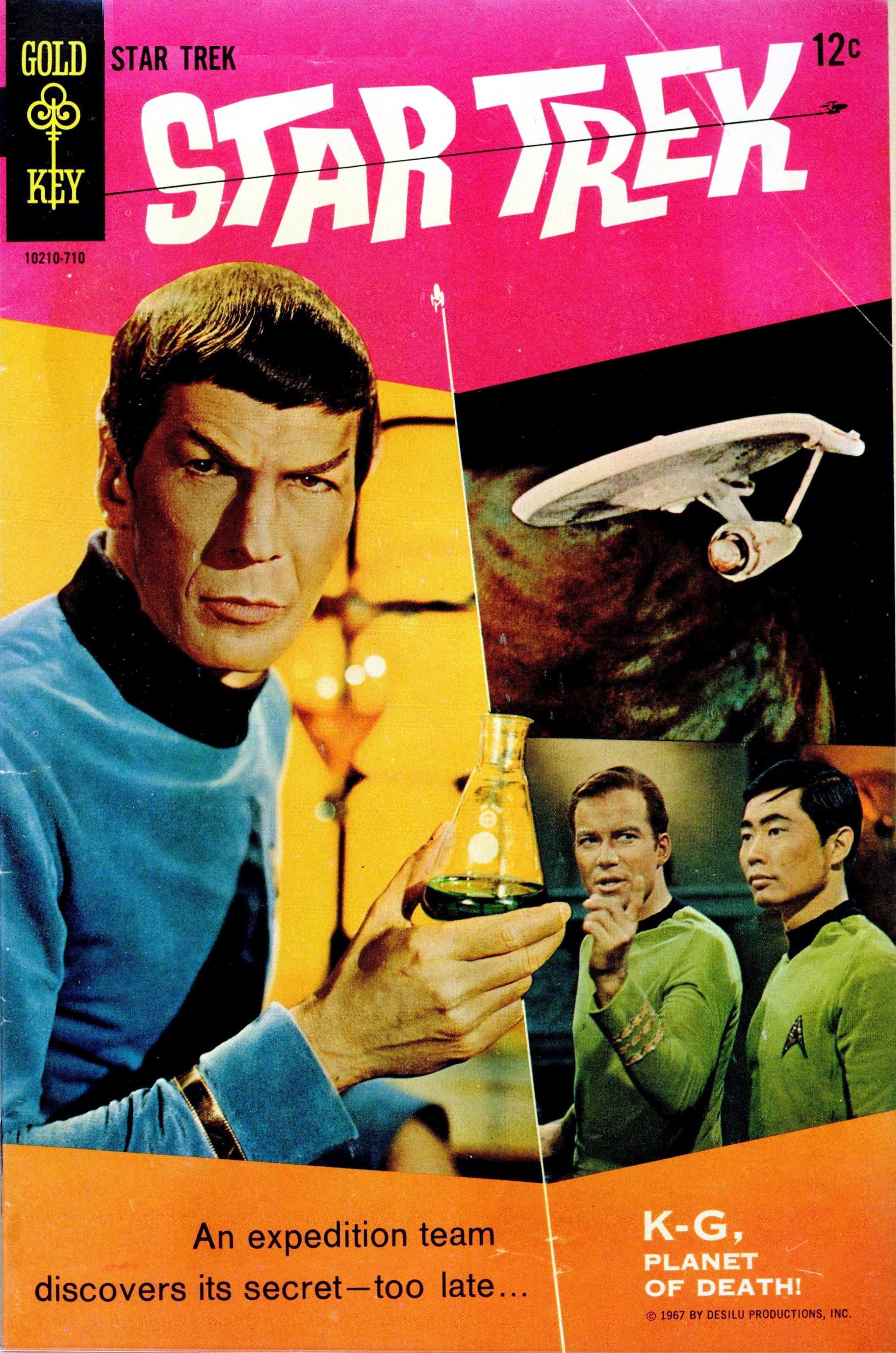
Over the summer of 1967, Key Comics published the very first Star Trek comic book, entitled "The Planet of No Return."  Unfortunately, the writer credit for this issue is long lost but the artist was Nevio Zeccara.  The Enterprise discovers a planet where the plant life holds dominion over the animals.

There were many advantages in telling a science fiction story in comic book form rather than television in the 1960s - no need for special effects.  If you could draw it, it could happen.  People turning into trees?  No problem.  However, it is abundantly clear that neither writer nor artist was especially familiar with the source material apart from character names and basic appearances.  For instance, the crew are exploring "Galaxy Alpha" rather than our own.  Transporting is referred to as "teleportation" - probably a more accurate description but that's beside the point.

More important than the nomenclature though was the very different character of the mission's approach to exploration.  In the comic book, the crew take a more Flash Gordonesque attitude toward encounters with alien beings: "They are different and they must be trying to kill us.  We must kill them first."  Most disturbing is the Captain's decision to destroy the planet in order to prevent its plant spores from infecting worlds.  That wouldn't jive with the Prime Directive at all.

It is interesting to note, though, that the Captain faced a very similar prospect in the last episode of the first season.  A parasite was destroying one world after another and the opportunity came to stop it in its tracks, but at the cost of the lives of millions.  It was not a happy choice but it was considered.  The comic book Captain, on the other hand, barely flinched in the decision.

Sunday, March 9, 2014

Family Movie Night: Spirited Away

Title: Spirited Away
Director: Hayao Miyazaki
Original Release: 2001
Choice: Our Girl's
My Overall Rating: 4 stars out of 5
via Spirited Away Wiki
Few movies in history have achieved the commercial and critical success of Miyazaki's Spirited Away.  It is the highest grossing Japanese film of all-time and added plenty of hardware to Studio Ghibli's trophy case.  In addition to winning best animated feature at the Academy Awards and best film at the Japanese Academy Awards, Spirited Away was a juggernaut at the international film festivals.  When the British Film Institute compiled its list of 50 films you should see by the age of 14, Spirited Away received the most votes of any movie.


Even by Miyazaki standards, Spirited Away is weird and wild an wonderful.  Chihiro is a sullen 10-year-old girl moving to a new town.  On the drive to the new house, the family detours and enters the spirit world.  Her parents are turned into pigs so she is left to figure things out for herself.  She makes her way to an extraordinary bath house and gets a job until a solution to her predicament can be found.
via Spirited Away Wiki
Artwork is dazzling, of course, but the real fun is in all of the extraordinary spirits who inhabit the bath house.  Characters slide back and forth quite freely on the moral spectrum but Chihiro finds a few friends in the mix.  Miyazaki managed to build quite an amazing world on a very small scale.

The film's score was composed by Joe Hisaishi, long-time Miyazaki collaborator.  Not long after we watched the movie the first time a few years ago, Our Girl hatched the idea of composing her own music for the story.  Mind you, she didn't know a thing about writing music or even playing an instrument at the time but I found the inspiration fascinating.  I haven't heard much about that particular ambition in a while.

On the Coffee Table: Jeffrey Brown

Title: Vader's Little Princess
Writer and Artist: Jeffrey Brown
via Amazon
Okay, everybody get your geek hats on, propeller beanies recommended.

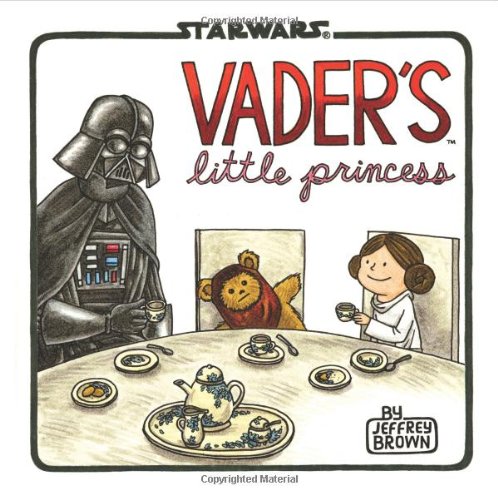
First, let's make very clear that Vader's Little Princess is a non-canon, satirical work.  We all know Darth Vader didn't really raise his children.  So, don't get your Underoos all bunched up, 'kay?  This is supposed to be fun!

Alright, now that's out of the way...  Vader's Little Princess is a graphic novel parody of what a father-daughter relationship might have been like between Darth Vader and Princess Leia.  Actually, calling it a novel is a stretch.  It's more a collection of comic strips.  Leia embarrasses Vader as he's dressing down an admiral who has failed him for the last time.  He disapproves of Han Solo as a boyfriend and the golden bikini as a socially acceptable outfit.  He gives her a TIE Fighter for her birthday.  She makes him a helmet cozy.

And so on.
via Amazon
The book is fun, a decent five-minute read.  I see T-shirts and coffee mugs in the licensing future, if they haven't happened already.  I'm not inspired to run to the book store to read Brown's other Star Wars parodies, Darth Vader and Son and Jedi Academy.  But if they come my way, I'll read them.