Greetings to all! I hope you'll join us for the next installment of
the Cephalopod Coffeehouse, an online gathering of bloggers who love
books. The next meeting is set for Friday, March 27th. If you're
interested, please sign on to the link list at the end of this post.
The
idea is simple: on the last Friday of each month, post about the best
book you've finished over the past month while visiting other bloggers
doing the same. In this way, we'll all have the opportunity to share
our thoughts with other enthusiastic readers. Please join us:
"If more of us valued food and cheer and song over hoarded gold, it would be a merrier world." - J.R.R. Tolkien
Saturday, February 28, 2015
Friday, February 27, 2015
The Cephalopod Coffeehouse: February 2015
Welcome one and all to the Cephalopod Coffeehouse, a cozy gathering of
book lovers, meeting to discuss their thoughts regarding the tomes they
enjoyed most over the previous month. Pull up a chair, order your
cappuccino and join in the fun. If you wish to add your own review to
the conversation, please sign on to the link list at the end of my post.
Title: Aya
Writer: Marguerite Abouet
Artist: Clément Oubrerie
Aya is the first in a series of graphic novels about the writer's experiences growing up in Ivory Coast in the 1970s. The '70s were a time of relative stability and optimism in West Africa, after independence but before the destructive horrors of civil war. So, Aya doesn't dwell on the topics we've come to expect from African literature like war, famine and disease. Instead, it offers a slice of life from a part of the world most of the rest of us know nothing about.
The titular character is a teenage girl, a bit older than the author herself would have been at the time. She is sweet, responsible and ambitious but her friends just want to go out dancing with boys. The main story of this first edition centers on one friend, Adjoua, who finds herself pregnant. But who is the father? In fact, the basic plot isn't specific to Africa at all - could just as easily take place in an American or European city.
Since the age of twelve, the author has lived in France, where the book was first published. The illustrator is her husband, Clément Oubrerie. The series - six volumes in all, four translated to English so far - has been very successful in France, even spawning an animated film. I'm definitely interested in reading more.
Please join us and share your own review of your best read from the past month. This month's link list is below. I'll keep it open until the end of the day. I'll post March's tomorrow. Meetings are the last Friday of each month. Next gathering is March 27th.
Title: Aya
Writer: Marguerite Abouet
Artist: Clément Oubrerie
![]() |
| via Amazon |
The titular character is a teenage girl, a bit older than the author herself would have been at the time. She is sweet, responsible and ambitious but her friends just want to go out dancing with boys. The main story of this first edition centers on one friend, Adjoua, who finds herself pregnant. But who is the father? In fact, the basic plot isn't specific to Africa at all - could just as easily take place in an American or European city.
Since the age of twelve, the author has lived in France, where the book was first published. The illustrator is her husband, Clément Oubrerie. The series - six volumes in all, four translated to English so far - has been very successful in France, even spawning an animated film. I'm definitely interested in reading more.
Please join us and share your own review of your best read from the past month. This month's link list is below. I'll keep it open until the end of the day. I'll post March's tomorrow. Meetings are the last Friday of each month. Next gathering is March 27th.
Labels:
Aya,
Book Club,
comics,
good reading,
graphic novels
Wednesday, February 25, 2015
What Is Star Trek?
![]() |
| via Memory Alpha |
How did this happen? What is it about this one science fiction program that inspired such a legacy? To be sure, the quality of stories was strong in the beginning, the characters appealing. World building was excellent, though that could be said for any number of other shows on TV in the late 1960s. High tech sci-fi was fun but not exactly unprecedented. No, there was something more to it. Over time, as I got to know the characters better and understand the relationships between them, I believe I figured it out. Or at least I found what makes Trek work for me, which seems as good a place to start as any.
Trekkies traditionally fall into two camps: those who prefer the original series (TOS) and those who prefer The Next Generation (TNG) and its successors. I went into this adventure with a strong TNG bias. I knew the later show better and preferred, among other things, its stronger character development, long one of the main arguments from the TNG wing. Most of TOS focuses on three characters: James Kirk, Captain; Spock, First Officer, and Leonard McCoy, Chief Medical Officer. Back stories on even those three are scant in comparison to the rich personal histories granted TNG's Enterprise crew. 79 episodes later, I still feel the argument falls in TNG's favor. But the argument misses the point.
The original Star Trek is ultimately driven not by the individual characteristics of the three leading men but by the dynamics of the relationship between them. Any casual fan could tell you that Spock is the constant, reliable voice of Logic. It doesn't take long, then, to recognize the temperamental McCoy as an advocate for Emotion. In weighing the input of his two advisers, Kirk must exercise Judgment. Sometimes, he decides in favor of Spock, other times McCoy, but usually somewhere in between. The consideration is the important thing as the three lead their faithful crew in exploring the unknown.
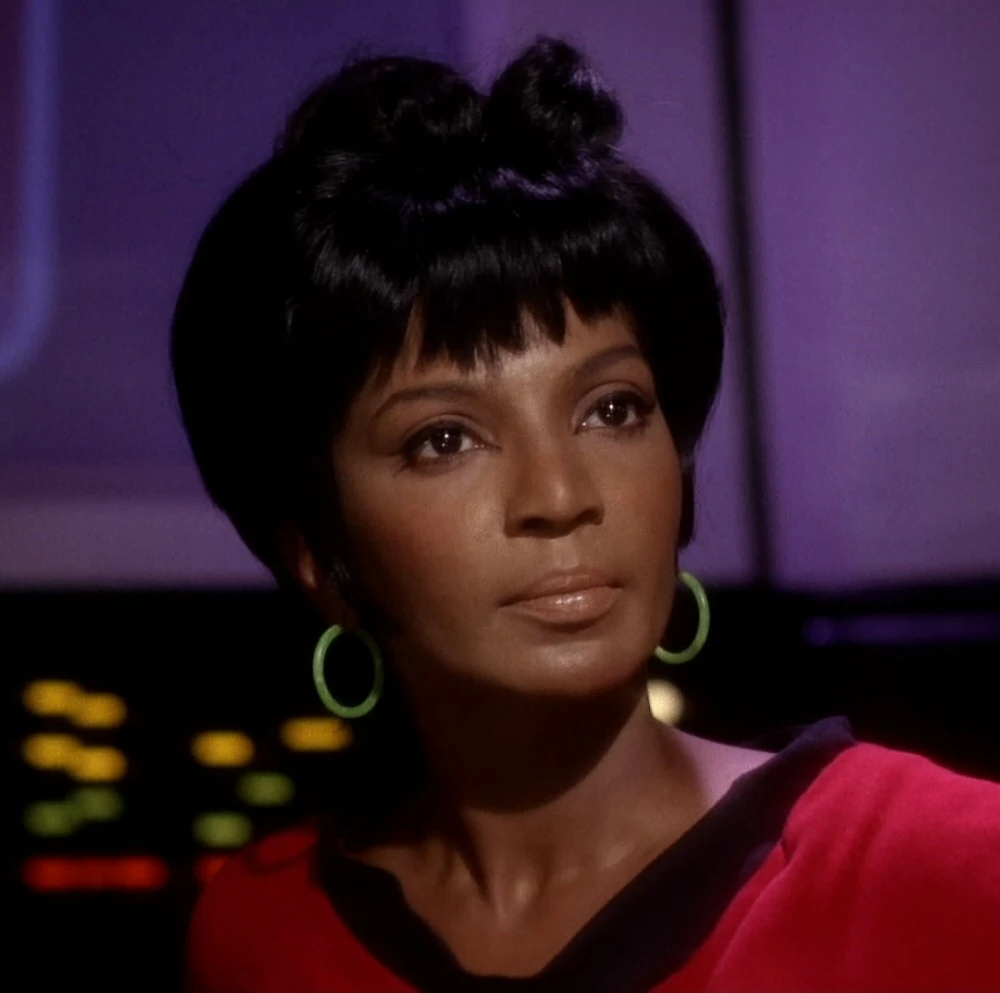
But to what end? This id-ego-superego arrangement was all very clever but not enough to explain small children wearing Vulcan ears at ComicCon nearly half a century later. A quick glance around the Enterprise bridge set offers other clues. Over the captain's right shoulder sits Lt. Uhura, Chief Communications Officer, an African character played by an African American woman. In the foreground are Lt. Sulu, Helmsman, and Ensign Chekov, Navigator. Sulu is played by a Japanese American who had spent part of his childhood in internment camps. Chekov is portrayed as Russian. Those choices were not accidental.
Star Trek, like any creative expression, was a product of its own time and place. Casting an African American woman in a position of authority for the first time in American television history was no subtle gesture during the ongoing Civil Rights Movement of the mid-to-late '60s. Nor was creating a sympathetic Asian character at a time when the nation had been at war in East Asia for much of the previous quarter century. Nor was establishing a likeable Russian character during the darkest depths of the Cold War. And let's not forget, there was that guy with the pointy ears, too. In 1966, many Americans were marching, others burning draft cards, others forming a new counterculture - all in protest of government policies. Gene Roddenberry, a former military pilot and policeman who had seen plenty of the world's evils first hand, didn't do any of those things. Instead, he created a television show.
Roddenberry sold Star Trek as "a Wagon Train to the stars." But his vision for the project obviously ran a lot deeper. The strongest forces in American science fiction to that point had been Flash Gordon and B-movie horrors. In both idioms, the approach to alien life forms was get them before they get us. Along with the bright colors, the cool gadgets and all the other bells and whistles, Star Trek brought a new approach to confronting "the other." Those folks working together on the bridge of the Enterprise were a sign of a more enlightened time in Earth's history. Having learned to get along better with one another, humanity was worthy of engaging with alien species. Encounters with unfamiliar beings would not be driven by conquest, exploitation or conversion. We would learn from the new, not destroy it.
The early converts were few but devoted. For the broader populace, the idea required simmering. Two decades later, when new stories found their way to television, the names had changed but the basic philosophy remained. In the end, it hardly matters if one prefers Kirk or Picard. Star Trek is no one character or even cast of characters. Trek is an approach to the unknown, weighing Logical and Emotional considerations with thoughtful Judgment. Trek is hope for a better world. That's why we still care 50 years later.
*****
It's time to hand out the hardware...
Favorite Episode: "Journey to Babel"
Sarek and Amanda, Spock's parents, are aboard the Enterprise en route to a diplomatic conference. Sarek suffers a "cardiovascular malfunction." Only a transfusion of Spock's blood can save him and the son readily submits to an experimental procedure to save the life of the father. Duty to the Enterprise, however, interferes with the treatment and Spock must choose between his loyalties to family and Starfleet. Sarek and Spock both know logic dictates that the mission should come first but Amanda, Spock's human mother, disagrees. She confronts her son in private. When Spock stands his ground, she slaps him and storms out of the room. We never see Spock's face after the slap. He moves towards the closed door and rests a hand on it. That simple gesture tells us everything we need to know about Spock. No contest: Trek's finest moment.
Least Favorite Episode: "The Way to Eden"
The Enterprise picks up a band of hippy types in search of their own utopia. They sing truly awful songs. There are probably weaker stories in Star Trek but none made me cringe quite like those songs.
Favorite Character, First Tier: Spock
![]() |
| via Memory Alpha |
Favorite Character, Second Tier: Uhura
![]() |
| via Memory Beta |
Uhura is more than just a political statement. Of Trek's second tier of characters, she is the most nuanced. On the bridge, she projects a confident, yet gentle demeanor. In the officer's lounge, she sings to her crew mates. Nichols herself has admitted that her favorite stories are the ones in which she wears civilian clothes and projects a more sensual femininity.
Favorite Guest Star: Mark Lenard
![]() |
| via Memory Alpha |
10 Must-See Episodes
If ever a friend or loved one should ask me for a quick tour of Star Trek's originals, I would offer the following collection, in order of original air date:
"The Corbomite Maneuver" - The first, clear glimpse of Star Trek's moral compass.
"Balance of Terror" - Our introduction to the Romulans, this was my favorite first season episode. The exchanges between Kirk and the Romulan Commander are exquisite.
"Space Seed" - We meet Khan, one of Star Trek's most important recurring characters. Again, the highlight is the verbal sparring between Kirk and a powerful nemesis.
"Errand of Mercy" - Our introduction to the Klingons. The Federation and the Klingon Empire vie for control of the planet, Organia. The natives are peaceful and seemingly helpless. In a wonderful turn, the Organians turn out to be quite powerful indeed and send both of the other parties away with a good scolding. Our heroes aren't morally irreproachable after all.
"City on the Edge of Forever" - The most revered episode of the original run, I can't say it's my favorite. It's a time travel narrative and Star Trek doesn't usually do well with those, in my opinion. But the overall quality is undeniable and I would not be a good guide if I did not include it in my tour.
"Amok Time" - We get to visit the planet Vulcan. Enough said.
"Mirror, Mirror" - Through a transporter malfunction, Kirk, McCoy, Scotty and Uhura find themselves in a parallel universe where the Enterprise functions within entirely different moral parameters. The cultural meme of evil twins with goatees derives directly from this episode.
"The Journey to Babel" - My favorite of the whole bunch. See above.
"The Trouble with Tribbles" - A much mocked episode by the uninitiated, the tribbles tale is actually quite clever, a highly effective demonstration of narrative misdirection. It was nominated for three Emmys and a Hugo.
"The Enterprise Incident" - One third season episode made it on the list after all. Kirk and Spock infiltrate a Romulan ship in order to steal its cloaking device. We learn a lot about the Romulans in this story, mostly through the ship's commander, one of Star Trek's best female characters.
*****
The fun continues next week. Beginning Wednesday, March 4th, fellow blogger Maurice Mitchell and I will be exploring Star Trek: The Animated Series one episode at a time. You're welcome to join us! Details are here.
Labels:
comics,
family adventures,
film,
good reading,
sources,
star trek,
TV
Monday, February 23, 2015
On the Coffee Table: Victims of a Map
Title: Victims of a Map: A Bilingual Anthology of Arabic Poetry
Authors: Adonis, Mahmud Darwish, Samih al-Qasim
Poetry is an ancient and revered art form in the Arab world. Verse consistently outsells prose many times over. Adonis, Darwish and al-Qasim are three of the most prominent modern practitioners. Darwish and al-Qasim, both now deceased, were Palestinian. Adonis is Syrian. The lives, careers and poetry of all three were shaped profoundly by the political turmoil of the region, thus this collection's wonderful title: Victims of a Map. The book contains 45 poems in all, 15 from each writer. Each is printed in both Arabic and English, some for the first time in either language.
I don't know if I'm a poetry person. I enjoy it. I admire it. But I don't know if I'll ever be one to happily curl up with a book of verse for hours on end. I've tried: Byron, Shakespeare, Frost, haiku, etc. It's lovely a little bit at a time, like a literary snack. But as an entree? I just don't think it's me.
The work here is enjoyable, and certainly quick. Few of the poems are long. "How I Became an Article" by al-Qasim is only two lines:
They killed me once
Then wore my face many times
The longest piece is Adonis's "The Desert (The Diary of Beirut Under Siege, 1982)" with 35 stanzas.
The imagery of the poems is beautiful and disturbing. I'm sure I'm missing a great deal without being able to experience the text in the original language but so it goes. Of the three, I enjoyed al-Qasim's style the best: short, economic and potent.
Authors: Adonis, Mahmud Darwish, Samih al-Qasim
![]() |
| via Amazon |
I don't know if I'm a poetry person. I enjoy it. I admire it. But I don't know if I'll ever be one to happily curl up with a book of verse for hours on end. I've tried: Byron, Shakespeare, Frost, haiku, etc. It's lovely a little bit at a time, like a literary snack. But as an entree? I just don't think it's me.
The work here is enjoyable, and certainly quick. Few of the poems are long. "How I Became an Article" by al-Qasim is only two lines:
They killed me once
Then wore my face many times
The longest piece is Adonis's "The Desert (The Diary of Beirut Under Siege, 1982)" with 35 stanzas.
The imagery of the poems is beautiful and disturbing. I'm sure I'm missing a great deal without being able to experience the text in the original language but so it goes. Of the three, I enjoyed al-Qasim's style the best: short, economic and potent.
Sunday, February 22, 2015
My Oscar Predictions
Happy Oscar Night to all! The following are my predictions for the award winners, everything but the shorts. Please note, these are the movies I think will win, not the ones I believe should. I haven't seen enough of them to be a worthy judge of that. Over the course of the evening, I will shade the ones I get right in red and the ones I get wrong in blue, with the actual winners indicated. Here we go:
BEST PICTURE: Boyhood
Winner: Birdman
BEST DIRECTING: Richard Linklater, Boyhood
Winner: Alejandro Iñárritu, Birdman
BEST ACTOR: Eddie Redmayne, The Theory of Everything
BEST ACTRESS: Julianne Moore, Still Alice
BEST SUPPORTING ACTOR: J.K. Simmons, Whiplash
BEST SUPPORTING ACTRESS: Patricia Arquette, Boyhood
BEST ORIGINAL SCREENPLAY: Birdman
BEST ADAPTED SCREENPLAY: The Theory of Everything
Winner: The Imitation Game
BEST ANIMATED FEATURE FILM: How to Train Your Dragon 2
Winner: Big Hero 6
BEST FOREIGN LANGUAGE FILM: Leviathan
Winner: Ida
BEST DOCUMENTARY - FEATURE: Citizenfour
BEST ORIGINAL SCORE: The Grand Budapest Hotel
BEST ORIGINAL SONG: "Glory," Selma
BEST SOUND EDITING: Birdman
Winner: American Sniper
BEST SOUND MIXING: Whiplash
BEST PRODUCTION DESIGN: The Grand Budapest Hotel
BEST CINEMATOGRAPHY: Birdman
BEST MAKEUP AND HAIRSTYLING: The Grand Budapest Hotel
BEST COSTUME DESIGN: The Grand Budapest Hotel
BEST FILM EDITING: Whiplash
BEST VISUAL EFFECTS: Interstellar
Labels:
family adventures,
film,
movie music,
music
Saturday, February 21, 2015
On the Coffee Table: The Summer Game
Title: The Summer Game
Author: Roger Angell
Since the last time I posted about Roger Angell (here), he has been awarded the J.G. Taylor Spink Award, the highest honor given by the Baseball Writer's Association of America. The National Baseball Hall of Fame has a permanent exhibit dedicated to the award and its recipients. The Summer Game is a collection of some of his earliest New Yorker columns on baseball, encompassing the seasons from 1962 through 1971, a period of great transition in the national pastime. I had read a few of the chapters before but there was plenty of new material, too.
As I have written of Angell before, his season synopses can be tedious - not unlike the endless "begats" in Genesis. There's only so much I can bring myself to care about the intricacies of a mid-season game in August 1967, for instance. Even so, the author's playful, elegant language catches the eye from time to time: likening a pitcher facing the heart of the opponent's lineup to opening a box of cobras.
Angell's most engaging pieces come when he takes a step back from the game, exploring the implications of moving and expanding leagues, the rise of television, the wonders of AstroTurf and domed stadiums, the encroachment of professional football and so on. Angell writes wonderfully about the stars of the day. A few, like Denny McLain and Vida Blue, never quite lived up to early projections. Others, like Willie Mays and Roberto Clemente, reside comfortably in the game's pantheon. He describes Clemente "playing a kind of baseball that none of us had ever seen before - throwing and running and hitting at something close to the level of absolute perfection, playing to win but also playing the game almost as if it were a form of punishment for everyone else on the field."
For me, much of the fun of this particular collection derives from the fact that the time period includes the glory years of my own favorite team, the Baltimore Orioles. From 1966-71, the Orioles won the American League pennant four times and the World Series twice. They won more than 100 games in three consecutive seasons (1969-71) and also swept the American League championship series in each of those years. The 1970 team is generally considered to be one of the best in baseball history. In 1971, they had four 20-game winning pitchers. In short, Baltimore was the premier franchise in baseball and, even more importantly, a place where players were happy playing.
I don't know if a non-fan would get much out of Angell's work but for anyone who already loves baseball, it's a must-read. This edition is top-heavy with season synopses but it's still plenty good.
Author: Roger Angell
![]() |
| via goodreads |
As I have written of Angell before, his season synopses can be tedious - not unlike the endless "begats" in Genesis. There's only so much I can bring myself to care about the intricacies of a mid-season game in August 1967, for instance. Even so, the author's playful, elegant language catches the eye from time to time: likening a pitcher facing the heart of the opponent's lineup to opening a box of cobras.
Angell's most engaging pieces come when he takes a step back from the game, exploring the implications of moving and expanding leagues, the rise of television, the wonders of AstroTurf and domed stadiums, the encroachment of professional football and so on. Angell writes wonderfully about the stars of the day. A few, like Denny McLain and Vida Blue, never quite lived up to early projections. Others, like Willie Mays and Roberto Clemente, reside comfortably in the game's pantheon. He describes Clemente "playing a kind of baseball that none of us had ever seen before - throwing and running and hitting at something close to the level of absolute perfection, playing to win but also playing the game almost as if it were a form of punishment for everyone else on the field."
For me, much of the fun of this particular collection derives from the fact that the time period includes the glory years of my own favorite team, the Baltimore Orioles. From 1966-71, the Orioles won the American League pennant four times and the World Series twice. They won more than 100 games in three consecutive seasons (1969-71) and also swept the American League championship series in each of those years. The 1970 team is generally considered to be one of the best in baseball history. In 1971, they had four 20-game winning pitchers. In short, Baltimore was the premier franchise in baseball and, even more importantly, a place where players were happy playing.
I don't know if a non-fan would get much out of Angell's work but for anyone who already loves baseball, it's a must-read. This edition is top-heavy with season synopses but it's still plenty good.
A New Project: Star Trek TAS
So, a change of plans...
Initially, I was planning to take a break from Star Trek after completing my goal of watching and blogging about all 79 original series episodes. But when fellow blogger Maurice Mitchell said he would be interested in watching The Animated Series along with me, I jumped at the chance. We'll be blogging every Wednesday, beginning with the first episode, "Beyond the Farthest Star," on March 4th.
We invite others to join us, too! The following is our link list for the project. Unlike with the Cephalopod Coffeehouse or Mock Squid Soup where I post a fresh list each month, I'll maintain a single, perpetual list for this. I realize not everyone will be up for watching the entire series but if folks are inclined to pop in from time to time, I'm happy to add and remove links as appropriate - no hard feelings.
| via Wikipedia |
We invite others to join us, too! The following is our link list for the project. Unlike with the Cephalopod Coffeehouse or Mock Squid Soup where I post a fresh list each month, I'll maintain a single, perpetual list for this. I realize not everyone will be up for watching the entire series but if folks are inclined to pop in from time to time, I'm happy to add and remove links as appropriate - no hard feelings.
Labels:
comics,
good reading,
sources,
star trek,
TAS project,
TV
Subscribe to:
Posts (Atom)