Over the past two years, I have watched every single episode of
Star Trek's original series, most of them for the first time in my life. I began my journey with a question: how did this show, one that struggled to stay on the air, manage to become one of the dominant forces in worldwide science fiction?
Star Trek was even lucky to be syndicated, having only completed three seasons in an era when most shows weren't considered without at least four. But those three seasons eventually begat another 27 over five spinoff series plus twelve feature films, the most recent pulling in $467 million at the box office. A 13th movie is already in the works for release in 2016, the 50th anniversary year of the franchise. Take that,
Bonanza!
How did this happen? What is it about this one science fiction program that inspired such a legacy? To be sure, the quality of stories was strong in the beginning, the characters appealing. World building was excellent, though that could be said for any number of other shows on TV in the late 1960s. High tech sci-fi was fun but not exactly unprecedented. No, there was something more to it. Over time, as I got to know the characters better and understand the relationships between them, I believe I figured it out. Or at least I found what makes
Trek work for me, which seems as good a place to start as any.
Trekkies traditionally fall into two camps: those who prefer the original series (TOS) and those who prefer
The Next Generation (TNG) and its successors. I went into this adventure with a strong TNG bias. I knew the later show better and preferred, among other things, its stronger character development, long one of the main arguments from the TNG wing. Most of TOS focuses on three characters: James Kirk, Captain; Spock, First Officer, and Leonard McCoy, Chief Medical Officer. Back stories on even those three are scant in comparison to the rich personal histories granted TNG's Enterprise crew. 79 episodes later, I still feel the argument falls in TNG's favor. But the argument misses the point.
The original
Star Trek is ultimately driven not by the individual characteristics of the three leading men but by the dynamics of the relationship between them. Any casual fan could tell you that Spock is the constant, reliable voice of Logic. It doesn't take long, then, to recognize the temperamental McCoy as an advocate for Emotion. In weighing the input of his two advisers, Kirk must exercise Judgment. Sometimes, he decides in favor of Spock, other times McCoy, but usually somewhere in between. The consideration is the important thing as the three lead their faithful crew in exploring the unknown.
But to what end? This id-ego-superego arrangement was all very clever but not enough to explain small children wearing Vulcan ears at ComicCon nearly half a century later. A quick glance around the Enterprise bridge set offers other clues. Over the captain's right shoulder sits Lt. Uhura, Chief Communications Officer, an African character played by an African American woman. In the foreground are Lt. Sulu, Helmsman, and Ensign Chekov, Navigator. Sulu is played by a Japanese American who had spent part of his childhood in internment camps. Chekov is portrayed as Russian. Those choices were not accidental.
Star Trek, like any creative expression, was a product of its own time and place. Casting an African American woman in a position of authority for the first time in American television history was no subtle gesture during the ongoing Civil Rights Movement of the mid-to-late '60s. Nor was creating a sympathetic Asian character at a time when the nation had been at war in East Asia for much of the previous quarter century. Nor was establishing a likeable Russian character during the darkest depths of the Cold War. And let's not forget, there was that guy with the pointy ears, too. In 1966, many Americans were marching, others burning draft cards, others forming a new counterculture - all in protest of government policies. Gene Roddenberry, a former military pilot and policeman who had seen plenty of the world's evils first hand, didn't do any of those things. Instead, he created a television show.
Roddenberry sold
Star Trek as "a
Wagon Train to the stars." But his vision for the project obviously ran a lot deeper. The strongest forces in American science fiction to that point had been Flash Gordon and B-movie horrors. In both idioms, the approach to alien life forms was get them before they get us. Along with the bright colors, the cool gadgets and all the other bells and whistles,
Star Trek brought a new approach to confronting "the other." Those folks working together on the bridge of the Enterprise were a sign of a more enlightened time in Earth's history. Having learned to get along better with one another, humanity was worthy of engaging with alien species. Encounters with unfamiliar beings would not be driven by conquest, exploitation or conversion. We would learn from the new, not destroy it.
The early converts were few but devoted. For the broader populace, the idea required simmering. Two decades later, when new stories found their way to television, the names had changed but the basic philosophy remained. In the end, it hardly matters if one prefers Kirk or Picard.
Star Trek is no one character or even cast of characters.
Trek is an approach to the unknown, weighing Logical and Emotional considerations with thoughtful Judgment.
Trek is hope for a better world. That's why we still care 50 years later.
*****
It's time to hand out the hardware...
Favorite Episode: "Journey to Babel"
Sarek and Amanda, Spock's parents, are aboard the Enterprise en route to a diplomatic conference. Sarek suffers a "cardiovascular malfunction." Only a transfusion of Spock's blood can save him and the son readily submits to an experimental procedure to save the life of the father. Duty to the Enterprise, however, interferes with the treatment and Spock must choose between his loyalties to family and Starfleet. Sarek and Spock both know logic dictates that the mission should come first but Amanda, Spock's human mother, disagrees. She confronts her son in private. When Spock stands his ground, she slaps him and storms out of the room. We never see Spock's face after the slap. He moves towards the closed door and rests a hand on it. That simple gesture tells us everything we need to know about Spock. No contest:
Trek's finest moment.
Least Favorite Episode: "The Way to Eden"
The Enterprise picks up a band of hippy types in search of their own utopia. They sing truly awful songs. There are probably weaker stories in
Star Trek but none made me cringe quite like those songs.
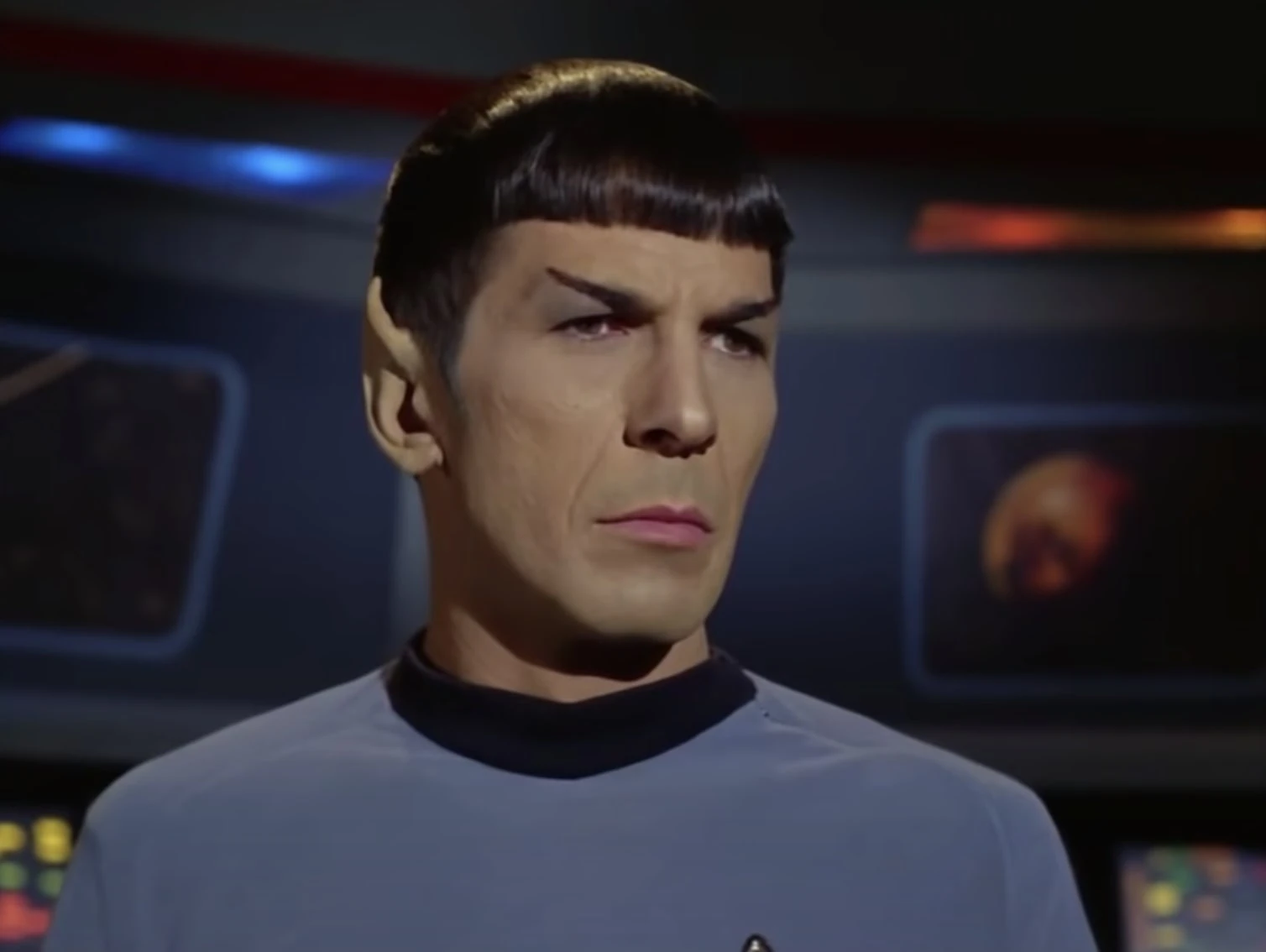
Favorite Character, First Tier: Spock
You can talk Kirk vs. Picard all you want. There's only one Spock. As much as I've grown to appreciate both Kirk and McCoy, the half-Vulcan first officer is the iconic face of the franchise. I don't always agree with him. I don't even always like him. But picking either of the others as my favorite would feel disingenuous. Many of the best stories in
Star Trek revolve around his self-identity struggles. All due credit to Leonard Nimoy, easily one of the greatest casting choices in the history of television.
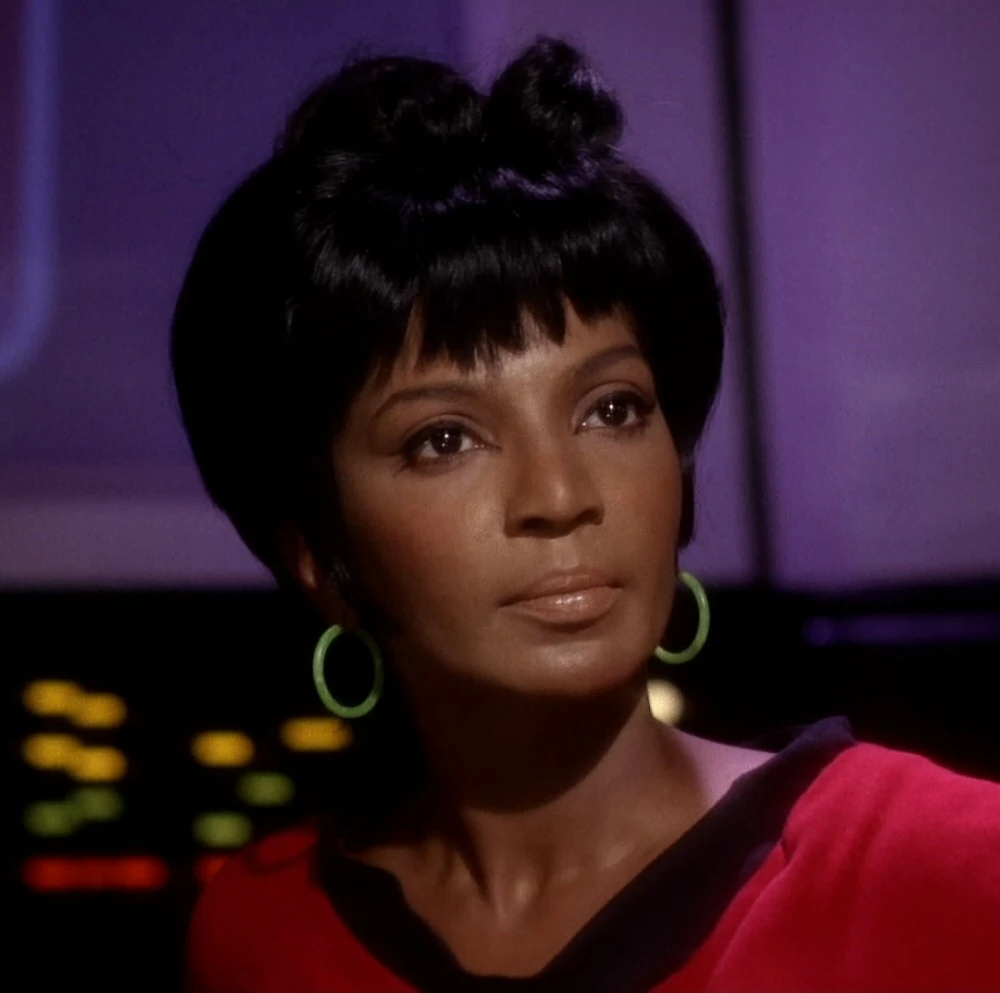
Favorite Character, Second Tier: Uhura
Lt. Nyota Uhura was a revolution all her own. Nichelle Nichols was one of the first African-American actors to be cast on American television in anything other than a servant role. None other than Dr. Martin Luther King, Jr. was a fan of
Star Trek, thanks in no small part to Uhura. Nichols met King after the first season and confessed that she was thinking of leaving the show to resume her stage career. Citing her cultural significance, he convinced her to stay.
Uhura is more than just a political statement. Of
Trek's second tier of characters, she is the most nuanced. On the bridge, she projects a confident, yet gentle demeanor. In the officer's lounge, she sings to her crew mates. Nichols herself has admitted that her favorite stories are the ones in which she wears civilian clothes and projects a more sensual femininity.
Favorite Guest Star: Mark Lenard
Lenard appears in two of my favorite episodes as two entirely different characters. In the first season's
"Balance of Terror," he is the unnamed Romulan Commander. In "Journey to Babel," he is Sarek, Spock's Vulcan father. In the first story, he achieves a remarkable combination of bone-chilling and heart-wrenching in his final communication with Kirk as his own ship crumbles around him. In the second, he provides an unforgettable prototype for the stoic Vulcan male.
10 Must-See Episodes
If ever a friend or loved one should ask me for a quick tour of
Star Trek's originals, I would offer the following collection, in order of original air date:
"The Corbomite Maneuver" - The first, clear glimpse of
Star Trek's moral compass.
"Balance of Terror" - Our introduction to the Romulans, this was my favorite first season episode. The exchanges between Kirk and the Romulan Commander are exquisite.
"Space Seed" - We meet Khan, one of
Star Trek's most important recurring characters. Again, the highlight is the verbal sparring between Kirk and a powerful nemesis.
"Errand of Mercy" - Our introduction to the Klingons. The Federation and the Klingon Empire vie for control of the planet, Organia. The natives are peaceful and seemingly helpless. In a wonderful turn, the Organians turn out to be quite powerful indeed and send both of the other parties away with a good scolding. Our heroes aren't morally irreproachable after all.
"City on the Edge of Forever" - The most revered episode of the original run, I can't say it's my favorite. It's a time travel narrative and
Star Trek doesn't usually do well with those, in my opinion. But the overall quality is undeniable and I would not be a good guide if I did not include it in my tour.
"Amok Time" - We get to visit the planet Vulcan. Enough said.
"Mirror, Mirror" - Through a transporter malfunction, Kirk, McCoy, Scotty and Uhura find themselves in a parallel universe where the Enterprise functions within entirely different moral parameters. The cultural meme of evil twins with goatees derives directly from this episode.
"The Journey to Babel" - My favorite of the whole bunch. See above.
"The Trouble with Tribbles" - A much mocked episode by the uninitiated, the tribbles tale is actually quite clever, a highly effective demonstration of narrative misdirection. It was nominated for three Emmys and a Hugo.
"The Enterprise Incident" - One third season episode made it on the list after all. Kirk and Spock infiltrate a Romulan ship in order to steal its cloaking device. We learn a lot about the Romulans in this story, mostly through the ship's commander, one of
Star Trek's best female characters.
*****
The fun continues next week. Beginning Wednesday, March 4th, fellow blogger Maurice Mitchell and I will be exploring
Star Trek: The Animated Series one episode at a time. You're welcome to join us! Details are
here.