Friday, May 8, 2015

Mock Squid Soup: A Soldier's Story

MOCK! and The Armchair Squid are proud to welcome you to Mock Squid Soup: A Film Society, meetings on the second Friday of each month.  Last week, society members posted three clues as to their chosen film for the month.  Today is the big reveal.  A reminder on my clues:

- The director has directed over 20 movies from a variety of genres.  Perhaps his most enduring films are a couple of musicals from the early 1970s.  This, however, is not a musical from the early '70s.

- One of the actors was in the midst of a career transition from television to film.  While he wasn't quite there yet, in a few years, he would become one of the biggest stars in Hollywood.  He wouldn't work with the director again until 14 years later.  But when he did, he was nominated for an Oscar.

- The film's score composer is a jazz titan.  After dropping out of a fine liberal arts college in rural Iowa, he caught on with the Miles Davis Quintet in the 1960s.  Over time, he became one of the world's premier electronic jazz musicians.

Drum roll, please...

Title: A Soldier's Story
Director: Norman Jewison
Original Release: 1984
My Overall Rating: 5 stars out of 5
via Wikipedia
Like many beautifully written movies, A Soldier's Story is based on a play: the Pulitzer-winning A Soldier's Play by Charles Fuller.  In 1944, Captain Richard Davenport (Howard E. Rollins), a JAG lawyer, is sent to investigate the murder of an African American sergeant on a segregated, Deep South army base.  Davenport himself is the first black officer most of the soldiers have ever seen.  The initial assumption is that the sarge (Adolph Caesar) was killed by the Klan but, of course, the truth proves more complicated. 


The story gets right to the heart of the racial dynamics of late-War America.  Expectations are high for civil rights prospects after the War but opinions diverge on how to achieve it, indeed even on what it means to be a black man.  In the platoon, being on the wrong side of the issue meant being on the wrong side of the sarge and the potential price was high. 

The writing is fantastic.  The film is fraught with tension filled confrontation, often turning violent.  Yet the most chilling scene finds the sarge staring at himself in a bar room mirror, telling tales of his World War I service.

Regarding the clues, several of you correctly guessed the composer, Herbie Hancock.  And yes, he did drop out of Grinnell on his way to jazz greatness.  Naturally, the school gave him an honorary degree years later anyway.  My clue for the director was admittedly vague but I had hopes some might figure it out once they guessed the actor.  Denzel Washington played a small role by his standards but a crucial one.  In 1984, he still had four years to go on St. Elsewhere but the big screen accolades would come soon.  His first Oscar nomination, for Cry Freedom, would come in 1987.  His first win, for Glory, came in '89.

By request, we shall do the trivia teaser again for June.  Choose your own movie.  Post three clues the week before: Friday, June 5th.  The next regular meeting is Friday, June 12th.  I'll post the sign up list tomorrow.  In the meantime, please visit this month's participants:


Wednesday, May 6, 2015

Star Trek: Mudd's Passion

My friends and I are embarking on a new journey to watch all 22 episodes of Star Trek's animated series.  We'll be posting on Wednesdays.  All are welcome to join us for all or parts of our adventure.

Episode: "Mudd's Passion"
Series: Star Trek: The Animated Series
Season 1, Episode 10
Original Air Date: November 10, 1973
via Memory Alpha
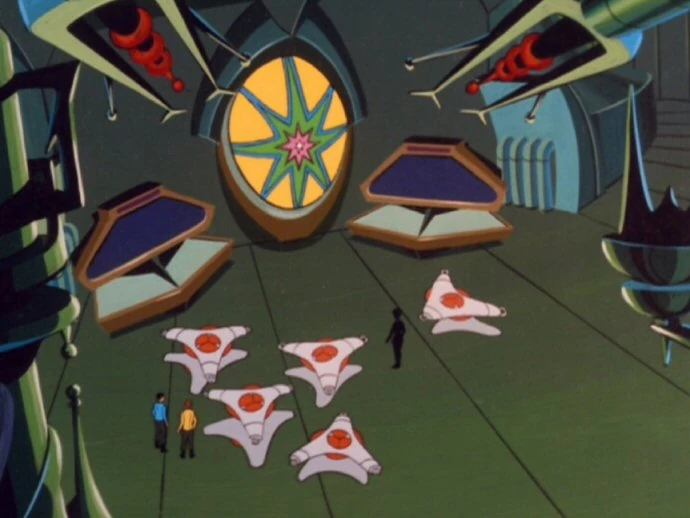
I am not a fan of Harry Mudd.  "Mudd's Passion" is the third and final Star Trek episode to feature the interstellar scoundrel/pimp/pusher/con man.   The two TOS episodes - "Mudd's Women" and "I, Mudd" - and this one were all written by Stephen Kandel.  This time, Mudd is hawking a love potion that actually works... or so it seems.  The story has amusing moments but I had a hard time getting past the unappealing guest star.

*****

TAS's main title theme was composed by Yvette Blais and Jeff Michael.  Both of those names are pseudonyms.

Yvette Blais was born Ray Ellis on July 28, 1923 in Philadelphia.  His varied career included arranging and producing for the likes of Billie Holiday, Johnny Mathis and Bobby Darin.  His television credits are extensive.  As the main composer for Filmation, the studio which produced TAS, he provided music for such Saturday morning fare as The Brady Kids, Shazam! and Fat Albert.  Yvette Blais was actually his wife's name.  Ellis died in 2008 from complications due to melanoma.

Jeff Michael began life as Norman Zachary Pransky, though professionally, he used the name Norm Prescott.  He was born January 31, 1927 in Boston.  Primarily a television producer, he was actually one of the co-founders of Filmation.  Jeff and Michael were the names of his sons.  As Norm Prescott, he also occasionally provided his voice talents to TAS.  He and co-producer Lou Scheimer won a Daytime Emmy for the show, the first such award claimed by any Star Trek series.  Prescott died in 2005 from natural causes.


If you would care to join us for all or part of our travels, sign on to the list below.  Please visit the other participants.  Next week: "The Terratin Incident."


Sunday, May 3, 2015

Family Movie Night: Snow White and the Seven Dwarfs

Title: Snow White and the Seven Dwarfs
Directors: Larry Morey, David Hand, Ben Sharpsteen, Wilfred Jackson, Perce Pearce and William Cottrell
Original Release: 1937
Choice: Mine
My Overall Rating: 4 stars out of 5
via The Disney Wiki
By 1937, animation had already been a part of the film industry for a long time, a news reel and a cartoon serving as standard appetizers to the main feature.  But Snow White was a revolution, the world's first full-length cel animated feature.  The movie, very briefly the highest-grossing picture of all time, kicked Walt Disney and his studio up to the big leagues.


In 2015, we are deep into the Pixar Age in which computer animation continually strives for hyper-reality.  One might expect an older, slower relic like Snow White to disappoint.  Guess again.  From the opening frame of the castle atop a mountain, the audience is drawn into a lush fantasy world of soft focus and brilliant color.  The only sharp line is the one between good and evil.  Reality was grim for most people in the late '30s.  The dreamworld strove to provide an escape from, not an enhancement of, that reality.

The story is well-known, based on the Grimm fairy tale.  An evil queen is jealous of her pure and beautiful stepdaughter, Snow White.  The queen commands a huntsman to kill the princess but he cannot bring himself to do it.  The girl escapes to a cottage inhabited by seven bachelor dwarfs.  While in hiding, Snow White dreams of love but the queen is hatching a new plan.

Disney's Snow White owes much of its legacy to the songs, all written by Frank Churchill and Larry Morey.  "Heigh Ho" and "Whistle While You Work" are both classics.  The crown jewel is "Some Day My Prince Will Come," a well-established jazz standard.  I'm not a huge fan of Adriana Caselotti, the uncredited voice of Snow White - rather shrill, an example of an unfortunate style of the era.  More satisfying is Harry Stockwell, the uncredited voice of The Prince. 

Friday, May 1, 2015

Mock Squid Soup: May Trivia Teaser


Today, as an added treat for this month's edition of Mock Squid Soup, all society members are invited to post three hints about their film choice for the month.  All are welcome to guess, of course.  Here are the three clues for my movie:

- The director has directed over 20 movies from a variety of genres.  Perhaps his most enduring films are a couple of musicals from the early 1970s.  This, however, is not a musical from the early '70s.

- One of the actors was in the midst of a career transition from television to film.  While he wasn't quite there yet, in a few years, he would become one of the biggest stars in Hollywood.  He wouldn't work with the director again until 14 years later.  But when he did, he was nominated for an Oscar.

- The film's score composer is a jazz titan.  After dropping out of a fine liberal arts college in rural Iowa, he caught on with the Miles Davis Quintet in the 1960s.  Over time, he became one of the world's premier electronic jazz musicians.

Any guesses?  Society reviews will be posted next Friday, May 8th.  See you then.  Meanwhile, please visit my fellow cinephiles today:


Wednesday, April 29, 2015

Star Trek: Once Upon a Planet

My friends and I are embarking on a new journey to watch all 22 episodes of Star Trek's animated series.  We'll be posting on Wednesdays.  All are welcome to join us for all or parts of our adventure. 

Episode: "Once Upon a Planet"
Series: Star Trek: The Animated Series
Season 1, Episode 9
Original Air Date: November 3, 1973
via Memory Beta
"Once Upon a Planet" is a sequel to the TOS episode "Shore Leave."   The Enterprise crew returns to their favorite vacation spot where a mind-reading computer generates fantasy tales for its visitors.  All innocent fun, or so they thought.  Alice and the White Rabbit are harmless enough but when the Queen of Hearts and her minions attack Dr. McCoy, the dream turns to nightmare. 

When our friends last visited, a being known as The Keeper oversaw the planet but he has since died, leaving the Master Computer (voiced by James Doohan) in charge.  The MC is tired of sitting around and amusing others.  It wants to get out and see the universe, intending to hijack the Enterprise for this purpose.

The fun of the TOS episode was the mystery of the origin of all the fantastical beings.  This later story goes a bit further down the philosophical query path: where is the relationship between human and machine heading?  Which is master, which servant?  If we are to endow machines with intelligence, what are our responsibilities to them?  To what rights and liberties are they entitled?  How can we convince them not to enslave us all?

Apparently we just need to convince them they already live in the perfect vacation spot.

If you would care to join us for all or part of our travels, sign on to the list below.  Please visit the other participants.  Next week: "Mudd's Passion."


Sunday, April 26, 2015

On the Road: Arlington National Cemetery

This past week, our daughter and I made our annual April visit to see my parents in Washington, DC.  The Purple Penguin is generally content to hang out with Grandma on her own which means I usually have an opportunity for my own adventures in town.  Despite growing up in the area, there was one major Washington sight I'd never gotten around to visiting: Arlington National Cemetery.  On Monday morning, I set off to rectify that.

Arlington National Cemetery is the most famous military cemetery in the United States.  Contained on the grounds are the remains of two Presidents, 367 Medal of Honor winners and surely thousands of others.  More come in nearly every day, as I was reminded by the white hearse that was leaving as I arrived.  The beautiful grounds are built upon the hill of an estate formerly owned by the legendary Confederate general, Robert E. Lee.  One can hardly help feeling moved walking amidst the endless sea of gravestones remembering those who have served, officers laid to rest alongside enlisted from the Civil War to the present.

Anyone living under the illusion that we live in a classless society would quickly be convinced otherwise at Arlington.  As one moves uphill, the markers get bigger and the ranks more impressive.  One sees a lot more generals and admirals near the top.  Even those with less distinguished military careers gained esteem as senators or captains of industry.  On the other hand, the cemetery's most revered memorial contains the remains of three soldiers who were never identified:
It was a beautiful, though warm day so I wasn't too keen to hunt down grave markers.  However, I did make a point of finding one:
Marshall never served in the military but certainly deserves his place for his extraordinary civilian service to the country.

The gravestones of Medal of Honor winners are marked, though I only saw one:
Click here to learn more about Staff Sergeant Windrich, including his award citation.

I am glad to have visited Arlington and recommend it to anyone with time and good weather in the Washington area.  The sun was certainly nice but I could have done with a cooler day.  In the visitor's center, there were some nice wintery pictures of the grounds, suggesting it might be meaningful to go again at a different time of year.

Saturday, April 25, 2015

On the Coffee Table: Flambé

Title: Chew, Volume Four: Flambé
Writer: John Layman
Artist: Rob Guillory
via Amazon
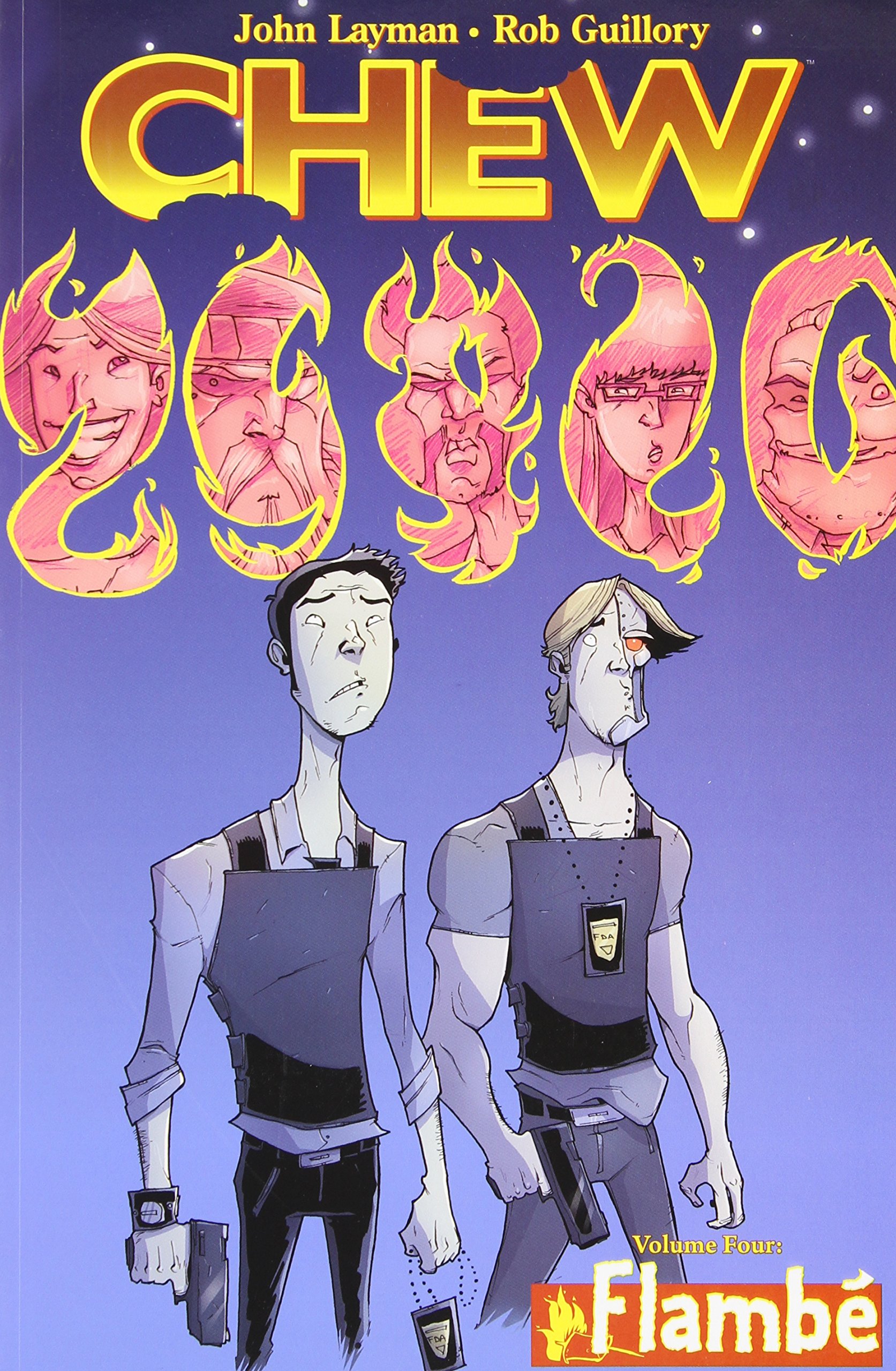
The excellent comic book series Chew continues with Flambé, collecting issues #16-20.  Strange writing appeared in the sky at the end of Volume Three and much of Four is devoted to unraveling that mystery.  Public reactions to the writing range from panicked lawlessness to religious fervor.  The stories continually push the edge on the disgusting but while I'm not as impressed as I was in the beginning, I'm still enjoying the series.  Layman has quite a knack for strong cliffhangers and the end of Flambé is no exception.

Half the fun of Chew is the food powers some of the characters possess and Flambé introduces a couple of new ones.  Daniel Migdalo, a former FDA agent, is a Voresoph meaning he becomes smarter the more he eats.  New character Peter Pilaf has an unnamed power which allows him to control people with food.  There's also The Vampire lurking around the periphery.  I've rather had enough of vampires in pop culture but given the overarching food theme of Chew, I suppose it's appropriate.