Showing posts with label Family Book Swap. Show all posts

Monday, December 23, 2024

Family Book Swap: Be Gay, Do Comics!

Title: Be Gay, Do Comics: Queer History, Memoir, and Satire from The Nib
Editor and Publisher: Matt Bors

via Amazon

I was never the parent who didn't want his kid to grow up.  I've loved watching the individual emerge at each new stage.  When the ultrasound nurse asked all those years ago if we wanted to know the sex of the fetus, I instantly realized it was the least of what I wanted to know.  Are they right- or left-handed?  (right)  What instrument will they choose to play?  (so many over the years - these days, clarinet and bass clarinet)  What's their favorite color?  (historically, very challenging to get a consistent answer on this one)  In the years since, as each question was answered, I was already eager for the next.  From their conception onward, one of the foremost drives in my life has been to know my child as fully as possible.

One night when the Purple Penguin was about ten years old, we went out for dinner just the two of us.  Once we settled in, they opened conversation with "Not to get too personal with you, but have you ever been gay?"  I don't know what I was expecting from our little outing but it certainly wasn't that!

From that night onward, sexuality and gender have been reasonably open topics in our family.  A few years later, they reached one of those critical realization moments for themselves.  My wife and I were quickly out of our depths in answering questions.  Off to the independent bookstore we went, returning with several of what we hoped would be helpful volumes.  Be Gay, Do Comics turned out to be the best of the bunch.  A few years later on again, the PP has asked us both to read it, too.

Independent comics have been a relatively queer-friendly space for a long time.  Alison Bechdel's Dykes to Watch Out For and the Hernandez brothers' Love and Rockets are probably the two most famous examples but there have been many others, and across cultures, too.  As associate editor Matt Lubchansky points out in the introduction,
Comics are accessible in a way that other forms of media can only dream of being.  They're not only accessible for the reader, who is presented with a lot of information in an easily digestible way, but for the creator:  One person can control the entire narrative in a medium they can publish easily online or cheaply in print.  Thus, comics presents amazing opportunities to be heard, and to hear each other, and to make the exact stories that we want and need to tell.
Be Gay, Do Comics is a collection of works by various creators.  There are several self-discovery stories which I imagine were the most important ones for the PP.  But there's more: histories of activism and resistance, bios of closeted and not so closeted (though historically hidden) homosexuals, examinations of the queer experience in other countries, etc.  We all sit somewhere on both the gender and sexuality spectra and probably most not so far on one side or the other as many would like to pretend.  The strips collected here explore both.  Even biological sex is a more complicated matter than we've been led to believe.  Be Gay, Do Comics addresses that, too.

Donald Trump takes the Oath of Office next month.  His party will hold majorities in both houses of Congress and on the Supreme Court.  Dark times are looming.  If you're not worried for the queer folks in your family and your community, you should be, no matter how blue you think your state is.  Our child has spent their entire life living in two of the most queer-friendly communities in the United States and even so, there have always been reasons to worry, regardless of which way the national political winds blow.  As they explore life options for the future, it makes me deeply sad that there are broad stretches of the country which feel unsafe to visit, never mind live in.  

As a parent, I worry.  The world is cruel and frequently dangerous.  I don't ever like to think of my child as being vulnerable so that part is hard - probably always will be.  

Beyond that, I don't feel that my basic obligations as a parent have changed.  They're still the same sweet,  imaginative, earnest and empathetic person they've always been.  Only the labels change and even the labels can seem constraining in describing the entirety of the human in my life.  Obviously, we accepted a long time ago.  In fact, I'd say we were aware of some things before they were.  But even "acceptance" doesn't feel like enough.  It implies resignation, a passive acknowledgement.  

Just as I recognized at the ultrasound all those years ago, one of my most important jobs as a parent is to know my child as fully as possible.  I have to listen without judging.  Not everything requires my reaction, one way or the other, because it's not about me.  I must honor both the questions and the answers.  The world may not always be safe.  But I need to make damn sure my child always feels safe with me.  And for that, I must do the work to truly know them.

I do have one gripe with the book.  Some of the print is very small.  Moreover, the color contrast also occasionally makes it difficult to read the text.  True, my eyes are not what they used to be but I can't imagine I'm the only one who might struggle.  I was grateful to own a magnifying glass.

Otherwise, I recommend the book to all without reservation.  One of the most important ways we can all push back on the dark cultural forces is to normalize these conversations.  It shouldn't be uncomfortable for two cis straight people to have a relaxed, comfortable, non-threatening discussion about sexuality and gender no matter how the issues directly impact their lives.  Even if you live in the reddest corner of the reddest state, these questions touch the people in your lives in ways you might never imagine.  Be the safe haven.  Listen and believe without judging.  Work to know, not just accept and tolerate.  Be Gay, Do Comics can help.  

Monday, July 1, 2024

Family Book Swap: Starter Villain

Title: Starter Villain
Author: John Scalzi
via Amazon

Charlie Fitzer is down on his luck.  Once happily married and gainfully employed as a business reporter, he is now divorced and working as a substitute teacher.  He moved back into his childhood home to take care of his ailing father, now deceased.  His financial situation is dire.  On the bright side, he has two cats who clearly adore him.

Charlie's world gets turned inside out when he learns an estranged billionaire uncle has died.  Charlie is his only living relative so much to Charlie's own shock, he is placed at the head of an international financial empire that extends way beyond owning parking lots.  He becomes, in effect, a supervillain based in a remote Caribbean volcano cave.

The story that unfolds is a combination of The Hitchhiker's Guide to the Galaxy, Doctor No and The Cat from Outer Space.  The ties to James Bond are the most obvious with direct references to Goldfinger, Blofeld and SPECTRE.  But the Douglas Adams narrative elements are many: a lovable loser who learns his world is not at all what he thought it was; animals (including dolphins) who turn out to be a lot more intelligent than expected; Ford Prefect- and Zaphod Beeblebrox-like characters plus a generally irreverent sense of humor.  We're talking laugh out loud funny.  As for the cats, well, some surprises are worth preserving for anyone intending to read the book.

Scalzi is a well-established scifi novelist. He has won several Hugos in various categories, including Best Novel.  Starter Villain has been nominated for that award for 2024, the winner to be announced in Glasgow on August 11th.  The fantastical elements aside, the basic premises of the billionaire playground world are surprisingly believable.  The typically incompetent super rich play by their own rules with minimal accountability to anyone besides, only occasionally, each other.  Sounds about right.  

I'm not sure how I feel about the ending.  It's not all tied up quite so neatly as one expects which I suppose it's a good thing.  Fortunately, Charlie is certainly better off than when the book started and the most important characters are still devoted to him.  There's just enough of a crack in the door to allow for a sequel but perhaps better to leave the story as it is.

Overall, it's definitely a strong book.  I'll be keeping an eye out for Scalzi's other work and certainly will check in for the Hugo results in August.

Monday, March 11, 2024

Family Book Swap: Sea of Tranquility

Title: Sea of Tranquility
Author: Emily St. John Mandel

via Target

Edwin is an English aristocrat exiled by his family to Canada in 1912.  Mirella is a receptionist in 2020 New York.  Olive is a novelist on a book tour in 2203.  Their lives are connected by a shared, extraordinary experience and by their encounters with a time traveler, Gaspery Roberts.  Perhaps coincidentally, they are also connected by the fact they each had these experiences immediately prior to a global pandemic.

To tell more about the story would be to give too much away.  I already fear I've said too much.  And it would be a shame if my post did anything to discourage anyone from reading Sea of Tranquility.  It was my most rewarding read in quite a long time.

I read a lot of books and enjoy most of what I read.  What I long for, though, is a book that makes me want to do nothing but curl up in a corner and lose myself in the narrative, perhaps even to forget that I'm reading.  I want to be invited into a world I hate to leave when the book is over.  That level of immersion has been much more difficult to find as an adult than it was as a child.  It's possible, of course, that I've been reading the wrong books.

Sea of Tranquility is the closest I've come to realizing that ideal in years.  The fact that it's a time travel story is all the more extraordinary.  As frequent visitors to The Squid have likely caught on, I approach such stories with great skepticism and tend to leave them annoyed and frustrated.  Mandel's take on the concept didn't bother me.  She certainly deserves credit for tidiness - time travel has rules in this book and she sticks to them.  And the answer to the central question - which I won't reveal - satisfies me.  I cared a lot more about what happened to the characters, especially Gaspery, than I did about the time travel consistency.  I can assure you, that is not easily said for me.  Mandel also deserves a lot of credit for a relatable rendering of the lockdown experience as well as a vision of the future that is not overly sensationalized.  

A snippet that spoils nothing but does exhibit the emotional intimacy Mandel allows the reader to have with her characters:
She never dwelt on my lapses, and I couldn't entirely parse why this made me feel so awful.  There's a low-level, specific pain in having to accept that putting up with you requires a certain generosity of spirit in your loved ones.
So yes, I would love to read more books like Sea of Tranquility.  Bravo!

Monday, November 14, 2022

On the Coffee Table: The Sandman

Title: The Sandman, Volume 1: Preludes & Nocturnes
Writer: Neil Gaiman
Artists: Sam Keith, Mike Dringenberg, Malcolm Jones III, Dave McKean

via Amazon

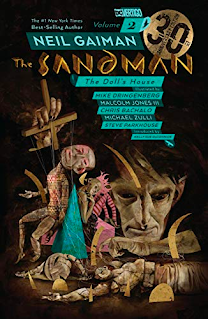
Title: The Sandman, Volume 2: The Doll's House
Writer: Neil Gaiman
Artists: Mike Dringenberg, Malcolm Jones III, Chris Bachalo, Michael Zulli. Steve Parkhouse, Dave McKean

via Amazon

The Sandman is widely considered one of the masterpieces of the comic book genre.  Neil Gaiman teamed up with a small staff of master artists to tell the tale of Morpheus, King of the Dreamworld.  Morpheus had been held captive for several decades.  Now that he's free, he must clean up the mess created by those who have sought to fill the void in his absence.  The story shifts not exactly seamlessly between demon-world, dream-world and real world.  

As I have written before, though not for several years, Gaiman's work is hit-or-miss for me.  I can't deny his command of language or narrative skill.  The Graveyard Book is one of my favorites.  But Gaiman often tends too far in the horror direction for my tastes.  I first tried Preludes & Nocturnes several years ago and was deeply turned off.  Maggots in people's eyes?  A diner full of people being manipulated into killing each other?  No thanks.

The new Netflix series sparked my wife's interest.  She'd never read the comics before but is now eagerly seeking them out.  She suggested I read the second book, The Doll's House, as a book swap.  I needed to re-read the first volume to get oriented.

After being freed, Morpheus sets out to gather his dream-manipulating objects: a gas mask, a bag of sand and an amulet.  All have fallen into the possession of unsuitable owners.  I can't say I liked the story any better with the second reading.  Still hauntingly beautiful at times?  Yes.  Still frequently gross and off-putting?  Most certainly.

The Doll's House is better.  The broad arc follows a mortal, Rose Walker, a young woman whose family has been torn apart.  As she works to gather them all back together, she learns of the role she plays, unwittingly, within the dream world.  Once again, some of the stories are lovely.  The prologue is set in the African desert, a man relating a rite of passage tale to his grandson after the latter's ritual circumcision.  In Part Four, Morpheus makes a friend in 14th century England.  After granting him immortality, Morpheus visits his pal every hundred years to see how he's doing.

But there are also truly sickening moments over the course of the story.  Maybe this is the trade off I have to accept with the Sandman series if I'm to continue with it.  And I think I will.  Eventually.  Gaiman is a genius.  If I can endure his horror stories, I will be rewarded with occasional elegance.  Even Rose's story, while frequently disgusting, is beautiful in the end.

The artwork is undeniably brilliant.  With several different artists come a variety of styles.  Sometimes, panel sequence gets confusing, which annoys me.  But overall, the visual presentation is top-notch.  Even the gross stuff.

I don't know if I'm interested in the TV series or not.  I suppose I am curious to see how it all translates to screen.  If I do watch, I may occasionally need to remove to another room from time to time.

Monday, October 10, 2022

Family Book Swap: The Book of Form and Emptiness

Title: The Book of Form and Emptiness
Author: Ruth Ozeki

via Target

Ruth Ozeki's novel tells the tale of Benny Oh, an early teen boy who is dealing with his father's sudden death and his mother's hoarding compulsion.  To complicate matters, Benny's hearing voices.  All of the objects around him - a book, a wall, a pair of scissors - are speaking to him.  Through his adventures at a psychiatric hospital and the public library, he makes some interesting human friends, too.

The Book of Form and Emptiness came into our lives this summer through new avenues.  It was the summer reading book for our child's college, then my wife chose it for her book club.  So now all three of us have read at least most of it - not sure the kid ever finished it.

It's an engaging read.  Perspective shifts frequently and oddly.  Sometimes it's Benny, sometimes his mom, sometimes a librarian.  The book itself becomes its own character and, in fact, most of the story is told from its point of view.  For this and other reasons, the novel is a book lover's book.  On page 388, there's a shift to second-person narrative which I always find unsettling but within context, it makes sense.  Goodreads classifies the novel as magical realism which got me to wondering about the fine line between that genre and schizophrenia, one of Benny's diagnoses.  Interestingly, I learned that magical realism developed, primarily among Latin American authors, as a vehicle for writing about mental illness without actually naming it. 

Our progeny found it tough going at times and I can understand why.  The story of Annabelle, Benny's mother, gets especially heavy as we watch her life spiral out of control.  Some in my wife's book group found the ending too tidy, which I can also appreciate.  But for me, overall, the story works.

Thursday, May 13, 2021

Family Book Swap: Interior Chinatown

Title: Interior Chinatown
Author: Charles Yu

via Amazon

Yu's novel about the life of "Generic Asian Man" Willis Wu is written in screenplay format.  Willis is an actor - or is he a character? - on a cop show called Black and White.  The leads are a Black man and a White woman.  Willis and all of the other Asians are background characters.  Of course, it's all an elaborate metaphor for the ways race plays out in American society, especially for those of East Asian descent.  While the weaving in and out of "reality" can be a little confusing, that's sort of the point.  Even Chinatown itself is simultaneously the reality and the metaphor for the compartmentalization of Asian culture in the United States.

Along the way, Willis navigates the complications of his relationships with his aging parents, falls in love, becomes a parent, gets divorced and reconciles with his ex-wife.  All the while, he works out his place within Chinatown and beyond it, against Asian-American expectations and those of the broader society.  Beautifully and convincingly, Yu makes some important points:
  • Not all Asians are Chinese.
  • Not all Chinese are of the same culture either.  He references the numerous dialects flying around Chinatown several times.  Willis's own family is Taiwanese.
  • Asians have been in the United States since 1815, that's earlier than any of my own paternal-side northern European ancestors arrived.
  • There has been a long history of laws restricting the property, immigration and citizenship rights of Asians in the United States, the last of which were not repealed until 1965.
  • Asians are not the only ones who feel unseen in White male dominated society.  
  • The societal relationship between Asian Americans and Black Americans is complicated.  Asians know their history of oppression pales in comparison to those of Black people and as a result are often reluctant to complain.  The "Model Minority" status of Asians only complicates that.  But the cop show metaphor demonstrates that Black Americans, at least Black men, exceed Asian Americans in terms of cultural visibility.
The final analysis: Asians are the permanent guests in American culture.  Even though their presence predates that of many European immigrant groups, they can only ever hope to exist within the defined parameters of White expectations.  Yu, through Willis, pleads no innocence for himself.  He admits to fetishizing the coolness of Black culture and romanticizing White women.  However, he has little choice but to live within the box in which society has confined him.  In Chinatown, be it reality or metaphor.

Interior Chinatown is excellent and it reads quickly.  I'd say this is the first book I've read in a while which I can see recommending to anyone I can, starting with my daughter.  With the targeting of Asians in the age of COVID and the recent, horrific murders in Atlanta, understanding the plight of Asians within American society has never been more important.

Tuesday, May 11, 2021

Family Book Swap: Parable of the Sower

Title: Parable of the Sower
Author: Octavia E. Butler

via Amazon

Lauren Olamina is a fifteen-year-old girl living in southern California in the 2020s.  Except it's not now exactly.  Butler published her novel in 1993.  In the future she envisioned, climate change has brought economic collapse.  Lauren's family lives in a gated community which doesn't do a very good job of protecting them from roving street gangs, many of them high on a drug which makes fire look awesome.  So they burn people's houses and also rape and murder people.  And steal all of their stuff.  It's all pretty bad.  

However, Lauren's not one to sit quietly.  She's prepared for the worst, or so she thinks.  She has also invented her own religion.

When reading a dystopian narrative, one must parse out what is metaphor from what is cautionary tale.  In this case, while Butler offers a culprit for the future condition of the world, the sad truth is that much of her story is a repackaging of history, or even the present.  Forced migration - where Lauren's adventure ultimately leads - is real.  It has happened over and over again.  Listen to news reports about current conditions in Honduras and it doesn't really seem so different from the horrors Lauren must escape.  Human slavery is real.  Human trafficking is real.  The exploitation of "unskilled" labor is real.  Butler hits on all of these in a fictional context but it's an easily believed world.

At one point, Lauren and her fellow travelers go through Salinas.  No late 20th century writer brings up Salinas, California by accident.  It's an obvious allusion to Steinbeck.  The message is clear: this has all happened before and I'm not even the first person to write about it.

Parable of the Sower is a strong novel and it reads fairly quickly.  Butler develops characters well, though I'd say there are a few too many of them.  I was half-tempted to make a diagram.  There is a sequel and I'm definitely curious.  In fact, Butler initially envisioned a trilogy though she died in 2006 without having written a third book.  

Tuesday, June 23, 2020

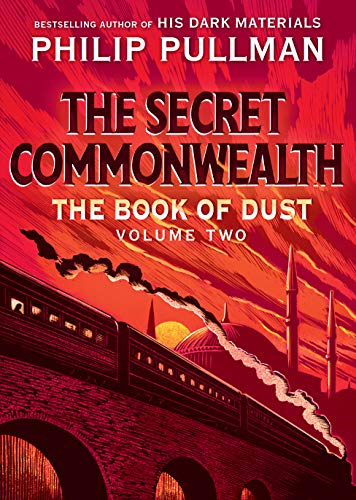
Family Book Swap: The Secret Commonwealth

Title: The Secret Commonwealth
Author: Philip Pullman

Amazon.com: The Book of Dust: The Secret Commonwealth (Book of ...
via Amazon
As expected, my wife gave me The Secret Commonwealth, the second volume of Philip Pullman's The Book of Dust trilogy for our latest book swap.  Here is my reflection on Book One.  The story is set some 20 years after La Belle Sauvage and about 10 years after His Dark Materials.

Lyra is a university student at Oxford, though in a different college from Jordan, the one that essentially raised her.  Pantalaimon, her separable daemon (long story - read the books!), witnesses a murder while out wandering one evening.  This sets off a chain of events that leads to Pantalaimon running away and Lyra setting off to find him, sending both on an adventure across Europe to what we know as Turkey.

Malcolm, whom we met in Book One of this series, still sees himself as Lyra's protector.  What's more, he's in love with her.  So, when she runs off after Pan, Mal runs off after her.  Luckily for all involved, he's become even more of a badass with age.  Seriously, George Smiley would be proud!

There's a lot more to all of this but it's complicated.  However, it's well worth immersing oneself in this world.  I wasn't too sure about this second trilogy, having enjoyed the original so much, but the second book has me convinced.  While it is set in the same world with, for the most part, the same protagonist, the story is not a feeble attempt to rehash the old.  With more adult characters comes a more adult atmosphere and a more adult adventure.  As with Book One, not a read aloud for the tots.

Perhaps most importantly, Pullman tests the limits of the very world he created, specifically the limits of the daemon-human bond.  The original series portrays the relationship as invariably blissful.  In the new, Lyra learns quite a lot about how different the reality can be, and not merely between herself and Pan.  While His Dark Materials begins with the "I am not what I seem" premise of so many fantasy tales, The Book of Dust revolves more around "The world is not quite what I've always assumed it was."  If anything, it makes the concept more believable.

One other thing I really like:  Lyra, whom we've now known at three life stages, is acknowledged as a sexual being.  She has had sex.  She enjoyed it.  No big deal.  At no point is she shamed for this.  Nice.

In fact, the story is so different that I wonder how well it would stand on its own.  I love His Dark Materials and would certainly encourage anyone who hasn't read it to do so but I don't think it's necessarily a pre-requisite.

Tuesday, February 11, 2020

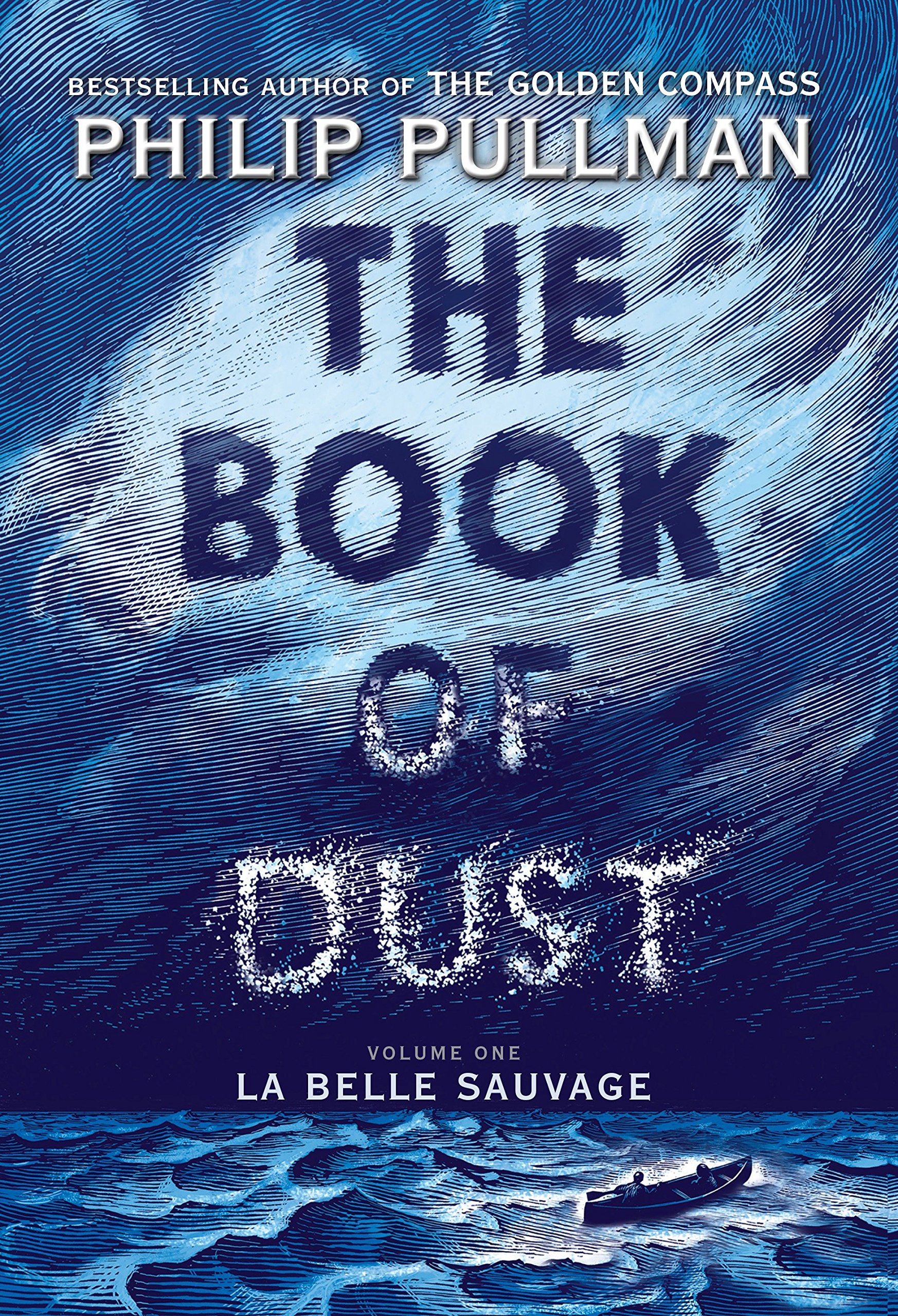
Family Book Swap: La Belle Sauvage

Title: La Belle Sauvage
Author: Philip Pullman
Image result for la belle sauvage
via Amazon
As noted in this post, Philip Pullman's His Dark Materials series was a favorite of my wife's and mine even before we were married.  We listened to the wonderful, full-cast audiobooks on road trips early in our relationship.  So, hopes for Pullman's latest series about Lyra's world are rather high.  La Belle Sauvage is the first volume of The Book of Dust trilogy.  It is set several years before The Golden Compass.  Lyra is an infant and the new protagonist is Malcolm, a young and extraordinary innkeeper's son who is heroically devoted to protecting her.  Malcolm is drawn into a world of simultaneously colorful and terrifying characters.  Some we already know: Lord Asriel and Mrs. Coulter.  Others, like the horrible Bonneville, are new.  Practically by accident, he stumbles into a spy network through which he learns of alethiometers. 

For a different hero, we get quite a different tale.  The new story is a lot darker than His Dark Materials.  The subject matter and even some of the language implies teenagers rather than younger children as the intended readers - not a good read-aloud for the tots.  In parts, the story also tends more to the surrealist end of fantasy than the original series did. 

Malcolm and Alice, his partner in this adventure, are total badasses.  One can't help admiring them tremendously by the end.  There is some untidiness in the narrative.  For instance, at one point Bonneville is revealed to have a predilection for young boys, a fact presented in such a way that one assumes it to be important to the story but then it isn't.  Or maybe it still will be in future books?  Hard to see how but we'll see.  Overall, Pullman's language, character development and world development are all expert level so I'm certainly up for more.  The second volume, The Secret Commonwealth, jumps ahead to the time after His Dark Materials.  I expect my wife will be swapping with me for that one soon, too.

Friday, October 27, 2017

Cephalopod Coffeehouse: October 2017

Welcome one and all to the Cephalopod Coffeehouse, a cozy gathering of book lovers, meeting to discuss their thoughts regarding the works they enjoyed most over the previous month.  Pull up a chair, order your cappuccino and join in the fun.  If you wish to add your own review to the conversation, please sign on to the link list at the end of my post.

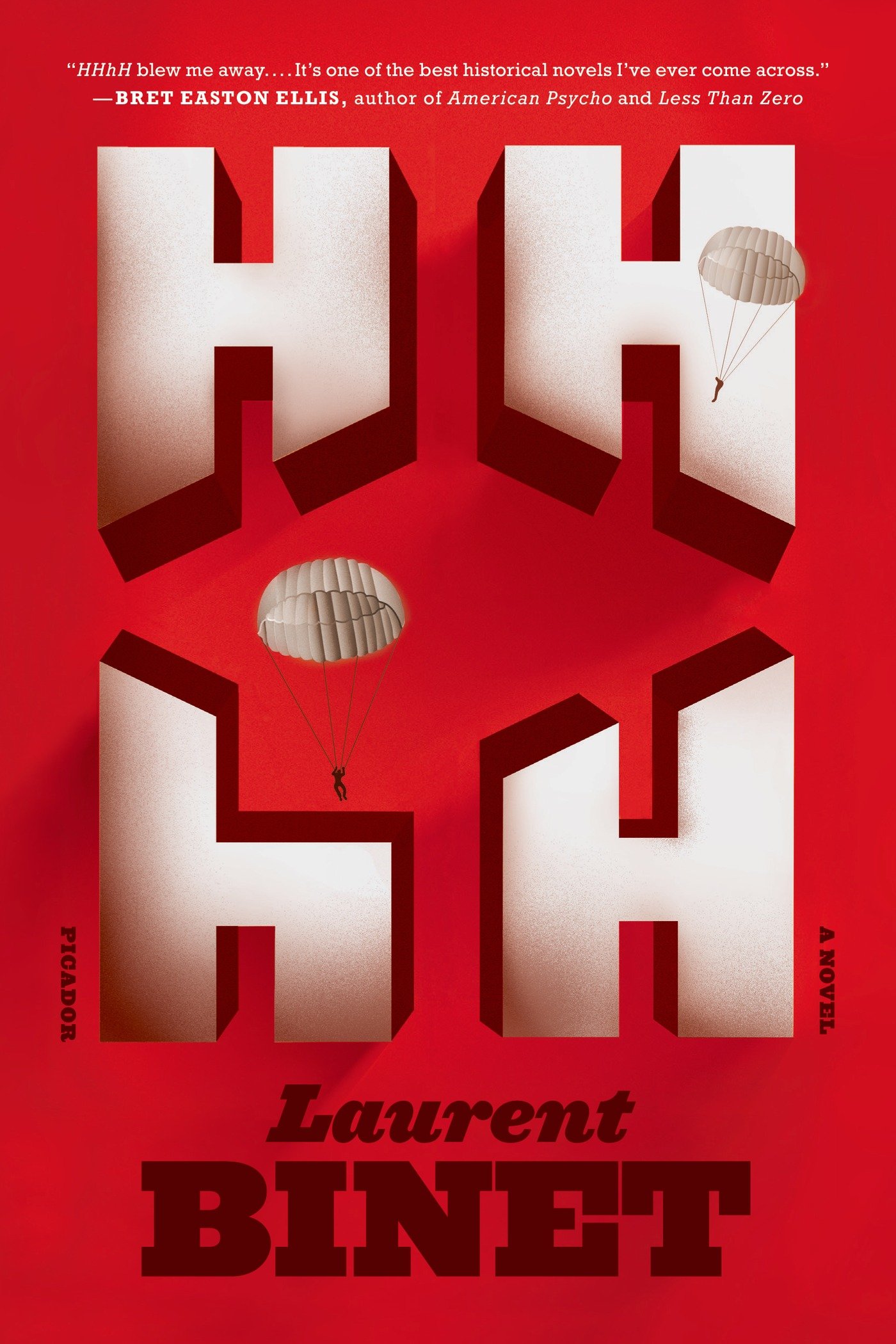
Title: HHhH
Author: Laurent Binet
via Amazon
I'm pretty sure I like this book.  I certainly like it most of the time.  HHhH is mostly a work of historical fiction, exploring the characters and events surrounding the assassination of Nazi monster Reinhard Heydrich in Prague in 1942.  I say "mostly" because Binet's approach to the story is highly unusual.  Interlaced with the historical tale is the author's recounting of his own challenges in writing the book.  While his commentary is, to a point, interesting, I find it distracting.  The instant the assassination story gets rolling, Binet pulls back to indulge in his meta crap.  I enjoyed his overall style but I just wanted him to shut up about himself after a while.

But of course, the meta crap is exactly why Binet's book has gotten attention.  After all, there are other books and movies about Operation Anthropoid, the assassination plot's code name.   Interestingly, and to me somewhat puzzlingly, there is a movie adaptation of HHhH.  It was released in France in May and an English translation entitled The Man with the Iron Heart will be released later this year.  From what I've read, it doesn't sound like the movie includes the meta crap - a good choice in my opinion.

I know, it sounds like I didn't actually enjoy the book but I really did.  Binet writes well even as he meanders.  He leaves no doubts as to the deep evil of the Nazi regime, a sobering reminder in the midst of today's racial struggles.  Binet, a Frenchman, also paints a loving picture of Czechoslovakia (as it was at the time) and Prague in particular.

Please join us and share your own review of your best read from the past month.  This month's link list is below.  I'll keep it open until the end of the day.  I'll post November's tomorrow.  Meetings are the last Friday of each month.  Next gathering is November 24th.


Thursday, July 6, 2017

Family Book Swap: Caddie Woodlawn

Title: Caddie Woodlawn
Author: Carol Ryrie Brink
via Amazon
For our summer book swap, our daughter gave me Caddie Woodlawn, a fictionalized memoir of a girl growing up in Pioneer Era Wisconsin.  Yes indeed, the premise is remarkably similar to that of Little House in the Big Woods by Laura Ingalls Wilder, yet this book has a strong legacy in its own right.  Caddie Woodlawn was awarded the Newberry Medal in 1936 and was one of the inaugural winners (along with Little House) of the Lewis Carroll Shelf Award in 1958.  Just like the Ingalls house near Pepin, Wisconsin, the Woodlawn home near Menomonie is preserved as an historic site.

Caddie's story is as much about her tomboy adventures with her brothers as it is about the frontier experience.  She prefers exploring the woods more than the more "ladylike" pursuits embraced by her mother and older sister in the house.  The traditional gender roles defined in the book are more than a little uncomfortable in light of 21st century sensibilities, though less so than the stories about Native Americans.  Those issues aside, the stories are charming enough.  Caddie's growing up moments center around the development of empathy: empathy for her Native American neighbors, for her tattle-tale younger sister, for her more refined Boston cousin, etc.  Overall, I'd say the book is better than Little House, which I've begun several times but never finished, though far inferior to Anne of Green Gables.

Our daughter has long expressed an interest in the Upper Midwest, particularly Wisconsin and Minnesota.  Her affection for this book helps me to understand why.  Brink's love for the northern woodlands is obvious.  We're hoping to make a cross-country journey sometime in the next few years and that part of the country seems a likely target for exploration.

For my part of the swap, I gave her A Spell for Chameleon by Piers Anthony.  I first read the book when I was about her age, 13.  I'll be interested to see what she thinks of it.  She's a far more sophisticated reader, especially of fantasy, than I was.

Friday, June 30, 2017

Cephalopod Coffeehouse: June 2017

Welcome one and all to the Cephalopod Coffeehouse, a cozy gathering of book lovers, meeting to discuss their thoughts regarding the works they enjoyed most over the previous month.  Pull up a chair, order your cappuccino and join in the fun.  If you wish to add your own review to the conversation, please sign on to the link list at the end of my post.

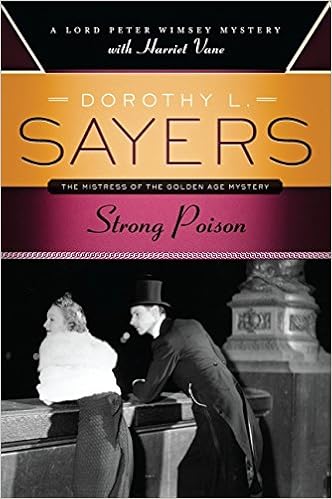
Title: Strong Poison
Author: Dorothy L. Sayers
via Amazon
My wife is a huge mystery fan.  Sherlock Holmes, Nero Wolfe, Hercule Poirot: she loves them all.  In fact, I'm a little surprised that she hasn't chosen one for a book swap with me before this.  She is especially fond of the Lord Peter Wimsey mysteries of Dorothy L. Sayers and chose Strong Poison as the best choice for introducing me to that series.

Lord Peter is an English aristocrat, circa 1930, who solves mysteries basically because he's good at it and has nothing better to do.  He strikes me as a cross between Holmes and Bertie Wooster of the P.G. Wodehouse novels.  In fact, this book references both of those other works.  Fortunately, he is more grounded than Sherlock and far more useful than Bertie.

Strong Poison begins in a courtroom.  Harriet Vane, a successful mystery novelist, stands accused of murdering her lover.  Nearly everyone is convinced of her guilt but Peter is sure she didn't do it.  When a hung jury suspends the trial, Peter pledges his services to the accused.  To make things more interesting, he's in love with her, though as the story opens, he hasn't actually met her yet.

As far as the mystery itself goes, I figured most of it out fairly early.  The story's appeal, though, is more in the characters than the plot.  Peter's delightfully zany, if brilliant.  Harriet is understated, yet charming - a perfect complement.  Bunter is Jeeves to Wimsey's Wooster.  Police inspector Parker is the practical everyman, also in love with Peter's sister.

The most clever part of this series, though, is the "cattery."  Peter maintains a typing service - I suppose an early version of a temp agency - employing women to use as his own stable of spies.  If nothing else, I think it was a brilliant way for a woman of Sayers's era to involve more female characters in the dirty work of the narrative.  Miss Climpson, who runs the cattery on Peter's behalf, is an engaging personality in her own right and plays a particularly important role in putting the pieces together for the current case.

I'm definitely up for more of this series.  I am inclined to go back to the beginning.  Strong Poison was, in fact, the sixth of the series published by Sayers, though the first to introduce Harriet Vane.  Now I want to know the established principals better, especially Peter, so it's back to the origin story.  Our shelves are bursting with mystery novels so it's a genre that could keep me occupied for years to come.

For my half of the swap, I gave my wife my Coffeehouse book from last month: Shark's Fin and Sichuan Pepper (reflection here).  

Please join us and share your own review of your best read from the past month.  This month's link list is below.  I'll keep it open until the end of the day.  I'll post July's tomorrow.  Meetings are the last Friday of each month.  Next gathering is July 28th.


Friday, March 31, 2017

Cephalopod Coffeehouse: March 2017

Welcome one and all to the Cephalopod Coffeehouse, a cozy gathering of book lovers, meeting to discuss their thoughts regarding the works they enjoyed most over the previous month.  Pull up a chair, order your cappuccino and join in the fun.  If you wish to add your own review to the conversation, please sign on to the link list at the end of my post.

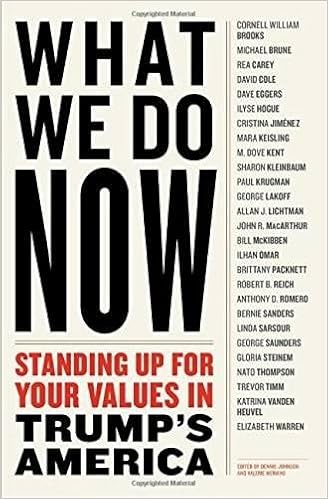
Title: What We Do Now: Standing Up for Your Values in Trump's America
Editors: Dennis Johnson and Valerie Merians
via Amazon
We're living in interesting times.

My wife's most recent Family Book Swap book for me was What We Do Now, a collection of essays from a range of left-leaning leaders.  Included on the roster are current senators (Bernie Sanders and Elizabeth Warren), a former cabinet secretary (Robert B. Reich), a Nobel laureate (Paul Krugman), leaders of powerful political organizations (David Cole and Cornell William Brooks) and even novelists (Dave Eggers and George Saunders).  Okay, so "left-leaning" is an understatement.  These are the true blues.  All write in response to the current liberal panic: how do we survive a Donald Trump presidency?

As a rule, I avoid discussing politics on the blog.  Here, as in the real world, it's an easy way to lose friends.  But we're living in interesting times and it's becoming darn near impossible to avoid discussing where we suddenly find ourselves on the American cultural journey.  For those of you who visit regularly, my own positions probably aren't too difficult to suss out, though I'm sure this post will resolve any lingering confusion.

The liberal objections to the rise of Trump are both numerous and obvious.  I think it's important, though, to delineate between objections to the Orange One himself and objections to policy shifts that would have occurred with any Republican victory in November.  Narcissism, paranoia, contempt for humanity, lack of experience: that's all Trump and frankly, there are plenty on the right who find those qualities just as terrifying as I do.  (Any bets on which Republican senator will ultimately take him down?  My money's on Lindsey Graham.)  Trump certainly owns the ridiculous Muslim ban, the stupid border wall, his attacks on the press and his way too cozy relationships with white supremacists.  But overturning Obamacare, backslides on race relations, LGBTQ rights, women's rights, climate change?  Those were likely with any White House party switch.

All of the book's essays are well-written.  Unfortunately, not all of them do genuinely offer constructive solutions.  There's a lot of admiring the problems.  Too many of the writers focus too much on their own areas of interest (though to be fair, that's probably exactly what the editors requested of them).  I can't say the book actually made me feel any better, though I do feel I have a better grasp of some of the issues.

I did have one important epiphany after reading: perhaps we, as liberals, have bigger problems than losing one election.  Maybe there are good reasons why our side lost and failing to attend to those matters is why we lost.

Clinton lost the election because she lost three states: Michigan, Pennsylvania and Wisconsin.  The last Republican to win any of those three was George H.W. Bush in 1988.  The last to win all of them was Reagan in '84.  All three were close.  Trump won Pennsylvania by 68,236 votes, 1.2% of the votes cast.  Wisconsin: 27,257 votes, 1%.  Michigan: 13,080 votes, 0.3%.  All three states have been hit harder than most by the changes in industrial America over the past generation.  As Eggers pointed out in his piece, 110,000 voters in Michigan chose neither presidential candidate in 2016, twice as many as in 2012.  To be clear, these are not people who didn't vote at all.  These are people who dutifully filled out ballots, making their choices in statewide and local races, but left the Clinton/Johnson/Stein/Trump boxes blank.  110,000 people were so disgusted by the choices at the top of the ticket that they chose no one.  110,000 people felt that no candidate was doing anything to address their interests.  If 13,081 of them could have been convinced that Clinton was the best choice, she would have carried the state.

But it's not Clinton's fault.  It really isn't.  Yes, I know all the Bernie supporters (of which I was certainly one) say he would have won and maybe he would have but that's beside the point.  Those 110,000 people in Michigan are right to be disappointed with the Clintons and with the Democratic Party at large.  When you make free trade agreements that help the stockholders but screw the workers, you're going to pay for it at the ballot box.  Sure, the Republicans aren't really offering much help either but the Dems are supposed to be the pro-labor party.  For too many in this country, the Dems dropped the ball.  For those 110,000 people in Michigan and the thousands of others like them in Pennsylvania, Wisconsin, Ohio, etc., the lesser of two evils isn't good enough.  And it shouldn't be.

For me, it all boils down to this one simple truth: we, as an American society, are not good at dealing with poverty.  Americans see being poor as personal failure, not as an inescapable reality in an economy built on inequities.  We're great at scapegoating.  The inner cities would be better if there weren't so many poor people.  Let's gentrify!  Public schools can be saved by upper middle class parent involvement!  The far right blames minorities, immigrants and labor unions for the problems of the working poor.  Democrats blame Republicans, knowing full well their own campaign coffers are just as dependent on big-moneyed interests.  We on the left would rather blame Trump and what could only be his racist and misogynist supporters or question the validity of the Electoral College than own up to our shortcomings.

Meanwhile, poor people are left to wonder who the hell is actually going to help make their lives better.  No one does so they lose faith in the whole process.  Who can blame them?  Oh, that's right.  We do.  All the time.

Please join us and share your own review of your best read from the past month.  This month's link list is below.  I'll keep it open until the end of the day.  I'll post April's tomorrow.  Meetings are the last Friday of each month.  Next gathering is April 28th.


Wednesday, July 27, 2016

Family Book Swap: The Night Manager

Title: The Night Manager
Author: John le Carré
via Goodreads
My wife is a big fan of spy novels, especially the work of John le Carré, himself a former British agent.  Together, we have watched several screen adaptations: Tinker, Tailor, Soldier, Spy, Smiley's People, The Tailor of Panama and The Constant Gardener.  Just recently, BBC and AMC aired a six-part miniseries of The Night Manager, starring Tom Hiddleston, Hugh Laurie and Olivia Colman. We both enjoyed it thoroughly and my wife used it as an opportunity to share the book with me.  For my side of the swap, I gave her Samskara by U.R. Anantha Murthy.  Her Goodreads review is here.

As we meet Jonathan Pine, he is the night manager of a ritzy hotel in Zurich.  The new guests for the evening are arms-dealing king pin Richard Roper and his entourage.  Unknown to Roper, Pine is already aware of him and the source of his wealth from a previous encounter in Cairo.  Roper had killed the woman Pine loved, or at least arranged for her killing.  Out for personal revenge and spurred by his own needs for redemption, Pine makes contact with British intelligence and becomes the point man in a scheme to bring Roper down.

After devoting some time to developing a credible back story, Pine ingratiates himself with Roper by rescuing his son in a staged kidnapping attempt.  Roper rewards Pine by giving him a cushy job in the operation.  While trying to gather information for his intel handlers, Pine dances around the suspicions of Roper's inner circle as well as the increasing affections of his girlfriend, Jed.

The differences between book and miniseries are many.  The novel was le Carré's first after the end of the Cold War.  Latin American drug cartels were the big concern.  The 2016 adaptation plays more on worries about armed militias in the Middle East.  In the book, Olivia Colman's character Burr is a man.  Jed is British in the book, American in the series with a different backstory.  The endings are significantly different, particularly important for anyone who has experienced one but not the other.

I think Hugh Laurie's involvement in the project (both he and Hiddleston also have executive producer credits for the miniseries) is interesting.  Laurie himself wrote a novel, The Gun Seller, which also dealt with the arms trade.  Clearly it is an issue of importance to him, explaining his willingness to play the villain and also, perhaps, the different ending to the miniseries.

I definitely recommend the book.  A lot of material is devoted to the bureaucratic battles behind the scenes in London.  That bit's not as interesting to me but as long as the story sticks with Pine, it moves quickly.

Wednesday, July 6, 2016

Family Book Swap: The Big Short

Title: The Big Short: Inside the Doomsday Machine
Author: Michael Lewis
via Wikipedia
My wife and I have resumed our annual summer tradition of a family book swap.  The Purple Penguin has her own reading agenda for the summer so she's not participating this year.  I gave my wife Foundation by Isaac Asimov.  Her Goodreads review is here.

Her book for me was The Big Short by Michael Lewis, the story of the subprime mortgage crisis told from the perspective of the few in the financial world who saw it coming.  My wife and I saw the excellent film based on the book during our visit to Washington in December.  I am also already a fan of Lewis's work having read and thoroughly enjoyed Moneyball (review here).  As such, I was delighted for the excuse to read The Big Short.

In his book Polysyllabic Spree, British author Nick Hornby offered a marvelous review of Moneyball: “I understood about one word in every four of Moneyball, and it's still the best and most engrossing sports book I've read in years."  That's a fair summation of my feelings about The Big Short.  High finance talk loses me in a hurry.  As much as I love numbers, the stock listings never drew my attention the way the sports page did.  Of course, all of the jargon surrounding the mortgage crisis is more esoteric than most, by design.  We peasants on the street were never meant to understand.  Those who control the information control the world - until they lose control, that is.  Then we're all screwed.

Lewis does his best to explain it all, though the film did it better so I was glad to have seen it first.  Even so, the book is brilliant.  Lewis's genius as a writer is character development.  The heroes of his tale are a few hedge fund managers who saw the madness and fragility of the subprime market and boldly bet against it.  All of them are wonderfully drawn.  My favorite is Steve Eisman, played by Steve Carell in the movie.  He's a misanthropic wacko with a gift for seeing through bullshit.  His attempt at playing golf in chapter 6 is not to be missed.

The crazy part about following this story either in print or on screen is the realization that in rooting for these guys to be right, you are rooting for economic catastrophe.  It's not a good book to read if you want to maintain a positive outlook on humanity.  You will laugh and you will learn.  Just don't go into it hoping for reassurance.

Friday, August 28, 2015

The Cephalopod Coffeehouse: August 2015

Welcome one and all to the Cephalopod Coffeehouse, a cozy gathering of book lovers, meeting to discuss their thoughts regarding the works they enjoyed most over the previous month.  Pull up a chair, order your cappuccino and join in the fun.  If you wish to add your own review to the conversation, please sign on to the link list at the end of my post.

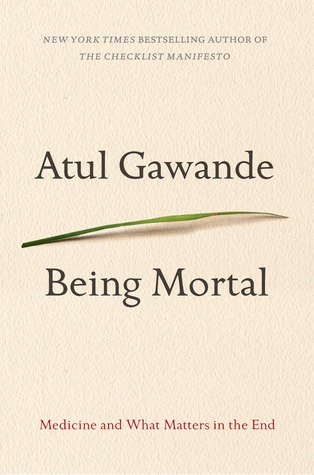
Title: Being Mortal: Medicine and What Matters in the End
Author: Atul Gawande
via Goodreads
Death is inevitable.  That is the one inescapable truth of human existence.  Yet the medical establishment is armed to the teeth with both the tools and the philosophy to prolong life as long as possible, too often disregarding the quality of life it fights to preserve.  Dr. Gawande, a surgeon himself, shines a light on this troubling dilemma.  He exposes the failings of his profession but also the efforts of those who work to provide a more noble, dignified and enjoyable life to both the aged and the dying.  He is not shy about discussing his own shortcomings and how learning about the alternatives has made him a better doctor.

As Gawande points out, most people in the industrialized world do not die abruptly.  Modern medicine is a lot better at fending off the Reaper than it was even a generation ago.  Also, most of us are going to require a significant level of care as we near the end.  Nearly a quarter of all Medicare expenses are paid out in the last year of life.  Yet most people don't devote enough thought to how they want to live at the end.  What makes our lives worthwhile?  What sacrifices are we willing to make in order to live more meaningfully?  At what point does letting go of life become more important than fighting death?

Gawande explores all of these questions in regards to long-term care, doctor-patient relationships, palliative care and other end-of-life choices.  He interviewed experts in pertinent industries but also shares his own experiences, both personal and professional.  The material can be difficult to read at times but that's sort of the point.  As humans, our natural tendency is to live in denial of our own mortality.  We never talk about it.  We never think about it until we must.  By then, we're too often making critical decisions based on lack of information, external influence from doctors and the pressure of the moment.  Meaningful conversations with our loved ones and professional providers are vitally important.  We should have them early, before we are forced to act in desperation.

The book's cautionary tales are brutal but Gawande does provide a hopeful path forward.  Oddly enough, it did not leave me fearing death.  For me, there has always been a comfort in knowing that life is finite.  We have no choice but to make the most of the time we have. 

So, you need to read this book.  Because if you're lucky, you'll grow old.  More importantly, regardless of whether you're lucky or not, you're going to die.  The same is true for everyone you care about.  Being Mortal provides meaningful guidance in helping one another face the inevitable.

Please join us and share your own review of your best read from the past month.  This month's link list is below.  I'll keep it open until the end of the day.  I'll post September's tomorrow.  Meetings are the last Friday of each month.  Next gathering is September 25th.


Friday, July 31, 2015

The Cephalopod Coffeehouse: July 2015

Welcome one and all to the Cephalopod Coffeehouse, a cozy gathering of book lovers, meeting to discuss their thoughts regarding the works they enjoyed most over the previous month.  Pull up a chair, order your cappuccino and join in the fun.  If you wish to add your own review to the conversation, please sign on to the link list at the end of my post.

Title: The Graveyard Book
Author: Neil Gaiman
via Wikipedia
Imagine The Jungle Book set in an English cemetery rather than an Indian rainforest.  That, in a nutshell, is The Graveyard Book.  As I've written before, Neil Gaiman's work is hit or miss for me.  This one was a bullseye.

The basic narrative structure is Kipling but the world-building is Gaiman, with an assist from illustrator Dave McKean, his longtime collaborator.  A little boy, on the run from a man who had just murdered his family, wanders into an old cemetery.  The ghostly inhabitants take him in and do their best to raise him as clearly not one of their own.  They give him a near-anonymous name: Nobody Owens, Bod for short.  Bod's friends - truly his extended family - span centuries and social classes, including the outcasts in the Potter's Field.  His Bagheera is Silas, a being who resides between the worlds of the dead and the living.

Bod does have occasional interactions with the world beyond the graveyard.  He befriends a little girl.  He goes to school briefly.  Unfortunately, such adventures leave him vulnerable to the man who is still out to kill him for reasons unknown.  So he spends most of his life behind the gates of the graveyard where Silas and the others can keep him safe.

It occurs to me in reading this book that my issues with Gaiman have nothing to do with his style.  He's a wonderful writer.  But his stories tend toward horror and I've never been so keen on the trappings of that genre.  I prefer wizards to vampires and elves to ghosts.  But I'm always up for suspense and The Graveyard Book delivers nicely.  It's one of those reads where the pace picks up considerably at the end, as the reader sorts out what's going on just ahead of the characters. 

The Graveyard Book was my daughter's choice for me in our most recent family book swap.  The story has been adapted into a graphic novel in two volumes.  A film is in the works, too, to be directed by Ron Howard.
 
Please join us and share your own review of your best read from the past month.  This month's link list is below.  I'll keep it open until the end of the day.  I'll post August's tomorrow.  Meetings are the last Friday of each month.  Next gathering is August 28th.


Sunday, July 12, 2015

On the Coffee Table: Hungry Planet

Title: Hungry Planet: What the World Eats
Authors: Peter Menzel and Faith D'Aluisio
via Peter Menzel Photography
Menzel and D'Alusio, a husband-photographer/wife-writer team, have created a number of globe-trotting coffee table books.  They seek to document the everyday lives of ordinary people around the world.  The concept for Hungry Planet is simple in theory, no doubt arduous in execution: family portraits, all members gathered around the week's groceries.   The journey covers 36 families in 24 countries over six continents.  Profiles range from Darfur refugees in Chad to middle class families in the United States.  Family challenges range from healthy dietary balance to basic survival.

Hungry Planet inspires a number of emotional reactions for me.  I envy the authors' adventure.  I have harbored world travel fantasies from a young age.  In what wanderings I have managed, I have learned that the most meaningful discoveries are to be found not at major sights but in family homes.  I realize such a book requires far more money, time and energy than I am either able or willing to commit at this point in my life so I am grateful for the armchair perspective.

I am also grateful for the lifestyle which accidents of birth have afforded me.  Obviously, the differences between life in the Ecuadoran Andes and the Tokyo suburbs go far beyond what's on the dinner table but I would argue there is no more meaningful starting point.   As much is to be learned from the procurement and storage of food as from its preparation and consumption.  A sharp line is seen between the cultures of abundance and those of scarcity.  Anyone who has spent their life in more of the former than the latter as I have should consider themselves lucky indeed.  Occasional similarities are noteworthy.  Coca-Cola bottles are seen the world over, of course, but we are also treated to preparations for All Saints Day festivities in both Guatemala and Poland.

Each family profile includes photos, a recipe and demographic statistics for the country in question.  Interspersed with these chapters are essays by various food writers on global gastronomic issues: fast food, responsibilities towards the animals we eat, ocean stewardship, the health consequences of over-abundance, etc.  If any place is presented as the ideal, it is Okinawa, Japan.  As a result of healthy lifestyle choices and a reverence for the aged, the small island boasts the world's highest longevity rates.  But even there, the global reach of fast food culture has had a major impact on the health statistics of younger generations.  Fewer Okinawans are likely to reach age 100 in decades to come. 

The photography is excellent.  The text is good, too, though the editing is a bit funky.  Most of the writing is D'Aluisio's but Menzel adds his own notes and, of course, there are photo captions.  As such, the same story often gets told three times.  The captions themselves sometimes suffer form awkward placement on the page.  Overall, though, the book is very good and a wonderful exploration of daily life around the world.

In other exciting news, my wife recently blogged about our summer book swap.  See her post here.

Friday, June 26, 2015

The Cephalopod Coffeehouse: June 2015

Welcome one and all to the Cephalopod Coffeehouse, a cozy gathering of book lovers, meeting to discuss their thoughts regarding the tomes they enjoyed most over the previous month.  Pull up a chair, order your cappuccino and join in the fun.  If you wish to add your own review to the conversation, please sign on to the link list at the end of my post.

Title: Bonk: The Curious Coupling of Science and Sex
Author: Mary Roach
via Amazon
My Wife's first book swap choice of the summer for me was Bonk, Mary Roach's survey of sex research.  Just as The Omnivore's Dilemma inspires an assessment of one's relationship with food, Bonk inspires a re-examination of one's sexual being.  Am I going to share that assessment with you as I did with the other?  Well, no, I'm not that kind of blog (I can hear your collective sigh of relief).  Suffice to say, the book did leave me feeling grateful for my own lot in life and gave me plenty of reason to hope for continued health in the future.

I wouldn't consider myself particularly prudish.  In fact, I am of the opinion that people should be able to talk about sex openly and respectfully.  I don't mean the locker room talk.  That's about ego gratification.  I simply mean that we shouldn't all be so embarrassed by the idea that sex is a significant element of human life.  Learning more about it and being able to discuss it frankly with the important people in our lives is both healthy and responsible.  I wouldn't say I'm always able to do that but I think it's a worthy goal as a society.  As such, I think Mary Roach and the scientists she studied are to be commended for their contributions.

That is not to say the book didn't make me squeamish from time to time.  For me, the discomfort had more to do with surgery than with sex.  I'm okay with discussing body parts unless you're talking about cutting them open.  Yick!  There are plenty of leg crossing moments for both ends of the gender spectrum.  I was tempted to skip a few particularly cringe-worthy passages but I soldiered on.  Even with the occasional wince, I think I'd be up for more from Roach.

Be forewarned, the book is very funny.  I would not be comfortable reading Bonk on an airplane - less for the subject matter than for my own incessant chortling.  Roach's commitment to the project is total, even offering herself and her husband as study subjects.  Her sense of humor about both sex and herself make for a highly engaging read.

Please join us and share your own review of your best read from the past month.  This month's link list is below.  I'll keep it open until the end of the day.  I'll post July's tomorrow.  Meetings are the last Friday of each month.  Next gathering is July 31st.


Tuesday, May 26, 2015

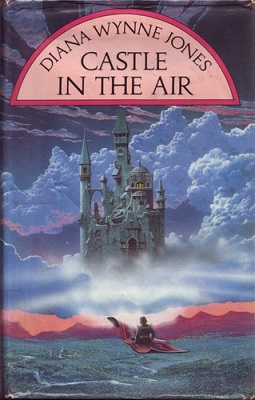
Family Book Swap: Castle in the Air

Title: Castle in the Air
Author: Diana Wynne Jones
via Wikipedia
With summer approaching, we have resumed our Family Book Swap.  Castle in the Air was my daughter's book for me.  Diana Wynne Jones is her favorite author, her devotion reaching the point where her teacher had to encourage her to try other books for the sake of variety.  I read Howl's Moving Castle a couple of years ago and was curious about this companion story so I was delighted she chose it for me.

Abdullah is a carpet merchant.  One day, a man sells him a magic carpet, one that not only flies but has an uncanny knack for making Abdullah's daydreams come true.  He is whisked away to a beautiful garden where he meets Flower-in-the-Night, the Sultan's daughter (though he doesn't learn that bit until later).  The two fall in love.  The trouble begins when she is kidnapped by a djinn and Abdullah is compelled to run after her.

As it turns out, the djinn and his brother have nabbed a whole slew of princesses, though clearly without fully considering the implications of trying to control 30 willful women together in one room.  The Howl characters do turn up over time but it takes a while.  The energy of the story certainly picks up once they do, perhaps even drowning out the Abdullah adventure.  Even so, I did enjoy the book and am curious about the third volume of the Howl series, House of Many Ways.