Showing posts with label Buddha. Show all posts

Sunday, August 24, 2014

Squiddies 2014

The Armchair Squid turns five years old today.  It's time to hand out some hardware.  And the Squiddy goes to...

Biggest Surprise: Stan Wawrinka Wins the Australian Open
via Wikipedia
In my Squiddies post a year ago, I wrote that Switzerland's Stanislas Wawrinka was not likely to threaten for major tennis title.  Well, he showed me!  In January, he broke the Big Four's stranglehold on the Slams by winning the Australian Open.  It was the first time since the 2009 US Open that any man outside of Novak Djokovic, Roger Federer, Andy Murray and Rafael Nadal won a major.


Biggest Disappointment: Basement Flood
via Amazon
One Wednesday morning in April, we woke up to three inches of water in our basement.  We lost a lot of stuff, mostly books.  Most disappointing for me, my treasured Dungeons & Dragons books from the '80s were thoroughly soaked.


Best Match: Wimbledon Men's Final

Roger Federer is not the irresistible force he was 5-10 years ago but he's still substantially better than nearly everyone else on tour.  He gave Novak Djokovic just about all he could handle for five sets in the Wimbledon final before the Serb finally broke through.  It was a brilliant match with both players providing sparkling moments of genius.  With the win, Djokovic also regained the World #1 ranking.


Best Story: Wawrinka

With his Aussie Open title, Wawrinka cracked the top 5 for the first time in his career and, far more shocking, became the top ranked Swiss player.  There's no shame, of course, in being second best to Federer but finally passing the grandmaster must have felt awfully good.  Wawrinka won their next head-to-head match, too, besting Fed in the final of the Monte Carlo Masters in April.  Alas, at Wimbledon, order was restored.  Federer's quarterfinal victory over Wawrinka was visibly demoralizing for the younger man.  Roger is Swiss #1 once again.


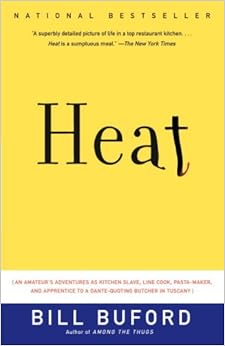
Best Read, First-Time Category: Heat: An Amateur's Adventures as Kitchen Slave, Line Cook, Pasta-Maker, and Apprentice to a Dante-Quoting Butcher in Tuscany by Bill Buford

via Amazon
My Wife had the brilliant idea of a Family Book Swap for the summer, each of the three of us giving books to the other two.  Heat was the first one she gave to me and my favorite book for the year.  As the subtitle explains, Buford's culinary odyssey takes him from New York City to the Italian countryside.  He genuinely wants to learn to cook but also clearly enjoys the outrageous characters he meets along the way, as do I.  It's a book that makes me want to learn more: always a good thing.


Best Read, Re-Read Category: A Wrinkle in Time by Madeline L'Engle
via Wikipedia
Admittedly, Wrinkle was my only re-read this year but I was delighted to revisit this childhood classic.  L'Engle's tale of inter-dimensional travel and self-actualization speaks to me differently as an adult.  I still prefer the third book of the series, A Swiftly Tilting Planet, but Wrinkle's good fun.


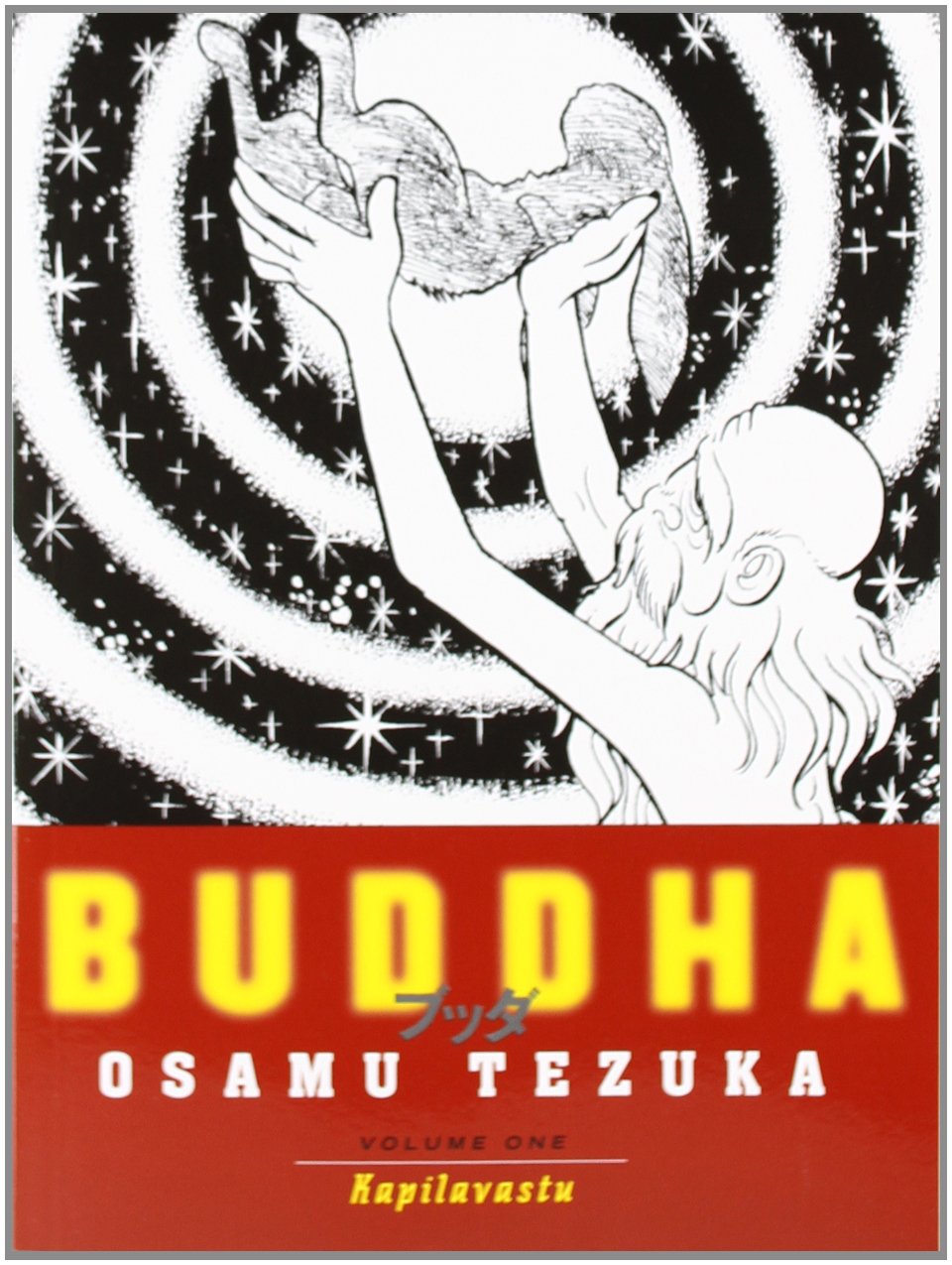
Best Comics Find: Buddha by Osamu Tezuka
via Amazon
Tezuka is manga's most revered creator.  His series on the life of Buddha ran in Japan from 1972-83 and was translated to English in 2006.  Buddha's path is filled with characters both historical and fictional.  I am by no means an expert on the faith but I think the series is at least good fuel for anyone eager to learn more.  The artwork, especially the landscapes, is frequently breathtaking.


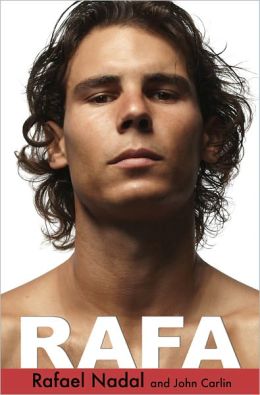
Athlete of the Year: Rafael Nadal
via Barnes & Noble
The computer rankings say that Djokovic has had a better year but Rafa's two Slam titles over the past twelve months trumps Novak's one.  Plus, I read Rafa's autobiography this year.  The long-term outlook for Nadal is frequently worrisome and concern is definitely warranted at the moment.  He hasn't played a match since Wimbledon and has withdrawn from the US Open with a wrist injury.  He would have been defending champion in New York so his ranking points will take a serious hit.  Some day, he'll decide that the wear and tear on his body just isn't worth it anymore and he'll retire to Mallorca to wallow in his millions.  He doesn't have much left to prove but the Rio Olympics will be played on clay.  I can't imagine that isn't a powerful incentive for him to tough it out for a couple more years.


Post with Most Unexpected Consequences: Star Trek: The Alternative Factor

Janet MacLachlan.jpg
"Janet MacLachlan" by [1]. Licensed under Fair use via Wikipedia.

I think it's fair to say that "The Alternative Factor" is one of the weaker stories from the Star Trek original series run.  However, the episode is notable for what didn't happen.   The original script included what would have been network television's first interracial romance, sealed with a kiss.  But southern affiliates balked so the idea was shelved for a couple of years.  This discovery inspired my blogger pal Maurice Mitchell to do further research.  His much better post on the subject can be found here.


Best Family Adventure: Montreal

This was a tough choice.  Looking back, we've had several satisfying adventures this year.  Our Colorado trip last month was a wonderful opportunity to reconnect with extended family.  That would be Purple Penguin's top choice for sure.  Our weekend in Montpelier for the Green Mountain Film Festival was also a great success.  Even the Family Book Swap was worthy of consideration here.

In late February, we spent a few days in Montreal.  The city's only a couple hours away from us and we go several times a year but always just for the day.  This was our first overnight in town as a family.  We hit a few tourist attractions but mostly, it was an opportunity to observe Montrealers going about their daily lives: going to work, walking their kids to school, etc.  Not wanting to be stressed out by driving, we left the car at the hotel for the duration and got around via subway.  Public transit is excellent, a great way to see Montreal.  It was bitterly cold but that gave us an honest view of life in the Canadian winter.  I'm very happy about the role Montreal has come to play in our family. Getting to know the city on more intimate terms was lovely.


Best Unexpected Benefit of Blogging: The Adventure of Guest Posting
via Goodreads
In July, I had the honor of writing my first guest post, a piece about bullying on Janie Junebug's blog, WOMEN: WE SHALL OVERCOME.  It was also a second opportunity to share my thoughts on another of my favorite books from the past year, Wonder by R.J. Palacio.  Engaging with another blogger's audience was highly enlightening and a great way to make new friends.


Squiddy Posts from Previous Years:

2013
2012
2011
2010

Friday, May 2, 2014

On the Coffee Table: Ananda and Beyond

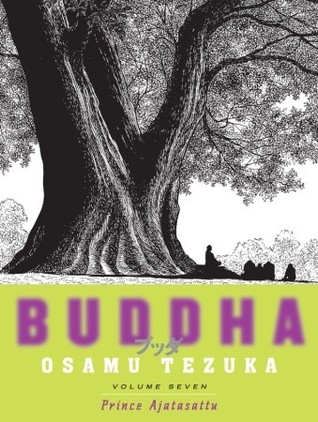
Titles: Buddha
- Volume 6: Ananda
- Volume 7: Prince Ajatasattu
- Volume 8: Jetavana
Writer and Artist: Osamu Tezuka
via Amazon
I have reached the end of Tezuka's Buddha series.   My previous posts on this manga can be found here, here and here.  While I am not completely ignorant of Buddhist teachings, I don't know enough to say with any authority whether Tezuka portrays the faith or its central figure accurately.  However, I can say the presentation is highly engaging and provides enough of an introduction to the subject matter to inspire a novice to learn more.
via goodreads
From comments on some of my posts about sequential art (the fancy-schmancy way of saying comic books), I've gotten the sense that many are not entirely comfortable with the idea of serious subjects presented in this medium.  To a point, this is understandable.  In American society, at least, comics and cartoons are associated with children, humor and/or the fantasy realm of superheroes.  A graphic novel about the sociopolitical dynamics of pre-war Germany, for instance, might not even seem possible, let alone appealing.  But if one takes a step back, one might acknowledge that film and other visual arts deal adeptly with a broad range of material and there's really no reason comic books can't accomplish the same.
via goodreads
Of course, religion would be considered by many to require a higher level of serious treatment than most subjects.  A certain reverence is expected for any faith.  But the Japanese perspective on religion - particularly their own - is quite different from the typical Western view.  Most modern Japanese don't consider themselves to be religious at all.  However, religious rituals dominate the culture.  As the saying goes, the Japanese are born Shinto and they die Buddhist.  Most of the customs associated with birth come from Shintoism, the animistic faith native to Japan, while the customs surrounding death come from Buddhism.  People take those rituals very seriously, indeed, but more for the rituals themselves than any deeper belief system.  Religious satire isn't nearly as taboo as it is in Western society so even the occasional moments of levity within the Buddha series are not entirely out of place within the broader context.

Osamu Tezuka (1928-89) is considered by many to be the greatest and most influential of all manga creators.  This was not my introduction to his work.  I was less impressed by the Black Jack series.  I feel Buddha was a much stronger showcase of his talents, as both artist and storyteller.

Sunday, March 16, 2014

On the Coffee Table: Osamu Tezuka

Titles: Buddha
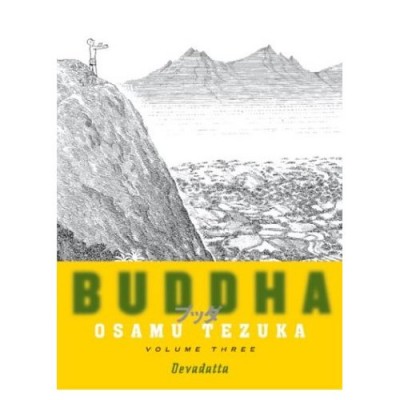
- Volume 3: Devadatta
- Volume 4: The Forest of Uruvela
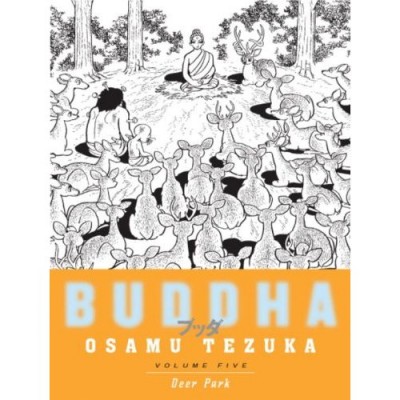
- Volume 5: Deer Park
Writer and Artist: Osamu Tezuka

My reviews for the first two volumes of this series can be found here and here.
via WorldLanguage.com
We had a rare couple of snow days this past week which afforded me time to make further progress in Buddha, Osamu Tezuka's excellent manga series.  Volume 2 ended with Siddharta leaving home to begin his spiritual journey.  The next three books cover the various paths he pursued - gurus he sought who failed to meet his needs, painful ordeals he endured which left him unfulfilled and ultimately embittered.  Finally, he attains enlightenment one day while sitting under a tree.  Brahma, whom he meets him in his dreams, renames him Buddha and a world religion is born.
via Atomic Books
Unlike most comic book series which tend to start strong, then drop off in quality, I'm finding Buddha gets better as it goes along.  In Volume 5, especially, the basic ideas of the new philosophy are thoroughly explored, often in sermons given to deer, the only beings around to listen.  I read the story of Buddha in a Major Eastern Religions class in college and was less than enthralled.  If these comics had been around at the time, my experience with the subject might have been quite different.  There is occasional levity in Tezuka's presentation but overall, the religious ideas are treated thoughtfully and respectfully.  I'm definitely up for more.
via WorldLanguage.com

Friday, March 7, 2014

On the Coffee Table: The Four Encounters

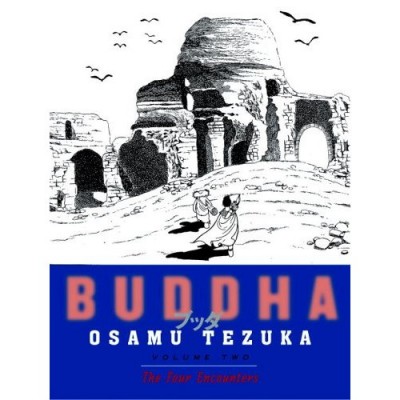
Title: Buddha, Volume 2: The Four Encounters
Writer and Artist: Osamu Tezuka
via WorldLanguage.com
As I lay in bed last night with a charming new stomach bug, My Wife brought me a delightful gift: the second book in Tezuka's Buddha series (Volume 1 reviewed here).  I knew she'd ordered it but didn't realize it had arrived.  Being sick stinks but it is a reasonable excuse to stay in bed and read.

While Volume 1 primarily developed fictional side characters, Volume 2 is entirely devoted to the early life of Siddhartha, the man who would become Gautama Buddha.  Siddhartha, born into royalty, is a misfit from the beginning.  Perceived as weak, he shows neither interest nor aptitude for becoming a warrior.  From an early age, he demonstrates disdain for India's caste system and great sympathy for all humans and animals as well.  His curiosity about death leads him to ask questions and no one in his immediate sphere is able to provide satisfying answers. The Four Encounters follows his efforts to break away from the world of his parents in order to pursue a monastic life.

The strengths of the first volume all carry over for the second.  The artwork is stunning.  I'll admit, as a comic reader, I don't spend as much time on each individual frame as I probably should.  I'm a text guy.  But with Tezuka's work, it's impossible not to linger over a panel from time to time.  Landscapes are his greatest strength, not unlike Hayao Miyazaki, a film director who was greatly influenced by Tezuka. 

I'm looking forward to Volume 3.

Monday, March 3, 2014

On the Coffee Table: Buddha

Title: Buddha, Volume 1: Kapilavastu
Writer and Artist: Osamu Tezuka
via Jeffrey M Brackett
Once again, I must break my self-imposed rule of avoiding discussions of politics and religion on my blog.  Once again, it is the quality of the work in question that drives me to do so.  Osamu Tezuka's manga Buddha tells the story of the life of Gautama Buddha, the founder of Buddhism.  The series was first published in Japanese from 1972-83.  Vertical Publishing launched an English translation in eight collected volumes, beginning in 2003.

Tezuka is the biggest name in manga, credited by many as the artist who brought the form to the Japanese mainstream.  His most famous creation was Astro Boy, which ran from 1952-68.  Religious historical fiction would seem an unusual choice for the medium but Tezuka's stunning artwork and masterful storytelling make it work.

Kapilavastu is mostly about characters other than Buddha.  Siddharta is not even born until the latter half of Volume 1.  The two characters who drive the narrative in the beginning are Chapra, a boy from the slave caste who aspires to a better life, and Tatta, a thief from the very lowest pariah caste who does not.  Both are entirely fictional but help to establish the world of Ancient India and its social system. Also Tezuka-invented is the character Naradatta, a monk who is condemned for violating a newly emerging morality.  The stage is set for a new spiritualism.

The tone is often different from what one would expect given the subject matter.  At least in the early going, story is far more adventure tale than religious fable.  But even within that context, Tezuka injects humor at odd moments: cameos for himself and Astro Boy characters as Chapra lies dying in his bed, for instance.  Perhaps it is the writer's wink to the readers to let us know that Chapra won't die... yet.

The artwork is outstanding, particularly the landscapes.  The very first panel is a breathtaking view of the Himalayas.  With strong investment in character and a curiosity to see how the introduction of Buddha is developed, I can definitely see this series holding my long-term interest.