Showing posts with label graphic novels. Show all posts

Monday, September 15, 2025

On the Coffee Table: Rawand Issa

Title: Inside the Giant Fish
Writer and Artist: Rawand Issa


In this graphic memoir, creator Rawand Issa describes her childhood in El Jiyeh, a seaside town in Lebanon.  She and her family were effectively shut off from her fondest, earliest memories when private resorts cut off access to what was once a public beach.

There's no shortage of stories about how much Lebanon has changed in recent decades.  Civil wars and military occupations by both Syria and Israel have devastated a once beautiful country.  Issa's tale is unusual for the fact that it mostly ignores the violence, focusing instead on how privatization and politics combined to separate the town's local population from an ocean that defined its culture for generations.

The book is neither long nor densely worded.  I read it in a single sitting - maybe half an hour.  The artwork is rather boxy, though boldly colored.  Inside the Giant Fish (Jonah's whale is the metaphor here) makes a simple point quite elegantly.  Solid work.

Wednesday, July 2, 2025

On the Coffee Table: The Sculptor

Title: The Sculptor
Writer and Artist: Scott McCloud

via Amazon

Struggling professional sculptor David Smith makes a deal with Death.  Over the next 200 days, his hands will create - as if by magic - anything his creative mind can conjure.  However, at the end of 200 days, he will die.  To complicate matters further, soon after, he falls in love.

I first became aware of Scott McCloud through his extraordinary non-fiction work.  His books Understanding Comics, Reinventing Comics and Making Comics offer a fascinating behind-the-scenes tour of the sequential arts medium.  They were an essential part of my own orientation to the comic book world.  The books themselves also reveal a great deal about their creator.  McCloud is as fascinated by the artistic process as he is by the product.  

The Sculptor reflects this, too, though rather than focusing on the technical aspects - especially since with his new "powers," David instantly creates whatever he wants by simply touching the material - the story follows the artist's emotional journey.  The narrative itself, particularly the love story, is engrossing.  But the deeper explorations of inspiration, motivation and the relationships between creator, consumer and critic are the more interesting drivers.  

A few years ago, I had a memorable conversation with an art teacher colleague about the role of "the audience" in creating art.  I asserted, naïvely as it turns out, that one should always consider the perspective of the consumer in the creation of a piece.  She furrowed her brow at me and responded, "No.  Some of the most important work you'll ever do as an artist is what you create for yourself - only for yourself."

I can say from decades of experience that musicians, like me, hardly ever see things that way.  Our training is built entirely around what we project to the listener.  Yes, we should internalize the work as much as we can so we embody it.  But still, that is for the sake of the performance.  Until that conversation, I took for granted that everyone in the arts felt the same way.  

While The Sculptor doesn't explore this matter explicitly, much of David's journey revolves around reconciling what is meaningful to him with what is meaningful to the consumer.  He is, after all, trying to make a living so finding buyers is important.  But as the literal deadline approaches, the financial motivations fall away.  It's the legacy that matters.  How will he be remembered?  Eventually, even that becomes less important than the honesty of his work.  

My own visual art talents don't extend very far past stick figures.  I envy anyone who can convert a mental vision into a concrete reality.  McCloud's talents are considerable.  He's a master of black-and-white, bringing rich depth and texture to his drawings.  The Sculptor was published in 2015 and I haven't seen anything new from him since.  His work is so detailed that I'm not surprised he doesn't crank out books more quickly.  Still, I hope we see more from him before too long.

Monday, December 23, 2024

Family Book Swap: Be Gay, Do Comics!

Title: Be Gay, Do Comics: Queer History, Memoir, and Satire from The Nib
Editor and Publisher: Matt Bors

via Amazon

I was never the parent who didn't want his kid to grow up.  I've loved watching the individual emerge at each new stage.  When the ultrasound nurse asked all those years ago if we wanted to know the sex of the fetus, I instantly realized it was the least of what I wanted to know.  Are they right- or left-handed?  (right)  What instrument will they choose to play?  (so many over the years - these days, clarinet and bass clarinet)  What's their favorite color?  (historically, very challenging to get a consistent answer on this one)  In the years since, as each question was answered, I was already eager for the next.  From their conception onward, one of the foremost drives in my life has been to know my child as fully as possible.

One night when the Purple Penguin was about ten years old, we went out for dinner just the two of us.  Once we settled in, they opened conversation with "Not to get too personal with you, but have you ever been gay?"  I don't know what I was expecting from our little outing but it certainly wasn't that!

From that night onward, sexuality and gender have been reasonably open topics in our family.  A few years later, they reached one of those critical realization moments for themselves.  My wife and I were quickly out of our depths in answering questions.  Off to the independent bookstore we went, returning with several of what we hoped would be helpful volumes.  Be Gay, Do Comics turned out to be the best of the bunch.  A few years later on again, the PP has asked us both to read it, too.

Independent comics have been a relatively queer-friendly space for a long time.  Alison Bechdel's Dykes to Watch Out For and the Hernandez brothers' Love and Rockets are probably the two most famous examples but there have been many others, and across cultures, too.  As associate editor Matt Lubchansky points out in the introduction,
Comics are accessible in a way that other forms of media can only dream of being.  They're not only accessible for the reader, who is presented with a lot of information in an easily digestible way, but for the creator:  One person can control the entire narrative in a medium they can publish easily online or cheaply in print.  Thus, comics presents amazing opportunities to be heard, and to hear each other, and to make the exact stories that we want and need to tell.
Be Gay, Do Comics is a collection of works by various creators.  There are several self-discovery stories which I imagine were the most important ones for the PP.  But there's more: histories of activism and resistance, bios of closeted and not so closeted (though historically hidden) homosexuals, examinations of the queer experience in other countries, etc.  We all sit somewhere on both the gender and sexuality spectra and probably most not so far on one side or the other as many would like to pretend.  The strips collected here explore both.  Even biological sex is a more complicated matter than we've been led to believe.  Be Gay, Do Comics addresses that, too.

Donald Trump takes the Oath of Office next month.  His party will hold majorities in both houses of Congress and on the Supreme Court.  Dark times are looming.  If you're not worried for the queer folks in your family and your community, you should be, no matter how blue you think your state is.  Our child has spent their entire life living in two of the most queer-friendly communities in the United States and even so, there have always been reasons to worry, regardless of which way the national political winds blow.  As they explore life options for the future, it makes me deeply sad that there are broad stretches of the country which feel unsafe to visit, never mind live in.  

As a parent, I worry.  The world is cruel and frequently dangerous.  I don't ever like to think of my child as being vulnerable so that part is hard - probably always will be.  

Beyond that, I don't feel that my basic obligations as a parent have changed.  They're still the same sweet,  imaginative, earnest and empathetic person they've always been.  Only the labels change and even the labels can seem constraining in describing the entirety of the human in my life.  Obviously, we accepted a long time ago.  In fact, I'd say we were aware of some things before they were.  But even "acceptance" doesn't feel like enough.  It implies resignation, a passive acknowledgement.  

Just as I recognized at the ultrasound all those years ago, one of my most important jobs as a parent is to know my child as fully as possible.  I have to listen without judging.  Not everything requires my reaction, one way or the other, because it's not about me.  I must honor both the questions and the answers.  The world may not always be safe.  But I need to make damn sure my child always feels safe with me.  And for that, I must do the work to truly know them.

I do have one gripe with the book.  Some of the print is very small.  Moreover, the color contrast also occasionally makes it difficult to read the text.  True, my eyes are not what they used to be but I can't imagine I'm the only one who might struggle.  I was grateful to own a magnifying glass.

Otherwise, I recommend the book to all without reservation.  One of the most important ways we can all push back on the dark cultural forces is to normalize these conversations.  It shouldn't be uncomfortable for two cis straight people to have a relaxed, comfortable, non-threatening discussion about sexuality and gender no matter how the issues directly impact their lives.  Even if you live in the reddest corner of the reddest state, these questions touch the people in your lives in ways you might never imagine.  Be the safe haven.  Listen and believe without judging.  Work to know, not just accept and tolerate.  Be Gay, Do Comics can help.  

Thursday, August 8, 2024

On the Coffee Table: Thi Bui

Title: The Best We Could Do: An Illustrated Memoir
Writer and Artist: Thi Bui

via Amazon

In an extraordinary work of sequential art, Thi Bui documents her family's history through much of the 20th century to the present.  She shares all of the struggles through the wars - first with the French, then between the North and the South with the US taking the side of the latter - and beyond.  Her family made it to the States in 1978.

The Vietnam War had an enormous impact on American society.  Obviously, those who fought were affected deeply.  Television brought the battlefield right into civilian living rooms, affecting millions more.  Countless books have been written.  Academy Award-winning films and documentary mini-series were made.  Vietnam is, for many in the Baby Boomer generation, the defining event of their young adulthood.  

What is lost through nearly all of this storytelling is the Vietnamese perspective.  In American history, Vietnam is painted as the first war we lost because the expressed objectives were not achieved.  But who won, exactly?  Yes, thousands of American soldiers were killed.  But the Vietnamese deaths - both North and South - counted in the millions.  Never mind the long-term, catastrophic damage the American military brought to a primarily agricultural country in the form of napalm and Agent Orange.  Sure, the Communists marched into Saigon anyway but the damage exacted by the United States exceeded that suffered by the United States many times over.

Bui's narrative lays plain the realities.  She also makes clear, her family was fortunate to survive.

Her story isn't all war trauma.  The books starts with a quick, two-page history of Vietnam from 111 BC to 1975 AD.  Then we're taken to the labor ward of a New York hospital where Bui awaits the birth of her first child.  Throughout, the tale shifts back and forth between present and past.  It is the rare memoir that lives simultaneously - and successfully - in the personal, the familial, the local and the global.  For anyone interested in history, Asia and/or the immigrant experience, The Best We Could Do is highly recommended.

Wednesday, August 7, 2024

On the Coffee Table: Hostage

Title: Hostage
Writer and Artist: Guy Delisle

via Goodreads

Quebecois graphic novelist Guy Delisle interviewed Doctors Without Borders administrator Christophe André about the latter's experience being kidnapped in the Caucasus.  André was snatched out of his office one evening in 1997, then held for ransom for several months in Chechnya.  For most of the time, he was chained to a radiator, only a bare mattress between himself and the floor.  On a typical day, he only saw his captors for meals and a single bathroom break.

Delisle drags us along through the seemingly endless, torturous tedium.  Since he doesn't speak his kidnappers' language nor they his, he has no idea what's going on most of the time with only occasional indications that anyone on the outside is looking for him.  For his own psychological survival, André, a war buff, plays mentally through battles from the Napoleonic Wars and the American Civil War in order to keep his brain occupied.

Amazingly, he survived to tell the tale.  I'd be interested to know more about his adjustment back to "normal" life afterwards but the book doesn't dig into that.  While the action is minimal, it's certainly a compelling story.  The starkness of Delisle's typical art style suits it well.


Wednesday, July 31, 2024

On the Coffee Table: Manga Yokai Stories

Title: Manga Yokai Stories: Ghostly Tales from Japan
Original Author: Lafcadio Hearn
Adapted for manga by: Sean Michael Wilson
Artist: Inko Ai Takita

via Amazon

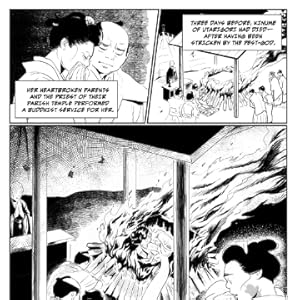
In the early twentieth century, Irish-Greek writer Lafcadio Hearn compiled and translated Japanese folk tales for an English-language readership, an important development in conveying Japanese culture to the West.  Hearn favored yokai tales, essentially ghost stories.  Sean Michael Wilson and Inko Ai Takita have adapted several from his collection to manga form.

Death is a taboo subject in Japanese culture.  The worst swears and insults refer to death in much the way they pertain to bodily functions in the Anglo world.  So even though I'm not into horror stories per se, I appreciate these for the perspective on Japanese views of death.  Themes include guilt, obsession and lust.  The most vengeful ghosts are the ones who were dishonored in life - not so different from Western tropes.  

The real treat is Inko Ai Takita's stunning artwork:

via Amazon

I would love to be able to read the stories in the original Japanese.  I always wonder what is lost in translation.  Alas, I have not the skills.  I guess adaptations will have to do.

Monday, July 22, 2024

On the Coffee Table: Yani Hu

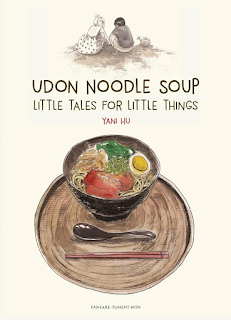
Title: Udon Noodle Soup: Little Tales for Little Things
Writer and Artist: Yani Hu

via Amazon

Udon Noodle Soup is a graphic-novel collection of short stories by Chinese-born creator Yani Hu.  As clearly indicated by the subtitle, the subjects are the simple objects that connect people in a life: the flavor of a soup, the warmth of a hand-knit sweater, a used toothbrush, a thoughtful gift, a soccer jersey.  

I was born a sentimental old fool so stories like these tug at me.  I don't let go of anything or anyone easily.  Held onto tchotchkes for way too long because they remind me of people?  Yes, I've done that.  Remembered old friends decades past the point when they've likely and understandably forgotten all about me?  All the time.  There are morals in Hu's tales, too, reminders of how cruel we can be to those who are unexpectedly generous.  It's easy to feel sorry for oneself in life - put upon, even victimized.  It's important to remember the moments we've been on the receiving end of more kindness than we've deserved.

Udon Noodle Soup is a soothing, quick read with beautiful, manga-style artwork.  It's Hu's first work in English.  I'll keep an eye out for more.

Wednesday, November 8, 2023

On the Coffee Table: Sarah Glidden

Title: Rolling Blackouts
Writer and Artist: Sarah Glidden

via Amazon

Sarah Glidden tags along when a couple freelance journalist friends travel to Turkey, Iraq and Syria in the early 2010s.  The primary goal of the trip is to uncover the stories of those displaced by the US war in Iraq: Kurds in Turkey and Iraq and Arab refugees in Syria.  Also joining the trip is Dan, an ex-Marine who had previously done two tours in Iraq.  The journalists are hoping to include his story in their project.

Embedded journalism - where a journalist is placed directly into a military unit for an intimate and often dangerous perspective - is a common practice in wartime.  Sarah Glidden's (admittedly less dangerous) experience feels like a comic book writer being embedded with journalists.  As a result, the war experiences the group hears are intertwined with Glidden's fascination with her friends' process.  Through her, we learn that the story you seek and the one you end up with are often quite different from each other.  Interview subjects don't give you the material you expect.  The truth can seem clouded by self-delusion or flat out dishonesty.  Mistrust of Americans and/or journalists impedes access.  

The group doesn't observe any combat directly.  Instead, they witness the everyday lives of refugees and exiles.  As such, we see the war from an indirect but deeply human level.  While everyone they talk to is reasonably safe in the moment, they have each been through a lot.  And the reaction to Americans run the gamut.  The Kurds typically see American involvement in the region as a positive as their own status has been boosted.  The Arabs are more resentful - and understandably.

A lot has happened in the region since - in fact, a lot happened between the trip and the ultimate publishing of the book, including the Arab Spring and the outbreak of civil war in Syria.  Since then, American withdrawal has had a brutal impact as well.  And that's not even getting into everything happening in Israel and Palestine.  American/Western intervention typically comes with its own brutally high price, no matter the best intentions of the participants.  Glidden's book doesn't offer much in the way of answers - how could it?  Instead, there are more questions.

Rolling Blackouts is an engaging read.  The artwork is simple and relatable.

Monday, September 25, 2023

On the Coffee Table: Will Eisner

Title: A Contract with God
Writer and Artist: Will Eisner

via Amazon

Will Eisner is on a short list of the all-time masters of the comic book medium.  In fact, at least in the English language, he may be the most esteemed of them all.  The American industry's most prestigious annual award as well as its Hall of Fame are both named after him.  Among his many accomplishments, Eisner is credited with popularizing the graphic novel.

In 1978, A Contract with God was published.  While it was not the first sequential art piece to break from the typical superhero model, it demonstrated the broader possibilities for the medium.  In the strictest literary terms, "A Contract with God" is probably better classified as a short story (with an epilogue) than a novel.  But its long form, self-contained, reality-based narrative was a clear break from the episodic sensationalism which had dominated the English language industry for decades.  The black and white images were richly detailed and expository text was no longer confined to the usual boxes and bubbles.  The original release was, in fact, a collection of four short stories.  In addition to the titular tale, "The Street Singer," "The Super," and "Cookalein" were also included.

The material was definitely not for children, better suited to older teenagers and above.  Frimme Hersh, Contract's protagonist, feels betrayed by God.  But he's not Tevye, Fiddler's gentle-hearted hero.  Frimme deals with his frustration by becoming a ruthless, exploitative tenement landlord.  His story is a memorable parable juxtaposing what a believer might want his relationship with God to be with what that relationship actually is.  The other stories involve nudity, sex, alcoholism and violence against women, children and animals.  The message is clear: life isn't pretty, especially not when you're poor.  Those who survive are not necessarily virtuous.

However you might classify it, A Contract with God is a masterpiece.  While I wouldn't put it on par with Maus or V for Vendetta, later works owe an obvious debt to Eisner.  He wrote sequels.  I'll be keeping an eye out for those.

Wednesday, September 20, 2023

On the Coffee Table: Seth

Title: George Sprott: (1894-1975)
Writer and Artist: Seth

via Amazon

George Sprott was a fictional local television personality from the fictional Ontario city of Dominion.  Seth (the pen name of Gregory Gallant) presents his biography in graphic novel form.  In Sprott's show, he shares films and stories of his adventures exploring Arctic Canada.  Much of his life story is told from the perspective of others after his death.  Not all of it is flattering.

I enjoyed the book but I'm also grateful to get it off my shelves.  It's enormous, over 16 inches tall and over 12 inches wide!  Finding space for it has been challenging ever since I first bought it several years ago.  The story was first serialized in The New York Times Magazine, explaining the unusual size.  Most of the panels are too small to have survived scaling down.  In his review, Glen Weldon offers "8 Practical Uses" for the book after you have finished reading it.

Nostalgia for old local television and the Canadian romanticization of the Arctic are both lovingly rendered.  The loneliness of a "star" past his prime is the main theme, interesting timing for me in that we also recently watched Sunset Blvd.  Panel usage is clever, almost like a storyboard much of the time.

Monday, September 18, 2023

On the Coffee Table: Roz Chast

Title: Can't We Talk About Something More Pleasant?
Writer and Artist: Roz Chast

via Amazon

Roz Chast's graphic memoir Can't We Talk About Something More Pleasant? addresses two of the most important topics we almost never talk about: aging and death.  The author shares the stories of dealing with her aging parents, helping them through the various transitions from independence to assisted living and through to the very end.  Chast is an only child so it's all on her.  

The book isn't pretty or sweet.  There's real pain and frustration at every stage.  The relationships are complicated in all directions - child-to-parent, parent-to-child, spouse-to-spouse - and the life changes don't make them easier.  

Chast's book hit me hard, harder than Fun Home did (see here).  These are the life changes staring me in the face.  My own parents are now in their 80s and starting, for the first time, to discuss next steps in concrete terms.  Fortunately, I have a few advantages Chast didn't.  I have a sibling, so I have an ally.  Thanks to Atul Gawande's encouragement, such matters have been an open conversation between my parents and me for a long time.  I think it's fair to say I have easier relationships with my parents than Chast had with hers but it's also fair to say our relationships aren't perfect either.  Finding the proper balance as my own needs decrease while theirs increase has been tricky.  Communication takes work.  And patience, vulnerability, persistence, forgiveness, grace... and did I mention patience?  I am neither a perfect son nor a perfect brother.  But I swear, I work at both.  

And naturally, facing my parents' increasing needs also forces me to confront the reality that one day, my wife and I will need to do the same for ourselves.  We have an only child so it will be all on them.  What can we do to make the transitions easier for all of us when the time comes?  I don't want to live forever, nor do I care to live past the point where I can reasonably take care of myself.  But mine are not the only wants and needs to consider.

Chast generously shares her struggles with all of this.  It's not an easy read.  She does little to hide the dirty details.  But it's deeply important for all of us to think about such things more than we do.  I'm grateful for her candor.  

Tuesday, September 12, 2023

Squid Flicks: Nimona

Title: Nimona
Directors: Nick Bruno and Troy Quane
Original Release: 2023
My Overall Rating: 4 stars out of 5

via Wikipedia

Ballister Boldheart is about to be knighted, an unusual honor for a commoner.  The ceremony does not exactly go as planned when he appears to assassinate the Queen.  But he's been framed.  Ballister is thrown in prison but a new, mysterious friend named Nimona breaks him out.  Nimona is eager to become Ballister's sidekick in his quest for revenge and redemption.  She is also quite a lot more than she appears.  She's a shapeshifter, one who figures prominently in cultural lore.

Nimona is based on the graphic novel of the same name by ND Stevenson.  Initially, it was supposed to be a Blue Sky Studios production, set for release in 2020.  But when Disney bought 21st Century Fox, Blue Sky's parent company, the new bosses balked at Nimona because of LGBTQ+ content.  Ballister, you see, is gay.  He has a boyfriend, Ambrosius, and the relationship is completely normalized.  Well, okay, Ambrosius is also one of the Elite Knights and cuts off Ballister's arm after the Queen is killed, ultimately emerging as a sympathetic antagonist - all of that gets a bit complicated.  But no one - not even the story's playground bully character - makes a big deal of the fact that they're both men.  Obviously, that ain't Disney!  The project was repeatedly delayed and ultimately shelved.

Shame on Disney!

Annanpura Pictures came to the rescue.  They bought up the rights.  Netflix signed on as the distributer.  Green light, go.

The movie's a lot of fun.  The animation is impressive - hints of The Secret of Kells in the early going and evidently Easter Egg homages to Blue Sky films (now defunct) throughout.  The world building is thorough, complete with its own internal mythology.  Nimona, the character, is particularly wonderful.  I don't know if there are plans for a sequel but I am in favor.

Monday, September 11, 2023

On the Coffee Table: Alison Bechdel

Title: Fun Home: A Family Tragicomic
Writer and Artist: Alison Bechdel

Many have banned and/or attempted to ban this book.  So, obviously, everyone should read it.

Fun Home is the graphic memoir masterpiece of Alison Bechdel, the queen of queer comics.  Before the book, she was well-established within the industry for the long-running strip Dykes to Watch Out For.  Fun Home brought her into the mainstream, hitting best-seller lists, earning loads of accolades and eventually being made into a Tony-winning Broadway musical.  

Bechdel tells her story of growing up in a small town in central Pennsylvania.  She clearly had complicated relationships with both parents, though the book is mostly about her father, a high school English teacher, an interior decorating savant and a closeted homosexual.  Alison didn't know the last bit until she came out to her parents herself during college.  Unfortunately, he had a preference for teenage boys, a fact which brought legal troubles.  Not long after these revelations, he committed suicide - quite a lot to absorb for Alison and her younger brothers.  

Intertwined with all of this are Alison's own adventures of sexual discovery.  Even more than the dirt on her father, this is the part that likely gets the conservatives bent out of shape.  There's sex, nudity, masturbation, etc.  It normalizes both female sexual awareness and the gay experience.  I've got what I expect is upsetting news for the MAGA crowd: both of those things are normal.  And healthy.  And far less damaging than the shaming and violence you would rather subject people to.  Indeed, Alison's path was deeply complicated by her own basic insecurities and the social politics of rural Pennsylvania (Pittsburgh and Philadelphia with Alabama in between).  

The story is not all sadness.  The author shares plenty of childhood joy, even in her relationship with her father.  The ultimate lesson: pain is complicated.  It is but one river of many that flows through a life.

Fun Home has been equated by some with Maus and Persepolis as masterpieces of the genre.  I'm not quite ready to put it on that level, though it is truly outstanding.  The intimacy grabs ahold of you from the first panel onwards.  I'm definitely up for more of her work.

Thursday, August 3, 2023

On the Coffee Table: The Customer Is Always Wrong

Title: The Customer Is Always Wrong
Writer and Artist: Mimi Pond

via Amazon

The Customer Is Always Wrong is a continuation of Over Easy.  The two books combine to form a memoir (with a few artistic liberties) of the author's experiences as a diner waitress in 1970s Oakland.  Ideally, one should probably read the two books back-to-back as no reminders are given at the beginning of the second book about story details from the first.  No matter.  Nothing is so complicated that it isn't easy to catch up quickly.  Most of the other diner employees are quirky at best, drug-addicted at worst.  The world is held together by Lazlo, the philosopher/manager/father-figure.  Madge's goal is to save up enough money ($2,000 is the goal) to move to New York and have a real go at an art career.

I found myself less sympathetic towards Madge in this second book.  She's highly judgmental of people she shouldn't be: "whores and drunks" who call for cabs when, in her opinion, they should have friends or family to come pick them up.  Then she's not judgmental enough of the people she should be: a loser, lying boyfriend first and then more tragically, her heroin-addicted colleague/neighbor Camille who constantly takes advantage of her.  In short, she's over-trusting and still expects other people to take care of her.  She's an entirely believable character.  I simply don't like her very much.

Even so, I'd read more Mimi Pond books if she writes them.

Wednesday, August 2, 2023

On the Coffee Table: Jeff Lemire

Title: The Underwater Welder
Writer and Artist: Jeff Lemire

via Amazon

Jack is an underwater welder for an oil well off the coast of Nova Scotia.  He's about to become a father and he's not handling the impending life change well.  He'd rather spend time fixing the rig than with his imminently expecting wife.  Meanwhile, he's haunted by memories of his own father who drowned in the ocean when Jack was a boy.

Jack has an accident on the rig and while he's blacked out, his subconscious dances between the present, the past and a supernatural dreamscape in which he's the only one left in his quiet coastal town.  The latter is seemingly what he wants, or at least the sort of existence his choices have been leading him to: no commitments, no betrayals, no emotional risks.  

via Goodreads

Lemire's style generates an intimate atmosphere.  People are crudely drawn, almost ghoulish, befitting the story.  The backgrounds are deceptively simple, suiting the desolation of the Nova Scotia seaside.  I would say the promotional materials - the back cover blurb and the intro - oversell the supernatural aspects of the story.  The dreamscape is clearly an hallucination, probably oxygen-depravation inspired.  Even so, the story is well told, based in raw emotion.

Monday, July 24, 2023

On the Coffee Table: Lamia Ziadé

Title: Bye Bye Babylon: Beirut 1975-1979
Writer and Artist: Lamia Ziadé

via Amazon

Bye Bye Babylon is Lamia Ziadé's graphic memoir about her childhood in Beirut, when one of the most beautiful cities in the world was reduced to a war-torn hell-scape in a matter of weeks.  Ziadé was seven years old when the Lebanese Civil War erupted.  Her story begins with the images of Bazooka bubblegum, Kraft marshmallows and other consumer products familiar throughout the world.  It soon moves to the weaponry of war, pictures that shouldn't be part of anyone's normal day, let alone a young child's.  Her artwork appears painted rather than drawn, with sharper lines for the war and political material than for the dreamier, mostly pre-war elements.

Though I didn't plan it that way, this was my second read in a row with Babylon in the title (see here).  Both this and Pat Frank's Alas, Babylon draw on the biblical/historical story of a great city lost.  There are common themes as the communities in each adapt to the realities of war: supply shortages, inconsistent and unreliable communication from the outside world, violence, lawlessness, death, uncertainty, fear.  There's an essential difference, of course.  Frank's work is fiction.  Ziadé's is the real deal.  The Lebanese Civil War really happened, a deeply embedded experience for millions.

Ziadé offers an intimate view.  There are sweet moments throughout her story, even after the war begins but one always feel horrors lurking on the next page.  The author has lived in Paris for most of her life but clearly still loves her native country.  She makes me wish I could visit Beirut before the war.

Thursday, May 18, 2023

On the Coffee Table: Shigeru Mizuki's Hitler

Title: Shigeru Mizuki's Hitler
Writer and Artist: Shigeru Mizuki

via Amazon

I've spent quite a bit of time with the work of Japanese manga master Shigeru Mizuki.  I was especially impressed by his Showa series, detailing the history of Japan from 1926-89.  As with many of his generation, World War II was a defining experience of his life.  His series Hitler, first serialized in Japan from 1971-72, offers a rare Japanese perspective on the European theater of the war.  Mizuki tells the human story of Hitler from his student days in Vienna to his death in Berlin in 1945.

Notice, I said "human" story, not "humanizing."  In his books on Japan, Mizuki makes crystal clear that he harbors deep resentment towards his government's destructive impact on its own nation during the war years.  The author sees Hitler the same way.  Just like Japan's leaders, the Nazis exhausted the nation's resources to pursue a maniacal vision of empire.  Indeed, Mizuki holds Hitler personally responsible for the troubles in his own life.  The human story he tells only makes Hitler all the more monstrous.  The Führer did not emerge overnight.  We get everything from his starving artist days, his military career, his wildly inappropriate crush on his own niece and, of course, his ultimate rise to power.  I learned quite a lot, particularly about the history of the party itself, beginning in the early 1920s.

The resulting impact is a bit like that of a Scorcese gangster movie.  The Nazis, Hitler included, were real people with dimension, not celluloid demigods, and that makes them all the more terrifying.  The beginning of the rise was surprisingly humble.  This could happen again all too easily.  Indeed, in other parts of the world, it has.  

Mizuki used the same artistic approach he employed in his Japanese history.  Individual historical figures are presented as near-caricatures against hyper-realistic backgrounds, often recreations of authentic photographs.  Mizuki deliberately did not devote much material to the Holocaust.  It is acknowledged graphically at both the beginning and end of the story but not in between.  Mizuki worried that to do more would overshadow the rest of the chronicle.  He wanted to emphasize the man and his madness over his most horrifying deeds.  

Shigeru Mizuki's Hitler is hardly a comforting read though it is certainly engaging.  

Wednesday, August 17, 2022

On the Coffee Table: Sonny Liew

Title: The Art of Charlie Chan Hock Chye
Writer and Artist: Sonny Liew

via Amazon

The Art of Charlie Chan Hock Chye is an extraordinary project.  Liew tells the history of Singapore from the perspective of a fictional comic book creator, Charlie Chan Hock Chye.  Charlie claims Japanese master Osamu Tezuka as his early inspiration, though the project itself, with autobiography and modern national history running parallel, is patterned more on the work of Shigeru Mizuki.  Over the course of his (fictitious) career, Chan incorporated the artisic and narrative styles of numerous comic enterprises: Walt Kelly's Pogo, Disney comics, Spider-Man, Mad Magazine, Frank Miller's Batman, etc.  Chan's (again, Liew-invented) comics are presented alongside historical annotations, sometimes also in cartoon form, further blurring the distinction between fact and fiction.

The scope of the book is breathtaking.  Liew shares a history most outside of Singapore (or even within, under a certain age?) don't know and his seemingly encyclopedic mastery of the comics medium is impressive.  The Art of Charlie Chan Hock Chye has been a best-seller and won numerous awards all over the world, including three Eisners.  It was the first graphic novel to win the Singapore Literature Prize.

Monday, February 7, 2022

On the Coffee Table: Hellraisers

Title: Hellraisers
Writer: Robert Sellers
Artist: JAKe

via Amazon

In a graphic novel Christmas Carol parody, spiraling alcoholic Martin is visited by four spirits (Ha - just got the double-entendre): Richard Burton, Richard Harris, Oliver Reed and Peter O'Toole, notorious Hollywood boozers all.  In turn, they regale him with tales of debauchery - not exactly tales of regret for any of them, interestingly.

Before we go on, a quick disclaimer: I know I write a lot about alcoholic beverages.  I enjoy drinking them and enjoy making them perhaps even more.  But folks, I am not advocating inebriation.  Let's be careful out there.  And if you or someone you love needs help, get it.

As I said to my wife the other night, Hellraisers makes me grateful that I am not an alcoholic womanizer.  At least one of the ghosts - Richard Harris, I think - says something along the lines of "people regret it when they don't live the wild life in their youth."  I won't play the saint.  There were times in my life when I bent further in those directions than I do now.  And it's not too late.  I could still get ripped every night and cheat on my wife but seriously, who has the energy?

Joking aside, when I think of the less responsible times in my life, I don't exactly miss them.  When I think wistfully of youth, I think of other things.  Might there have been ego satisfaction in more women?  I suppose.  But I'll take quality over quantity.  And once you start down that road, how many is enough?  Or is enough not the point?  And how much does betrayal become a permanent feature in all of your relationships?  Sex is great but love is better, no contest.  More booze?  Would have just meant more hangovers and blacking out on the highlights.  I'm always shocked by the sheer volume alcoholics consume.  How do you stay conscious long enough to drink that much?  Drugs?  I suppose there are experiences I missed out on.  But they're also addictions avoided.

Here's the truth I've learned: you can never be sure what you're going to regret later.  And that's why life is hard.  Whatever I might miss from younger days, I know with certainty that I'm happier now.  The predictability of middle age is delightfully comfortable.

Sorry, back to the book...

The tales of hard living are entertaining to a point but each of them ultimately sad.  Happy marriages do not mesh well with the way these men lived.  It's fun to visit the films they made: Lawrence of Arabia, Oliver, Becket, Harry Potter.  One certainly feels sympathy for the people who chose to work with them.  The book is well executed.  The art - black and white, bold lines, sharp angles - feeds the quasi-trippy, vaguely angry atmosphere.  The cautionary tale is effective.

Thursday, January 13, 2022

On the Coffee Table: Explorer

Title: Explorer: The Mystery Boxes
Editor: Kazu Kibuishi

via Amazon

As with his Flight series, Amulet creator Kibuishi created Explorer as an anthology series to showcase the sequential art work of others along with his own.  Perhaps the lesson of Flight (see here) led him to be more deliberate in establishing a theme for each installment.  Each of the seven stories in The Mystery Boxes involves just that, a mysterious box.  Obviously, each tale takes the idea in a different direction and therein lies the fun.

Most of the contributors are relative unknowns.  However, Raina Telgemeier (Drama, Smile, etc.) teamed up with Dave Roman to create "Spring Cleaning."  I appreciated the Japanese folk tale elements of Rad Sechrist's "The Butter Thief" and the Looney Tunes-esque zaniness of Johane Matte's "Whatzit."  The strongest, though, is Kibuishi's own "The Escape Option."  I find it reminiscent of Vonnegut and the final panel, which closes the volume, is stunning.