Showing posts with label science books. Show all posts

Tuesday, September 9, 2025

Off My Duff: Readjusting to the School Year


For the most part, I love middle age.  Life is simpler in many ways.  Put simply, I just don't give a crap about quite a lot of things that used to preoccupy me.  All of the self-consciousness of youth is long gone.  Ambitions remain but they're more personal than professional.  In Being Mortal, Atul Gawande writes of how our worlds get smaller as we age.  While I am still well short of elderly, I'm already feeling a need to draw those I love most closer and make the most of our time together, however long it lasts.  Truly, mine is a precious age.

But of course, there are trade offs.  My body doesn't function as well as it used to.  Most noticeably, my once 20/13 eyesight - "You could fly fighter jets," a doctor once told me - is fading fast.  I also can't keep the weight off the way I could in my youth.  Last October, one of the numbers on my blood labs was higher than it should be.  Historically, I have shrugged off these sort of concerns.  This time, the message was different: change your life or you'll be forced into changes you won't like at all.  I had three months to bring the number down for the next blood test and I took the goal seriously.

One of the big changes I made was getting more regular exercise.  I was an athletic child - not a good athlete, mind you, but a genuinely active one.  I played soccer, basketball, baseball, ran track and cross-country.  Adulthood has been different.  Team sports were a meaningful motivator for years but those are harder to pursue as an adult.  

On the bright side, just about the most efficient exercise I can get is going for a walk in my own, beautiful neighborhood.  You scoff.  I can assure you, a walk in my neighborhood is not like it is for most people reading this.  We live in the woods on a dirt road off of another dirt road.  Just to get to our mailbox, we have to go up an 8.5% grade hill.  Do you remember the old FitBits that measured how many flights of stairs you climbed each day?  It's 18 flights just up to the mailbox.  And that's only the first big hill of several on my walk route.  No kidding, it's a meaningful workout.  As long as I'm diligent, knocking out FitBit goals is pretty straightforward.

The big question is what to do in winter.  On the weekends, it's not bad.  I can still strap on the Yaktrax and feel reasonably safe even on icy days.  The problem during the week is the fact that it gets dark so early.  The nearest streetlight is literally miles away.  But we've found you can make a fitness tracker happy by jogging in place.  Cheating?  Maybe.  But I figure it's better for you than vegging on the couch.

Anyway, it all worked.  The number came down.  When I went to the doctor this summer, both my weight and my blood pressure were down, too.  He was thrilled.  

Summer's a relatively easy time to establish healthy routines.  Now that the school year has started up again, I'm finding it harder to meet my goals.  I can still knock out my step count without a problem.  Teaching keeps you on your feet.  But my active minutes are down.  I'm so tired when I get home that I just want to relax.  On the bright side, I'm sleeping better and that's important, too.  But I still want to keep those other numbers down and I know more vigorous exercise is essential.

I got a new fitness tracker several months ago: an AmazFit Band 7.  It's a third the cost of the FitBit I'd been using and, just as importantly, doesn't have the weird battery drainage issues I was experiencing.  The three main categories it emphasizes are steps, exertion and sleep.  It's a real taskmaster on the sleep - senses when I have to get up in the middle of the night to go to the bathroom, for instance.

Among other things, AmazFit tracks Personal Activity Intelligence or PAI.  PAI uses your heart rate data to assess your physical activity over a given week.  The initial goal is 30 PAI, then 50, ultimately reaching the optimum level of 100.  By the end of the summer, I was comfortably above 50.  Just two weeks later, I'm at 24.  I definitely need to make some changes.  

I think the first thing I'll do is raise my step goal.  Since reaching that has been relatively easy, it makes sense to push myself.  But I also need to be intentional about getting additional, more vigorous exercise in the evenings.

And maybe even blogging about it can help.  One thing The Armchair Squid has been very good for over the years is keeping me going with my hobbies.  Writing is a meaningful motivator for me.  Perhaps it can help here, too.

Friday, May 16, 2025

Star Trek: Meld

Episode: "Meld"
Series: Star Trek: Voyager
Season 2, Episode 16
Original Air Date: February 5, 1996

via Memory Alpha

There's been a murder and Tuvok must investigate.  The whodunnit question is resolved quickly.  Crewman Lon Suder, a Betazoid and a former Maquis, killed Crewman Frank Darwin.  With that out of the way, there's plenty of time left for a more interesting story.

Tuvok is frustrated by Suder's inability to articulate a logical motive for the crime.  He suggests a mind meld and Suder agrees.  The session has a welcome regulating effect on Suder but the impact on Tuvok is highly disturbing, awakening his own violent tendencies.  

"Meld" addresses several important philosophical quandaries in regards to criminal justice: punishment vs. reform, suspicion vs. guilt, logic vs. impulse and so on.  And, of course, there's the long-standing Star Trek question of what happens when a Vulcan lets down their well-honed emotional controls.  Tim Russ gets a wonderful opportunity to flex his acting chops and he makes the most of it.  

One of my favorite lines came early, before Suder's guilt is established.  When asked why Suder was initially recruited despite misgivings, Torres replied "In the Maquis, we didn't ask for resumes.  We needed all the help we could get."


Acting Notes

via Wikipedia

Brad Dourif (Suder) was born in Huntington, West Virginia, March 18, 1950.  He briefly attended Marshall University before leaving for New York to pursue acting.  "Meld" is his first of three appearances as Suder.

During an off-Broadway production of When You Comin' Back, Red Ryder?, Suder was discovered by director Miloš Forman who subsequently cast him in what would become Forman's masterpiece, One Flew Over the Cuckoo's Nest.  Suder played the unforgettable (aren't they all in that film?) Billy Bibbit.  Latere voiced Chucky in the Child's Play franchise.  As if that weren't enough to cement both a career and geek-cred for life, he played Wormtongue in The Lord of the Rings trilogy.  Television has been kind, too.  He played Doc Cochran in Deadwood.  He has won a BAFTA, a Golden Globe and a SAG and been nominated for an Oscar, an Emmy and a Saturn.

Friday, May 9, 2025

Star Trek: Crossfire

Episode: "Crossfire"
Series: Star Trek: Deep Space Nine
Season 4, Episode 13
Original Air Date: January 29, 1996

via Memory Alpha

Odo, as previously discussed, is in love with Kira.  Unfortunately, the Major is falling for her former comrade in arms, Shakaar, now First Minister on Bajor.  Further complicating the situation for the constable, he is in charge of Shakaar's security during his visit to the station meaning he needs to spend far too much time in the vicinity of the budding love affair.

"Crossfire" is all about Odo.  After the "Homefront/Paradise Lost" story, this one feels lighter on the surface, though anyone who has experienced unrequited love knows it's no laughing matter.  Even beyond the Kira situation, the episode involves meaningful development in Odo's relationships with others, particularly Quark and Worf.  This exchange between the two security officers is especially satisfying...


Suddenly and unexpectedly, I have mixed feelings about the Odo/Kira story.  I understand that it's meaningful self-actualization for Odo but honestly, Star Trek should be above the typical "will they? won't they?" schlock that was ubiquitous on mid-90s television.  Admittedly, with an actor of Rene Auberjonois's ilk in the role, the trope plays better than it would for most.  I have the benefit of knowing where this is going and fortunately, the writers don't leave the question dangling for as long as they could have.  Overall, I love the Odo story.  I wonder what it could have been without this element.


Acting Notes

via Battlestar Wiki

Bruce Wright played the role of Sarish Rez, Shakaar's right-hand man.  He guest-starred on the original Battlestar Galactica series as well as Cheers and The X-Files.  Films include Speed, Apollo 13 and The Negotiator.

Friday, September 27, 2024

Star Trek: Jetrel

Episode: "Jetrel"
Series: Star Trek: Voyager
Season 1, Episode 15
Original Air Date: May 15, 1995

via Memory Alpha

A Haakonian shuttle approaches Voyager, its occupant wishing to speak with Neelix.  The man introduces himself Dr. Ma'Bor Jetrel, a name which immediate horror into the Neelix's heart.  We soon learn the Haakonians had conquered Neelix's homeworld some fifteen years before and Jetrel had been the inventor of a horrifying weapon of mass destruction, an obvious Oppenheimer/atomic bomb parallel.  Jetrel claims Neelix is terminally ill, the long-term consequence of the weapon's wrath.

29 years after this episode aired, we are a year removed from the film release of Oppenheimer so our world society has spent some time recently confronting the same issues raised in "Jetrel."  It's a strong Neelix episode as he must navigate personal demons in regards to his own role in the war.  

As I write this, I have not yet watched Oppenheimer.  However, I've devoted significant personal time to learning about the bomb, mostly from the Japanese perspective.  In my early 20s, I visited Nagasaki, a city forever haunted by that horrible day but also determined to lead world peace efforts to help ensure it never happens again.  Here on the blog, I've reviewed books that deal with the subject, most meaningfully the excellent Barefoot Gen manga series by Keiji Nakazawa about the Hiroshima bombing and its aftermath (see Volume 1 and Volume 2).  I also reviewed Trinity, a graphic novel by Jonathan Fetter-Vorm about the creation of the first atomic bomb.


Acting Notes

via WikiSein

Character actor Larry Hankin played the role of Gaunt Gary, a pool hustler in Tom Paris's Chez Sardine holodeck program in the light-hearted beginning of this unusually heavy episode.  Hankin was born December 7, 1937 in New York City.  He graduated from Syracuse University, then trained at Second City in Chicago.  "Jetrel" is his second Star Trek appearance, his first of three as Gaunt Gary.

via Friends Central

No one would call Larry Hankin famous, yet anyone who watched American television and/or movies in the 1980s and '90s would recognize him instantly.  Films include Escape from Alcatraz, Running Scared and Billy Madison.  He has appeared on numerous high-profile television shows in memorable roles, including Tom Pepper, the actor cast as Kramer in Seinfeld's "The Pilot," Mr. Heckles, the cranky downstairs neighbor on Friends and junkyard owner Old Joe on Breaking Bad.  He has an Oscar nomination to his name: Best Live Action Short Film in 1980 for Solly's Diner.

Wednesday, June 26, 2024

On the Coffee Table: Cal Newport

Title: Deep Work: Rules for Success in a Distracted World
Author: Cal Newport

via Amazon

Cal Newport defines deep work as "professional activities performed in a state of distraction-free concentration that push your cognitive capabilities to their limit.  These efforts create new value, improve your skill and are hard to replicate."  If you can program a computer to do it, it's not deep work.  If you can do it with minimal focus, it's not deep work.  His broader point: if you need to set aside time in your life for demanding intellectual enterprises, deep work is an approach to making it happen efficiently, mainly by creating a distraction-free environment.  Obviously, this isn't easy in our hyper-connected, distraction-rich world.  Fear not.  Newport has some advice.

I liked the book.  In fact, I think I'll get a lot out of the advice in the long run.  I feel I need to say that before I dig into the bits that irk me.  I also feel it's important, for myself, to bear in mind who Cal Newport is and for whom he is writing.  His day job is computer science professor at Georgetown so the output he has in mind for himself is primarily the academic publishing required to get tenure.  Deep Work reads like an advance brochure for speaking gigs, a lucrative source of supplemental income.  So his audience is corporate "business" types, always out to get more value out of everyone's time, including their own.  With all that in mind...

I take issue with the implicit limits on meaningful work.  Surely, the daily efforts of teachers, nurses, social workers and many others add "value to the world" even if they're not creating new, profound ideas for the general public to digest.  Indeed, is not parenting a child adding value?  Aren't there other - typically identified as "soft" - skills that are valuable in the work place?  How many CEOs and other corporate big shots have gotten to the top on the strength of their interpersonal skills as much as their financial wizardry?  How many people thrive thanks to their improvisatory gifts?

And so on.  Fortunately, there's more to the book than that.  Moreover, even though I am not in the target audience, I believe I can gain a lot from Newport's ideas.

According to the author, the most important requirement for attaining the mental state enabling deep work is the elimination of distractions.  The global scope of the problem is obvious.  The Internet (still capitalized, you'll notice) is ubiquitous.  As I write this, I have seven other browser tabs open.  My smartphone is within arm's reach and I don't need to lean too far forward to grab the television remote.  Delayed gratification is a quaint, archaic concept, especially in our post-COVID society and overall, that reality has undoubtedly done as much harm as good.  I cannot deny that reducing such distractions could only add value and meaning to my life.  In light of the awareness Newport's book has brought, I have already discovered what a huge difference it makes to be in a separate room from my phone. 

Late June is an interesting time to be reading such a book.  With the school year just finished, work motivation is at a low ebb indeed so the idea of taking on a huge project like Newport has in mind is not remotely appealing.  On the other hand, there's plenty of brain space for new ideas even if I'm not quite ready to put them into action.  In particular, it's a fantastic time to experiment with disconnection.

Coincidentally, I made significant progress with this book while lounging at a hydro spa in Bromont, Quebec.  Phones are forbidden once you enter the spa area, a wonderfully liberating inconvenience.  Silence - not quiet, but silence - is encouraged and even occasionally gently enforced.  So for the most part, there's "nothing to do" except sit in hot water and stare off into the distance.  It took a while for me to adjust to this intentional idleness.  Small, self-conscious preoccupations like what to do with my arms crept in.  When I settled on simply letting them float, I made real progress on relaxing.

Of course, we can't afford such indulgences very often so I'll need to find other means of achieving this mental state on a regular basis.  Newport recommends walking in nature most highly - easily accomplished in my neighborhood, at least in non-winter months.  He also suggests casual conversation, listening to music, playing a game (off-screen) or going for a run.  He didn't mention it but I certainly believe in meditation, something I've experimented with in the past.

I also want to remember Newport's advice regarding email: ignore what you can, avoid the knee-jerk tendency to respond to everything and when you do write, take the time to craft meaningful messages that get to the point and avoid endless back and forth.  

Overall, Deep Work is a good book and I'm glad to have read it.  While I'm not prepared to put all of Newport's advice into action tomorrow, he's provided tools for pursuing a more meaningful life.  At my age, that's my most important goal anyway.

Friday, May 24, 2024

Star Trek: Heart of Stone

Episode: "Heart of Stone"
Series: Star Trek: Deep Space Nine
Season 3, Episode 14
Original Air Date: February 6, 1995

via Memory Alpha

On their way back from Prophet's Landing, Kira and Odo happen upon a Maquis ship attacking a cargo ship.  Their pursuit of the assailant leads them down to a moon.  In a cavern, Kira's gets caught in a rock which seems to be consuming her.  Odo works frantically to save her.  His efforts fail.  She seems doomed.  He confesses his love for her.  She confesses love right back.  But something is amiss...

Spoiler: the Kira caught in the cavern is actually the Female Changeling (Salome Jens) in disguise.  She wanted to better understand Odo's relationship with the Deep Space 9 crew, and Kira in particular.  It's hard to say which is more heartbreaking: Odo confessing his love as he knows he's about to lose Kira or his realization that it can't be Kira because he knows she's not truly in love with him.  The story, based on Ken Kesey's novel Sometimes a Great Notion, has reasonably been criticized for being contrived, even by Trek standards.

I would argue the B-plot is more important for the long-term trajectory of the series.  Nog tells Commander Sisko he wants to join Starfleet, shocking news to everyone but Nog himself.  Even more surprising is the reason: he doesn't want to turn out like his father, Rom, doomed to live under Quark's thumb forever.  Nog describes his father as a "mechanical genius."  I'm pretty sure it's the first time we've seen Rom described as anything but an idiot.  Even better, when Nog tells Quark about his ambitions and Uncle Q is horrified, Rom backs his son rather than kowtowing to his brother.  

At long last, Rom and Nog come into their own and that is a fantastic development for DS9.  It takes a while for the Nog in Starfleet story to bear full fruit.  Rom, on the other hand, only gets stronger from here.  


Acting Notes

via Wikipedia

Max Grodénchik (Rom) was born in New York City, November 12, 1952.  He nearly picked baseball over acting.  He was a gifted ballplayer, a fact that plays out interestingly in a wonderful future episode.  

Rom was the biggest role of Grodénchik's career, though it wasn't his first Trek role.  He played Ferengi in two NextGen episodes.  Evidently, he is an expert on the Rules of Acquisition.  He also made guest appearances on Night Court, ER and CSI.  Films include Barton Fink, Sister Act and Apollo 13.  

Friday, March 8, 2024

Star Trek: Meridian

Episode: "Meridian"
Series: Star Trek: Deep Space Nine
Season 3, Episode 8
Original Air Date: November 14, 1994

via Memory Alpha

Our heroes discover Meridian, a planet which only appears in our dimension once every 60 years.  While visiting, Dax falls in love with one of the inhabitants, Deral.  To be together over the long term, either Dax or Deral will have to forfeit a life with their own people.  Dax is willing to make that choice.  Meanwhile, Quark schemes to get a holo-image of Major Kira to use for a sleazy holosuite program for Tiron, a wealthy patron.

"Meridian" was Co-Executive Producer Ira Steven Behr's attempt to recreate the musical Brigadoon.  Both critics and creative staff consider the episode to be the weakest of Season 3.  Mind you, that in itself is nothing to be ashamed of, at least so far.  DS9 had been on a solid run to this point, stretching back to the end of Season 2.  The love story isn't believable, which Terry Ferrel herself freely admitted, especially when compared to a masterpiece still to come in Season 4.  Her tender (ultimately unnecessary) goodbye with Commander Sisko, on the other hand, is amazing.  Avery Brooks's emotional availability gives both writers and actors a lot to build on as they seek to develop a sense of family for the series.

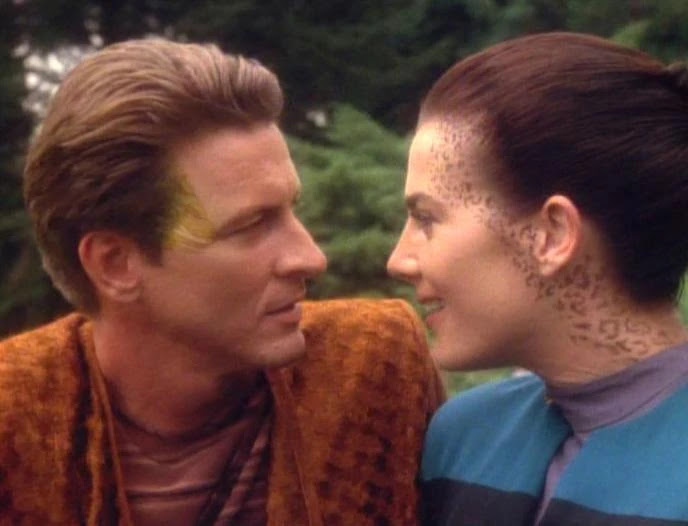
Once again, I appreciate that Dax was allowed to be a sexually expressive being in a way no woman on NextGen ever was.  In an otherwise weak romance, her responses to Deral's cheeky questions about her spots are absolutely dynamite:
Deral: I was admiring… your markings. Are they decorative?
Dax: No. Are yours?
De: No. …If you don't mind me asking… how far down do they go?
Da: All the way.
Sure, one could argue that the gender fluidity of the symbiont made it easier for the writers to move away from the Star Trek ideal of the demure female (at least within the context of a romantic relationship).  But they gave Kira a lot more elbow room, too.  Especially in Dax's case, granting her this range will pay off handsomely in tales to come.


Food Notes

Andorian ale makes its first Star Trek appearance when Tiron orders one at the bar.  Like Romulan ale, it is blue.  I found a recipe here.


Acting Notes

via The West Wing Wiki

Brett Cullen (Deral) was born in Houston, August 26, 1956.  He graduated from the University of Houston.  In television, Cullen has had principal roles on The Young Riders and Devious Maids and recurring roles on Falcon Crest, The West Wing and Lost.  Films include Apollo 13, The Dark Knight Rises and Joker

Monday, February 5, 2024

On the Coffee Table: Deborah Blum

Title: The Poison Squad: One Chemist's Single-Minded Crusade for Food Safety at the Turn of the Twentieth Century
Author: Deborah Blum

via Amazon

The Poison Squad tells the tale of Dr. Harvey Wiley, chemist and crusader.  Wiley worked for decades, through his position as Chief Chemist at the US Department of Agriculture, to fight food adulteration.  In the late 19th century, industrial food products often contained substitutes, fillers, dyes, preservatives and other ingredients that added no nutritional value.  That was the best case scenario.  In many instances, the additives were poisonous.  Unfortunately, government regulation was non-existent and private industry fought it at every turn.  

Wiley via Wikipedia

Deborah Blum's book would make a fitting sequel to Bee Wilson's Swindled.  While Wilson devoted her material to the struggles in detecting adulteration, Blum focuses on the battle for regulation.  The story of Wiley is a lesson in persistence.  Despite his successes in proving the harmfulness of various additives, getting effective laws passed and enforced was a road of seemingly endless setbacks.  It's a distressing read.  You would think doing something with such obvious public benefit would be easy but that's not the way the world works.  Wasn't then.  Isn't now.  The financial interests of the few seemingly always win.

On the bright side, the public loved Wiley and over time - over a long time - he gradually got his way.  Predictably, the most progress was made after his death in 1930.  But frankly, food regulation in the United States is still far from what it could be.  Private interests still trump public ones.  Do you ever wonder why our choices in a general election are typically between a far right Republican and a centrist Democrat?  This is why.

It's a good book - good but not great, a bit too technical at times to make for light reading.  Swindled is better.

Friday, September 8, 2023

Star Trek: Playing God

Episode: "Playing God"
Series: Star Trek: Deep Space Nine
Season 2, Episode 17
Original Air Date: February 27, 1994

via Memory Alpha

Jadzia Dax hosts her first Trill initiate, Arjin, a young man aspiring to become host to a symbiont.  She takes him on a mission through the wormhole.  After an accident forces them to return to the station, a strange mass is discovered attached to the runabout.  In time, the mass is found to be a proto-universe.  Meanwhile, there's a Cardassian vole infestation on Deep Space Nine.

"Playing God" is a good Dax story.  We learn a great deal about the initiate process generally as well as Jadzia's relationship with Curzon Dax.  She first met Curzon as an initiate herself and the encounter didn't go well.  Now joined, we see that while Jadzia honors the previous hosts of her own symbiont, she also works to maintain her own character apart from them, particularly her immediate predecessor.  We see a more sensuous side to Jadzia in this episode, too.  Arjin arrives at Jadzia's quarters the first morning and is greeted by her masseur - and sexual partner?  The narrative neither confirms nor denies but I would say it's strongly implied.  And why not?  Curzon has already been established as a playboy.  Why shouldn't Jadzia have her own fun?  Arjin is clearly intimidated by both the burly masseur and the confident Jadzia.  Ha!

The B and C narratives are fine, though mostly forgettable.  Deciding what to do about the tiny universe while its growth threatens our own presents interesting dilemmas.


Acting Notes

via Critters Wiki

Geoffrey Blake (Arjin) was born August 20, 1982 in Baltimore, Maryland, though he grew up in California.  He graduated from the University of Southern California.  His film resume is impressive, including several Tom Hanks-led features: Forrest Gump, Apollo 13, and Cast Away.  Blake and Terry Farrell (Dax) also appeared together in the short-lived TV series Paper Dolls.  Blake's character was Farrell's character's boyfriend.  

Friday, May 19, 2023

Star Trek: Second Sight

Episode: "Second Sight"
Series: Star Trek: Deep Space Nine
Season 2, Episode 9
Original Air Date: November 20, 1993

Commander Sisko falls in love with Fenna, a beautiful and mysterious woman he meets on the promenade.  This emotional adventure coincides with the arrival of Professor Gideon Seyetik, a famous terraformer who is in the area in order to try to reignite a dead sun.  Seyetik's wife Nidell is a dead ringer for Fenna which leads to both confusion and embarrassment for Sisko.  What's going on?

"Second Sight" is not a favorite episode for either critics or the creative staff.  The Professor character doesn't work - his arrogance is off-putting and as such, the audience has no chance to like him before his self-sacrificing death (spoiler).  The writers (and critics) also felt the love story fell short of what it could have been.  I wouldn't say it was my favorite either but I didn't hate it either.  As is often the case with DS9, I see redeeming value even in the weaker stories.

There was a larger purpose in the concept of "Second Sight."  As previously discussed, the DS9 writers were charged in the second season with creating stories to set the new series apart from The Next Generation.  "Second Sight" was an effort to establish Sisko as a very different character from Picard.  The Enterprise captain is the explorer.  Sisko is the builder, much better suited to the task at hand on the space station.  In the tease for this installment, we are reminded that whatever else is going on, the commander is, on the most human level, a loving, devoted father who misses his wife, deceased.  "Second Sight" aired only a couple weeks after TNG's "Attached" in which we learn how much Picard has suppressed his feelings towards Beverly for years.  Even in that story, the idea of Jean-Luc being in love feels awkward - believable, yet uncomfortable.  There's none of that with Benjamin.  Of course he falls in love and of course Fenna falls for him, too.  Benjamin is an emotionally available person.  We know that from the beginning of the series.  That makes a big difference in a relationship, especially in the early stages.  Trust me on this.  I speak from experience!


Acting Notes

Richard Kiley (Professor Seyetik) was born March 31, 1922 in Chicago.  He studied at Loyola University for a year before leaving for the Barnum Dramatic School.  He served in the Navy during World War II, then returned to Chicago to begin his career in acting.

By any reasonable measure, Richard Kiley was a Broadway legend with two Tony Awards to his credit, the first for Redhead, the second for the role that made his career: Cervantes/Quixote in Man of La Mancha.  He led the show in the original production and two revivals.  By his own admission, he was quite possessive of the part.  The small screen was kind to him as well.  Kiley won three Emmys: one each for The Thorn Birds, A Year in the Life and Picket Fences.  For all that, the film resume is surprisingly modest.  His highest profile gig was a voice part: Tour Voice in Jurassic Park.  He was also in Blackboard Jungle, The Little Prince and Patch Adams.

Kiley passed away in 1999 from a bone marrow disease.  Broadway's lights dimmed in his honor.  He was married twice and was survived by his second wife and six children, all from his first marriage.

Friday, February 10, 2023

Star Trek: The Circle

Episode: "The Circle"
Series: Star Trek: Deep Space Nine
Season 2, Episode 2
Original Air Date: October 3, 1993

via Memory Alpha

Continuing from last week's episode, our heroes on Deep Space 9 must contend with The Circle, a Bajoran faction intent on overthrowing the provisional government.  Meanwhile, Kira, removed from her post on the station, accepts an invitation from Vedek Bareil to visit his monastery in order to reflect and contemplate her next step.  Her spiritual adventure is interrupted when she is kidnapped by The Circle.

"The Circle" is the second of a three-part arc and it serves the middle-volume purpose of expanding upon the narrative set forth in the first.  The trilogy provides our most intimate glimpse yet of the religious and political world of Bajor.  Obviously, it's an essential Kira story, not only because of her complicated relationship with her home world but also because we get to see how important she is to Commander Sisko.  "The Circle" is a good Quark story, too - one that clearly demonstrates his value to the operation.


Acting Notes

via Wikipedia

Louise Fletcher played the role of Vedek Winn, a powerful orthodox religious leader on Bajor.  Fletcher was born July 22, 1934 in Birmingham, Alabama.  She received a degree in Drama from the University of North Carolina at Chapel Hill.  

Fletcher had a long, accomplished career in both film and television.  Her legacy is secure having played one of the greatest, cruelest villains in cinema: Nurse Ratched in One Flew Over the Cuckoo's Nest.  She won an Academy Award, a Golden Globe and a BAFTA for the part, only the third actress to accomplish the feat.  In accepting her Oscar, she thanked her parents in sign language as they were both deaf.  In 2003, the American Film Institute named Nurse Ratched the 5th greatest villain in film.

Other movies include The Lady in Red, Firestarter and Cruel Intentions.  Fletcher's television resume is extensive, too.  Early in her career, she was cast in a lot of Westerns - including Lawman and Maverick - partly because of her height.  Fletcher was 5'10", generally a disadvantage but as the male stars in Westerns were also usually tall, it didn't matter as much.  She received Emmy nominations for her guest appearances on both Picket Fences and Joan of Arcadia.

Fletcher passed away just this past year on September 23rd.  

Wednesday, December 28, 2022

On the Coffee Table: The Way We Eat Now

Title: The Way We Eat Now: How the Food Revolution Has Transformed Our Lives, Our Bodies, and Our World
Author: Bee Wilson

via Amazon

Food writer Bee Wilson tackles the eating habits of 21st century society.  Unsurprisingly, there's a lot of alarming news.  To be sure, we live in an age of unprecedented abundance and less of the world lives in on the brink of starvation than at any point in history.  But that's not to say we're eating well.  The reach of over-processed food produced by global corporation is ever growing, spreading American-esque obesity trends wherever it extends.  We don't eat sit down meals any more.  We don't even necessarily set aside time for meals any more.  Fad diets do little to actually make us healthier.  It's all pretty grim, especially for the poor.

And yet, there is hope.  Eating patterns evolve over time and Wilson offers plenty of thoughts on how to encourage the evolution in healthy directions.  Furthermore, as global habits trend away from a healthy acquaintance with our food and its sources, many - my wife, for instance - are making the deliberate choice to cook more of their own food.  The author also includes an epilogue with practical advice for simple, manageable ways one can improve personal habits.  One bit of advice she didn't include so I will: if you care about the way people eat, give thought to how you vote, both with the ballot and with your wallet.

I started the book during Thanksgiving week, a time when Americans celebrate abundance with excess.  It reminded me of how grateful I should be for the life I have.  We eat well and we're lucky to live in Vermont, a state that takes farm to table principles seriously.  I'm certainly lucky to be married to a woman who, in addition to being an exceptional cook, works hard to find and use local ingredients.  Compared to the average person, I don't eat much processed food - thanks more to her habits than my own.  That's not to say I don't have room for improvement because I certainly do.  It all falls apart when she's out of town.  But overall, I'm extremely fortunate.

This is my fourth Bee Wilson book and I always learn a lot from them.  Highly recommended.

Friday, December 9, 2022

Star Trek: Second Chances

Episode: "Second Chances"
Series: Star Trek: The Next Generation
Season 6, Episode 24
Original Air Date: May 24, 1993

via Memory Alpha

Will Riker meets his doppelganger.  Evidently, there was a transporter mishap during the evacuation of Nervala IV eight years before and Will was essentially split into two beings.  One is the character we have known on the Enterprise.  The other was marooned on Nervala IV, no one knowing he was there.  This second Will, who eventually decides to go by Thomas, has an understandably rough readjustment to life in Starfleet.  The presence of Deanna Troi aboard the Enterprise complicates matters for all involved.

"Second Chances" is a strong Riker episode and it plays on the very issue I have perceived with the character: the writers never seem to know quite what to do with Will.  By rekindling the Will-Deanna love affair, the story circles back to the beginning of the series when the two are first reunited.  We weren't given much to go on in the pilot regarding their past together, though there clearly was one.  NextGen doesn't develop the romance as much as it could have and for the most part, that's probably a good thing.  But questions linger.  A lot of those questions are answered in "Second Chances" and that's satisfying to a point.  And also very sad, especially for Deanna.  

In a sense, we get to see who Will is through who he isn't.  Thomas fell in love with Deanna and stayed in love.  Will didn't.  His ambitions took precedent.  But maybe we see in this story the limits of those ambitions.  Perhaps the romantic within Will helps to explain why he has repeatedly chosen staying on the Enterprise over accepting his own command.  The Starfleet flagship offers the greater adventure.  Maybe Deanna factors in his desire to stick around more than we've been led to believe.


Acting Notes

via Wikipedia

The best "Second Chances" story of all may be a behind the scenes one.  Dr. Mae Jemison plays the role of Palmer, a transporter tech.  In 1992, not even a year before the episode aired, Jemison became the first black woman to travel to space.  She was a mission specialist on the Space Shuttle Endeavour.  

Typical of astronauts, Jemison's bio is extraordinary.  She was born October 17, 1956 in Decatur, Alabama and grew up in Chicago.  She graduated from Stanford with two Bachelor's degrees, one in chemical engineering, the other in African and African-American studies.  After earning a Medical Degree from Cornell, she joined the Peace Corps, serving as a doctor in Liberia and Sierra Leone.  After working for a time as a general practitioner, she applied to NASA.  

Jemison was a huge Star Trek fan, Nichelle Nichols's performance as Uhura, in particular, inspiring an interest in space from an early age.  Bringing all full circle, Nichols was invited to the set during the filming of "Second Chances" in order to meet Jemison.  On top of everything else, Jemison is an accomplished dancer and choreographer.  She has also written several children's books, including a memoir and other books about space.

Thursday, May 5, 2022

On the Coffee Table: Charles Duhigg

Title: The Power of Habit: Why We Do What We Do in Life and Business
Author: Charles Duhigg

via Amazon

Habits rule our lives in ways we don't even notice.  That's the point, after all.  Habits are the things we do without thinking.  It's the simple routines: you floss before you brush, you put on the right sock before the left, you always leave your keys in the same place so you can find them easily, etc.  It's the more complex operations, too: you always follow the same route when you walk your dog.  Some of them, like smoking after a meal or always having dessert even if you're not exactly hungry for it, are deeply unhealthy.  Others, like eating fruits and vegetables every day, can prolong your life.  Charles Duhigg explores all of this and more.  Most importantly, and optimistically, he demonstrates how bad habits can be transformed into good ones.

Duhigg devotes a lot of the book to self-destructive personal habits: alcoholism, gambling addiction, overeating, etc.  However, he also explores how the manipulation of habits - on both the individual and interpersonal levels - can transform organizations like Starbucks, Alcoa or the Indianapolis Colts.  Further, he chronicles how all-time champion swimmer Michael Phelps used the power of habit to excel.  On the Big Brother end of things, he exposes how companies, particularly Target, are able to monitor customers' habits in order to successfully predict who is likely to buy what and when.  

A couple of principles were particularly interesting to me.  The first is the idea of "keystone" habits.  Exercise is a good example.  When someone successfully establishes a habit of regular exercise, they start to form other good habits along with it.  They sleep better.  They eat better.  I can confirm: my life definitely feels better balanced when I am exercising regularly.  Other keystone habits are less appealing to me: bed making, for instance.  I don't believe in it.

"Inflection points" are moments when an individual is confronted with a choice.  For instance, a Starbucks barista is chewed out by an angry customer.  The employee can react in a variety of ways, many of them reflexive and counterproductive.  But if such an employee plans a different, healthier reaction ahead of time, the likelihood of a positive outcome increases significantly.  The possible applications to public education, my own profession, are obvious.

I'll definitely be keeping The Power of Habit around.  I didn't read the book's appendix (I usually skip that, along with any Roman numeral pages in the beginning) but I expect I will at some point as it's all about how to use Duhigg's principals in one's own life.  

But I'm still not going to make my bed.

Monday, March 28, 2022

On the Coffee Table: Kenan Malik

Title: The Quest for a Moral Compass: A Global History of Ethics
Author: Kenan Malik

via Amazon

The Quest for a Moral Compass is an ambitious project.  As the subtitle indicates, Malik follows the history of moral and ethical philosophy from Homer's epics to the present.  While "global" is a bit of an exaggeration, he does reach far beyond the usual Western subjects to acknowledge the contributions of India, China and the anti-colonialists of the 20th century.  

I never took a philosophy class in college.  After art history, it's probably the biggest gap in my own liberal arts education.  As such, the survey course of the big names - Socrates, Plato, Aristotle, Kant, Descartes, Hobbes, etc. - is meaningful for me.  More comfortable ground for me are discussions about religion.  My own faithless upbringing left me deeply curious so I have studied the world's religions more eagerly, even if I've never been completely sold on any of them as a believer.  

Obviously, 344 pages is barely enough to scratch the surface of available material.  However, Malik's thesis is well presented and defended: morality is not absolute.  It shifts dramatically with both time and geography.  If I could encourage him to probe deeper, it would be further discussions of how philosophical thinking impacts the way people actually live.  I feel like I know plenty about how religion does that.  And we all know plenty about how both Marx's and Nietzche's musings shaped the 20th century and beyond, if more monstrously than either intended.  But those shifts from Socrates to Plato to Aristotle... how did they impact the daily life of the average illiterate Athenian?  Or did they?  Does any of it affect anyone beyond an intellectual few.  In reality, does philosophy reflect daily life more than it influences it?  Surely, someone has written that book.

I am especially grateful for Malik's inclusion of the anti-colonialist philosophers, about whom I knew exactly nothing previously: CLR James, Aimé Césaire, Frantz Fanon.  Reasonably, such writers questioned how Europeans could reconcile Age of Enlightenment morality with the realities of slavery and colonial oppression, questions still powerfully resonant in 2022.  Also relevant are Malik's examination of the evolution of the concept of "race" from the early 19th century to the present.  

We are all faced with moral questions as we confront our world both near and far.  Empathy for Ukraine is high and for good reason.  Meanwhile, those fleeing Mexico's horrific drug wars test our collective sympathy.  Why?  And what of our continual blindness to the violence and poverty within our own countries?  It's not a comfortable conversation - trust me, I've tried having it with people.  But the distinctions matter.  

Final analysis: it's a good book and I still have a lot to learn.

Thursday, February 17, 2022

On the Coffee Table: Dale Carnegie

Title: How to Win Friends and Influence People
Author: Dale Carnegie

via Amazon

How to Win Friends and Influence People is a self-help classic.  First published in 1930, its advice still has merit nearly a century later.  What's more, many of the books I've read in the genre obviously mimic its structure and its persuasive elements.  Anecdotal evidence - as opposed to anything backed by data - abounds.  The style is conversational, engaging and, despite my skepticism going in, quite convincing.

Carnegie got his start in this biz teaching public speaking and eventually expanded to create a series of workshops to help people work more effectively with others.  In truth, his advice isn't complicated: listen to people, be positive rather than critical, prop people up rather than shooting them down, be sincere.  I can attest that at least some of it works because, even though I didn't learn it from Carnegie, I already use some of his principles.  One I use and and encourage others to use: if you can, when making a proposal to a superior/customer/client/spouse/whomever, always present it as a solution to their problem rather than your own.  People hear you differently when they feel you've considered their point of view.  Some of the advice can come across as manipulative but the sincerity is key to making it work.

So, since I know some of it works, I see no reason not to give his other ideas a shot.  My industry, education, is as political as ever and effectively advocating for yourself, your program, your students, your professional community, your right to exist is a vital skill for any teacher.  I have nothing to lose by trying new tactics.  So, I'm likely to keep the book around for a while.

Carnegie writes a lot about his inter-personal skill heroes.  Abe Lincoln's his favorite, though he also refers a lot to Andrew Carnegie (no relation), Ralph Waldo Emerson and Teddy Roosevelt.  Given the time of origin, it's not surprising that attitudes towards gender roles and mental illness are rather dated.  Somewhat jarringly, he includes an inspiring story about Stevie Wonder.  Dale Carnegie died in 1955.  How does he know about a pop star who was only five years old at that time?  Well, as his former wife explains in the forward, the book has been updated numerous times since, even after his death.

Anyway, it's a fun read - better than I was expecting.  And it might even prove useful.

Tuesday, February 1, 2022

On the Coffee Table: The MVP Machine

Title: The MVP Machine: How Baseball's New Noncoformists Are Using Data to Build Better Players
Authors: Ben Lindbergh and Travis Sawchik

via Amazon

Baseball's Moneyball era is over.  Billy Beane's revolutionary concepts for evaluating player talent and how various individual strengths contribute to runs and ultimately wins on the field are no longer the exclusive purview of a select few.  Every team is using data these days and in fact, quite a lot of them are using the information a lot more effectively than Beane's Oakland A's ever have.  The Tampa Bay Rays are probably setting the standard these days.

A new revolution is underway.  Technology allows for the minute examination of player performance - pitch spin, launch angle, etc. - in more exacting detail than ever before.  Pair this newly available data with a far more prevalent growth mindset and player development becomes the new frontier.  A player's capacities are no longer a fixed point, nor do the growth or degradation of such skills follow predictable patterns.  Teams and players who are open to new approaches have gained significant advantages.  Minor leaguers who were never even considered prospects are being elected to All-Star teams.  Seasoned veterans are finding new life late in their careers.  Teams like the Astros have transformed from eternal doormats into perennial powers.  Coaching, scouting and administrative staffs are being overhauled at all levels of the game - out with the old guard, in with the new, many of the new folks having never played even high school baseball.  Shocker: even a few women have made their way into the coaching ranks.  It's a new day and anyone stuck in the ways of the past is quickly being left in the dust.

In their book The MVP Machine, Lindbergh and Sawchik document the sport's new wave, offering anecdotal evidence from all over the baseball world.  In particular, they focus on the journeys of Trevor Bauer, a data-obsessed Cy Young-caliber pitcher, and Kyle Boddy, one of many independent coach-consultants from outside the professional ranks who have revolutionized player development.  Major League franchises are quickly finding that investing in player development is the most cost effective way to improve their teams.  In the more progressive systems, every player, even those not believed destined for The Show, is considered worthy of data-driven training.  And the philosophy goes beyond the physical athletic processes.  For the first time, teams are feeding their minor leaguers on a nutritious diet rather than expecting them to survive on a minimal salary and per diem.  My personal hero in the book is Doris Gonzalez who works with the Astros' many Spanish-speaking players to help them assimilate, learn the language and quite often, stick with baseball when the going gets tough.  Many of her former charges, now Major League superstars, call her "Mom."  In short, learning to play professional baseball has become a more thoughtful, methodical, healthy and humane process.

There are downsides.  The emphasis on technology has made baseball a more expensive sport to play, even at the youngest levels.  With the increased importance of travel teams, more economically challenged families have been gradually priced out of youth sports over the past few decades.  The expensive tech has only widened the gap.

A surprise gift for me: eleven pages of the afterword are devoted to my team, the Baltimore Orioles.  The Orioles now are where the Astros were ten years ago, scraping the bottom of the standings barrel, minimizing payrolls while stockpiling high draft picks in hopes of a brighter future.  Fortunately, they have former Astro executives leading the way: general manager Mike Elias and assistant general manager for analytics, Sig Mejdal.  Both men are quoted extensively earlier in the book, in fact, as pioneers in player development while they were in Houston.  

So far, despite the terrible win-loss records for the varsity team, the O's are headed in the right direction.  The Birds now have the top-ranked farm system in baseball, including both the highest-rated position player prospect - catcher Adley Rutschman, future face of the franchise - AND the highest-rated pitching prospect, righty Grayson Rodriguez.  Meanwhile, a couple of previously undervalued players have reinvented themselves.  Lindbergh and Sawchik write extensively about John Means, a lefty pitcher who learned to use his best pitch, a change-up, more often and more effectively.  Pitchers using their best pitches more often is a major theme of the book.  This past July, Means pitched a complete game no-hitter, the first for Baltimore since Jim Palmer did it in 1969.  2021's biggest surprise, too late to be included in the book, was Cedric Mullins, the Orioles' center fielder and lead off man.  Long a switch hitter, Mullins converted to batting left-handed exclusively and made adjustments to his swing.  The result: a journeyman struggling to stay at the major league level became a 30/30 man, hitting 30 homers and stealing 30 bases.  

Baseball season is drawing near.  I must decide whether or not I want to subscribe to MLB.tv this season which would allow me to watch all (or nearly all) of the Orioles' games.  I did it in 2020, the COVID-shortened season, and thoroughly enjoyed it.   I didn't in 2021 and didn't miss it too much.  But the next stage of the Orioles rebuild is set to begin this year.  Both Rutschman and Rodriguez should debut for the top flight this season.  It may still be a while before Baltimore is genuinely good but the seeds are being planted.  And who knows who this year's surprise might be?  The MVP Machine has provided new perspectives for watching baseball, from the best teams and players to the weakest.  I think I'm in.

Now we just need to get this lockout resolved.

Tuesday, August 17, 2021

On the Coffee Table: Simon Sinek

Title: The Infinite Game
Author: Simon Sinek

via Amazon


According to Simon Sinek, an organization (or indeed, a person) is rooted in one of two mindsets: the finite or the infinite.  A finite game is one with set objectives within a given timeframe: a basketball game, for instance.  You win or you lose.  Everyone knows the rules.  The infinite game is open-ended.  The objectives are less tangible.  A youth basketball program seeking to bring a sense of purpose and belonging to its players and a sense of pride to the community is playing the infinite game.  As the title of his book suggests, Sinek is advocating for the infinite mindset.

Sinek's primary focus is the corporate world.  A company, or a CEO, focused on increasing value for shareholders is playing the finite game.  On the other hand, one with a mission to improve the lives of customers and make the world a better place is playing the infinite game.  He gives numerous real world examples.  Four Seasons Hotels and Resorts and Navy SEALs: infinite game.  Blockbuster Video: finite game.  

Worth noting, I find Four Seasons and Navy SEALs are always the poster children in these sorts of books, no matter the thesis.

It's inspiring and compelling stuff.  The trouble for me is I can't help thinking about work so I tried to think of it in terms of baseball instead.  New York Yankees: finite.  St. Louis Cardinals: infinite.  I'm delighted to elaborate for anyone who cares.  But I have to admit, Sinek inspired some healthy work thinking in the end.  I'm 20+ years into my teaching career.  These days, I play multiple roles within my professional community.  I'm not just the music teacher any more.  In fact, I've been more than that for a long time.  What's it all for?  What is my infinite vision for the work I do over the course of a day?  How does each of these roles serve the big picture?  I haven't arrived at exact answers yet but I find that line of thinking more inspiring than planning for the next concert, next curriculum unit or just trying to get through the blessed day/week/term/year.  I have to do all that stuff anyway.  But it's all more meaningful with a sense of broader purpose.

Entertaining though they might be, I feel there are inherent problems with this type of book.  Sinek has delineated too neatly.  Everything good is due to the infinite mindset, everything bad to the finite.  The world is more complicated than that.  My more cynical view: a book like Infinite Game serves as a pamphlet for a writer like Sinek.  Book royalties are great but the really money is on the corporate speaker tour.  

I am, however, convinced that Sinek means what he says.  He's given me a lot to think about as I start the new school year.

Tuesday, July 20, 2021

On the Coffee Table: Michael Pollan

Title: The Botany of Desire: A Plant's-Eye View of the World
Author: Michael Pollan

via Amazon

Before his career-defining treatise The Omnivore's Dilemma (read here), Michael Pollan wrote a book called The Botany of Desire.  He examines the complex and fascinating relationships between humans and four plant-based products: apples, tulips, marijuana and potatoes.  The book also inspired a PBS documentary hosted by Pollan.  We'd already watched it several years ago so I was already familiar with the material.  As is often the case, the book probes a bit deeper than the movie.

The basic premise: domestication is a two-way street.  Plants (and animals) often have as much to gain from their associations with humans as we do.  The four botanical stars of the book have been especially successful.  Each began in a remote corner of the globe (the first three in Asia, the fourth in South America).  Each has become world-famous, one even world-essential.  All four have been transformed biologically by the contact and each has a magnificent story to tell.


Apples

Johnny Appleseed was real.  Born John Chapman, he transported thousands of apple seeds into what was, in the early 19th century, the great American wilderness of Ohio and Indiana.  At the time, the greatest value in an apple was the cider, though alcoholic still safer for even children to drink than the local water supply.  The genius of an apple is its adaptability, allowing it to adjust to each new environment it enters.  However, over time, the capitalistic efficiency of monocultures has greatly reduced the varieties available to eat.  We'll come back to this problem in a bit.


Tulips

Flowers (like fruit) exist entirely as an advertisement to animals: here, come swim around in my loveliness in order to help me reproduce.  As such, it's no surprise the relationship between humans and flowers goes back a long time.  Tulips are particularly interesting for the mania they inspired, particularly among the Dutch, in the 17th century.  


Marijuana

Perhaps not surprisingly, this is the most interesting chapter.  Humanity's history with intoxicating plants is long and intimate.  Quite convincingly, Pollan draws a direct line between intoxicants and the development of all major world religions.  The recent history of the plant itself is fascinating.  Harsh crackdowns in 1980s America forced growers underground where they developed new, more potent strains in the greenhouse than ever could have been raised in the garden.  Once a niche segment of the overall market, domestically-grown pot now dominates the American industry.


Potatoes

Potatoes kick the snot out of grains as an efficient food source.  They're easier to grow, easier to convert into food and more nutritious.  World history and human geography reflect this basic truth pretty clearly.  They are also a primary focus for biotech.  Pollan's exploration revolves around NewLeaf, a potato genetically-engineered by Monsanto to resist pests.  Whether chemically or genetically facilitated, the potato industry's biggest vulnerability is a result of monoculture.  All those McDonald's fries, not to mention all of the other corporately produced potato-based products that rule the snack food industry, all come from the same spud: the Russet Burbank.  Since all Russet Burbanks are susceptible to the same diseases and pests, the entire world food supply is vulnerable to them.  This is not an exaggeration.  This is exactly what happened in the Irish Potato Famine.  A farmer's entire field could be wiped out by blight, literally overnight.


The world has changed in the 20 years since Pollan wrote the book.  Marijuana is now comfortably on the road to legalization in the United States and many other countries.  Also, pushback against GMOs has been strong.  Pollan and others like him have actually had some political impact.  Still, one should never underestimate corporate power over our food supply.  Monsanto survived the lawsuits to be bought out by Bayer in 2016 for a cool $66 billion.  The broader concept isn't going anywhere.

Our daughter has both a strong interest in biology and a strong altruistic drive, though she doesn't yet know what she wants to do with either.  I think it's time to sell her on responsible agriculture as a cause.  I'll be giving her this book in a pile with Omnivore's Dilemma, Fast Food Nation and The Third Plate (read here).  Stay tuned.