Sunday, November 17, 2013

On the Coffee Table: Ann M. Martin

Title: The Baby-sitters Club: The Truth About Stacey
Writer: Ann M. Martin
Artist: Raina Telgemeier
via BetterWorldBooks

Raina Telgemeier is writer/artist of two of the better graphic novels I've encountered in the past year: Smile (review here) and Drama (here). Eager for more of her work after finishing those two, I discovered this graphic novel series, adapting four books from Ann M. Martin's extremely successful series, The Baby-sitters Club (BSC).  While clearly targeting a preteen, female demographic, the same is certainly true for Telgemeier's other books and that did not interfere with my enjoyment.  Our Girl read the book first and gave it her stamp of approval.  So, why not give it a try myself?

Martin's franchise has sold 170 million books overall so it's highly likely that many reading this reflection are already familiar with the basics.  For those who are not, the club was formed by four middle school girls to run a fairly sophisticated babysitting network. The Truth About Stacey is that she has diabetes.  In addition to the babysitting and other standard female adolescent adventures, Stacey must contend with overprotective parents and friends who don't always know how to react.

The appeal of Tegelmeier's work for me thus far is her frank and realistic portrayal of the world of the preteen girl.  Her protagonists are likeable but not idealized or pigeon-holed - too often the case in stories about the age group.  Unfortunately, I don't feel BSC quite lives up to the same standard.  The story's enjoyable enough but I don't find the characters quite as believable.  Tegelmeier's characters are like kids I know.  Martin's are the more easily categorized versions of the kids I know.  So, while I eagerly await future Tegelmeier publications (a Smile sequel is set for release in 2014), I think I'll give the rest of the BSC series a pass.

Wednesday, November 13, 2013

Star Trek: The Conscience of the King

Episode: "The Conscience of the King"
Series: Star Trek: The Original Series
Season 1, Episode 13
Original Air Date: December 8, 1966
via Wikipedia

"The Conscience of the King" is part of a long-standing relationship between Star Trek and the legacy of William Shakespeare.  William Shatner, Patrick Stewart, Deep Space Nine's Avery Brooks and Voyager's Kate Mulgrew all have Shakespearean stage credentials on their resumes.  Interestingly, both Stewart and Brooks have played the part of Othello, while Mulgrew has played Desdemona.  The Memory Alpha entry on the Bard provides a list of references over the years.

The episode title itself comes from Hamlet and the story revolves around a traveling theater company.  Captain Kirk is invited to a performance of Macbeth by an old friend, Dr. Thomas Leighton.  Dr. Leighton suspects that the lead actor is actually Kodos "The Executioner," a ruthless dictator long-believed dead.  Soon, Leighton's lifeless form is discovered and a good, old-fashioned murder mystery ensues.  The end of the story revolves around a performance of Hamlet by the company aboard the Enterprise. 

*****

A quick word of reflection on my Star Trek posts thus far: a few of you have asked over the course of my explorations whether or not I like or dislike particular episodes.  I find it a difficult question to answer for most of them, though I certainly enjoy them all enough to keep watching.  I love Trek for its world-building and for the affection one develops for the characters over time.  The original series, in particular, is really more kitschy and charming than slick and sophisticated.  The special effects are primitive, of course, but that's to be expected.  The writing doesn't measure up to the television standards established in later decades by Aaron Sorkin, Joss Whedon, Steven Moffat and others.  For me, the magic of Trek runs deeper than the appeal of individual episodes.  And to be honest, while some ("The Menagerie") are definitely better than others ("Mudd's Women"), I have yet to find a goose bump worthy episode to claim as my own.  Meanwhile, I am thoroughly enjoying the stroll.

*****
via Wikipedia

Arnold Moss (Anton Karidian/Kodos) was an abundantly qualified casting choice for a Shakespearean episode, having played Prospero, the lead in The Tempest, for 124 performances on Broadway.  He was born January 28, 1910 in Brooklyn.  Apart from Shakespeare and Star Trek, Moss's highest profile roles were in two Bob Hope films: My Favorite Spy and Casanova's Big Night.  Moss died of lung cancer in 1989.

Sunday, November 10, 2013

Family Movie Night: Rebecca

Title: Rebecca
Director: Alfred Hitchcock
Original Release: 1940
Choice: My Wife's
My Overall Rating: 3 stars out of 5
via Wikipedia

Alfred Hitchcock, certainly one of the most famous and influential filmmakers in the history of the industry, only directed one movie that won Best Picture at the Academy Awards: 1940's Rebecca.  The film was also Hitch's first American project.  Before this weekend, I had never seen it.


The protagonist (played by Joan Fontaine) is unnamed until she becomes the second Mrs. de Winter, marrying a glum yet charming aristocrat, Maxim de Winter (Laurence Olivier).  The new Mrs. knows her husband is still mourning his dead first wife, Rebecca, but does not realize the extent to which she still haunts his existence until the newlyweds move back to his cavernous mansion.  Meanwhile, Mrs. Danvers, the ghoulish housekeeper (Judith Anderson), does little to make the new lady of the house feel welcome.

The plot is engaging, though the twists are fairly tame by Hitchcock standards.  The acting is solid, especially Judith Anderson.  The cinematography is the highlight, George Barnes's Oscar-winning work incorporating the shadows and silhouettes that would become Hitch staples.

Multi-generational considerations:
  • Our Girl enjoyed the story but was confused by all the talk about the first Mrs. de Winter.  We had to stop the movie a couple of times to explain.

On the Coffee Table: Once More Around the Park

Title: Once More Around the Park: A Baseball Reader
Author: Roger Angell
via Amazon

Roger Angell, now 92 years old, is one of America's foremost baseball writers.  I have reviewed two of his books previously: Five Seasons and Game TimeOnce More Around the Park cobbles together essays from several previous collections but also includes some new material.  Of the chapters I'd read before in other books, the best is "Distance," a profile of Hall of Famer Bob Gibson.  Thoughts on the new stuff - at least, new to me - is on offer below.

My least favorite part of Angell's books is usually the season recaps.  Occasional piercing insights creep in from time to time but generally speaking, those sections suffer from a one-thing-after-another feel.  He is a much stronger writer when he takes the broad view.  Many of the essays in this particular collection address the joys of fandom, following the game through box scores, daydreaming during the off-season and pitting the stars of yesteryear against one another in our mind's eye.  For Angell, this is serious stuff, his own passion for the game anything but casual.  He lives it and in his finest moments, I want to live it with him. 

"In the Country" was probably my favorite chapter.  In that August 1981 essay, Angell profiles Ron, a pitcher in his late-20s trying to work his way back into the game in the semi-pro leagues, and his wife Linda.  That particular story takes place mostly in northwest Vermont, not too far from our home.  My own familiarity with the setting adds significant charm.

"No, But I Saw the Game," first published in Summer 1989, is a brief survey of baseball movies and their varying reflections of the real game.  Angell poured effusive praise upon Bull Durham and, to be honest, I might have stopped reading if he hadn't.  He felt it was the first and only baseball film to present the game and its players in a realistic light.  He was less impressed by Eight Men Out and Major League and thoroughly panned Field of Dreams.  He touched on a few of the older movies, too, most notably Pride of the Yankees and Bang the Drum Slowly.

I am not prepared to devote as much of my own life to following baseball as Roger Angell has but his books always leaving me wishing I could.  Never content with any one perspective, he seeks out stories from fans, executives, coaches, umpires and, of course, players both amateur and legendary.  Baseball is one sport that is almost as much fun to read about as it is to watch and Angell is one of my favorite guides.

Friday, November 8, 2013

Ode-athon: Maurice Sendak


My blogger pal Tony Laplume is hosting his first bloghop this week!  The Ode-athon is an opportunity to celebrate our favorite authors.  Care to learn more?  Go visit Tony either here or here.
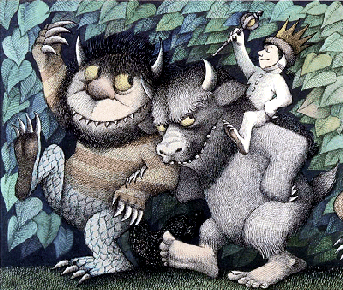
via Wikipedia
Anyone who has spent significant time reading books to children knows both the joys and the pitfalls of children's literature.  One major peril for a parent is that while adults appreciate variety, small children thrive on the familiar so a favorite story will be requested for multiple command performances.  We're talking triple digits.  As a result, we come to dread even the treasured books of our own childhood.  For me, Dr. Seuss, Curious George, Babar and Frances all suffered mightily from exhausting repetition when our daughter was little.

There was one book, however, of which I never tired.  Maurice Sendak's Where the Wild Things Are is, in my humble opinion, the golden masterpiece of the medium.  While I liked the book as a boy, I grew to love it as a father.  The pictures are the easy sell for a kid.  But for me as the read-aloud parent, the text was miraculous.  Words like "he sailed off through night and day and in and out of weeks and almost over a year" trip off the tongue so effortlessly that each reading was a soothing pleasure. 
via Wikipedia
Sendak's magical hand touched numerous other treasured works. Among them:
  • The Nutshell Library, the stories and illustrations of which would later become part of the Sendak produced television special, Really Rosie.
  • In the Night Kitchen, a book frequently banned for perfectly innocent child nudity.  The Caldecott committee didn't blush.  A New York City skyline created from the items in a kitchen pantry?  Genius!
  • The Little Bear series, written by Else Holmelund Minarik and illustrated by Sendak.  Our Girl first fell in love with the television series but the books are far better.  Little Bear's Visit is my personal favorite.
I found out about Sendak's death in May 2012 during my drive home from work.   NPR's Fresh Air, which had hosted the man four times, replayed highlights from his interviews with Terry Gross.  Sendak lived to the age of 83 and had been ill for many years so his death was far from surprising.  I still couldn't help feeling I had lost an old friend.  And yet, I knew that millions of people all over the world would celebrate his life that evening just as I planned to do, by reading his books aloud to their loved ones.  What better send off could a man possibly have?

Go check out the other entries in the Ode-athon:


Wednesday, November 6, 2013

Star Trek: The Menagerie, Part II

Episode: "The Menagerie, Part II"
Series: Star Trek: The Original Series
Season 1, Episode 12
Original Air Date: November 24, 1966
via Memory Alpha
In last week's installment, I touched upon the production history of "The Menagerie," the only two-part episode of Star Trek's original series. Having now watched the second part, I am better able to offer my thoughts on the story.

The novelties on offer for the devotees are numerous in "The Menagerie."  In addition to being the only two-parter of the originals, the episode marks the last on-screen appearance of Christopher Pike, Kirk's predecessor as captain of the Enterprise - the last, that is, until he hit the big screen in J.J. Abrams's 2009 reboot film.  It was also the public's only glimpse of footage from the original pilot until it was finally aired on television in 1988.  The draw for me, however, was the use of Spock as plot device.

Because of the inclusion of the pilot footage, the story gets quite complicated so for the sake of this exercise, I shall simplify: Spock kidnaps Pike, his own former commanding officer, and hijacks the Enterprise.  Next, he sets course for Talos IV - a capital crime in the Federation, apparently - then promptly surrenders himself to the court martial process.  Quite a set up, even without the older material thrown in the mix. 

Ultimately, Spock is vindicated, of course.  We all know he will be.  Trek just isn't Trek if Spock is executed in the twelfth episode.  But the plot is crafted cleverly enough to plant a seed of doubt, even for a long-devoted fan.  We all know Spock is infallible, reason over emotion always wins - except when it doesn't.  In the end, he believes his logic was flawless from the start but he's forgiven for all of his offenses because his heart was in the right place: on the right side of his torso, obviously.

*****
via Memory Alpha

Susan Oliver (Vina) was born Charlotte Grecke, February 13, 1932 in New York City.  She made her first major television appearance on Goodyear TV Playhouse in 1955.  Her first movie was The Green-Eyed Blonde in 1957.  She had the title role in that one, surprising as her eyes in Star Trek are a stunning crystal blue.  She is credited in "The Menagerie" as a result of her role in the pilot.  She doesn't feature in the new material.  Oliver died in 1990 of lung cancer.

Sunday, November 3, 2013

Family Movie Night: Gone with the Wind

Title: Gone with the Wind
Director: Victor Fleming
Original Release: 1939
Choice: Mine
My Overall Rating: 3 stars out of 5
via Wikipedia

In my Wizard of Oz post, I first presented 1939 as Hollywood's golden year.  The crown jewel of that year was Gone with the Wind, American cinema's great tale of opulence and misery.  In this year of years, Gone with the Wind dominated the Oscars with 13 nominations and ten wins, including Best Picutre.  When adjusted for inflation, the movie is still the highest grossing box office draw of all time.


From a strictly artistic perspective, Gone with the Wind is a stunning achievement, winning Academy Awards for both cinematography and art direction.  For those unfamiliar with the narrative, Scarlett O'Hara is the belle of antebellum Atlanta.  The movie (and the Margaret Mitchell novel upon which it is based) follows Scarlett's adventures through the Civil War and reconstruction as her plantation home is destroyed, then her fortune rebuilt through wit and guile.  Of course, the real fun is in her marital adventures.

The social politics of the story, however, are highly problematic to say the least.  The movie comes across as practically a propaganda film in favor of the Old South with cringe-inducing racial stereotypes of the slaves and freedmen.  The institution of slavery is never exactly condemned, nor acknowledged as the foundation of the carefree, aristocratic lifestyle which had been lost in the war.  Also, a marital rape occurs in the film's second act (included in the trailer above) and is forgiven far too quickly.  One could easily dismiss such charges as a product of the time but Gone with the Wind came under plenty of fire for them in its own era as well.  Watching in 2013, parts of the movie are downright painful.

The film's score, composed by Max Steiner, is one of the classics of the genre.  Steiner drew heavily upon the work of Stephen Foster among others.  The most immediately recognizable piece is "Tara's Theme":


Despite the music's lasting legacy, Original Score was the only Oscar category in which Gone with the Wind lost out to The Wizard of Oz.

Multi-generational considerations:
  • The movie is definitely long, clocking in at nearly four hours.  We spread it out over two days.
  • After we finished, we asked Our Girl what she thought.  Her response: "I liked it but it was very sad... I wonder what happened to the cat."  Bonnie (Scarlett's daughter) comes back from London with a kitten, you see, never to be seen again.