Sunday, January 12, 2014

Australian Open 2014: Squid Picks

I'm gearing up.  I've got Melbourne time and weather set up on my phone apps and I'm crossing my fingers in hopes that Chromecast will come through for my match streaming needs.  The Australian Open tennis tournament begins today - well, tomorrow Melbourne time.

As I've written in previous posts, the Australian - long the forgotten stepchild among tennis's Majors - may well be my favorite.  For starters, Southern Australia looks amazing in January.  Most players are well-rested, having just come off tennis's skimpy off-season.  The hard court surface is a happy middle ground between clay and grass.  All courts have lights, so plenty of night tennis.  Perhaps best of all, the Australian has two courts with retractable roofs.  The time zone is a bummer from the Eastern US perspective but otherwise, Aussie has positioned itself very nicely as the Slam of the Future.
via Shrewd Tennis
Melbourne has become Novak Djokovic's kingdom.  The 26-year-old Serb has won the Australian each of the past three years and four times overall.  He finished 2013 in good form and always trains hard so he should be the man to beat once again.  Nadal is always a threat, of course, but he's on the tougher side of the draw.  Murray's recovering from back surgery.  Federer's still a joy to watch but at age 32, days of winning Majors may be over.  (First time admitting that to myself, by the way.)  So, until proven otherwise, the defending champ is the favorite.

The narrative in women's tennis is very different these days.  When she is in top form, Serena Williams is not only the best player on tour, she's the greatest female athlete in the world.  Case closed.  Also 32, she seems as invincible as ever, last year becoming the oldest woman to be ranked #1 in the world.  Every tournament is hers for the taking unless she finds a way to beat herself through injury or emotional meltdown.  She has a history of ankle troubles Down Under so there's always a possibility someone else will snag the big paycheck.  The best bet to do so is Victoria Azarenka of Belarus.  Vika is the two-time defending champion, not usually the sort of player one would consider a long shot but such is the state of the sport in 2014.

via Wikipedia
Azarenka's my pick.  If you do catch one of her matches on the tube, keep a finger on the mute button.  She's a screamer!

Wednesday, January 8, 2014

Star Trek: The Return of the Archons

Episode: "The Return of the Archons"
Series: Star Trek: The Original Series
Season 1, Episode 21
Original Air Date: February 9, 1967
via Wikipedia
The Enterprise arrives at planet Beta III to investigate the mysterious disappearance of the USS Archon, lost 100 years before.  The crew discover a society dressed in 19th century Earth garb, living under apparent mind control.  The story reminds me a bit of The Prisoner, actually, a BBC series that would premier in September of '67.  I can't say I particularly cared for this episode, except for one very important feature.  "The Return of the Archons" is the first Trek episode to mention the Prime Directive.

In the Star Trek universe, Starfleet's Prime Directive dictates that there can be no interference with the internal development of alien civilizations.  As I have said before, I believe the best Trek stories are the ones in which the crew is faced with an ethical dilemma.  The best of those usually bump up against the Prime Directive.  As a literary device, the Prime Directive ranks with Asimov's Three Laws of Robotics as one of the best in science fiction.

The Prime Directive is not quite so ironclad as the Three Laws.  Asimov's robots will cease function before they break their laws.  The puzzle of each story usually involves figuring out how the robots manage to cause such trouble while still playing by the rules.  The Laws themselves, are never wrong. The problem is always a matter of human failure to understand them.

Enterprise captains get a bit more wiggle room.  In the case of "Return of the Archons," the Prime Directive is violated practically the moment it's introduced.  When Captain Kirk advocates destroying the computer he expects is controlling the planet, Spock invokes the Directive.  Kirk's response: "That refers to a living, growing culture...do you think this one is?"  In Trek, it seems we are always encouraged to side with the captain whether s/he is violating the Prime Directive or not.  The consideration is the important thing.

*****
via Memory Alpha
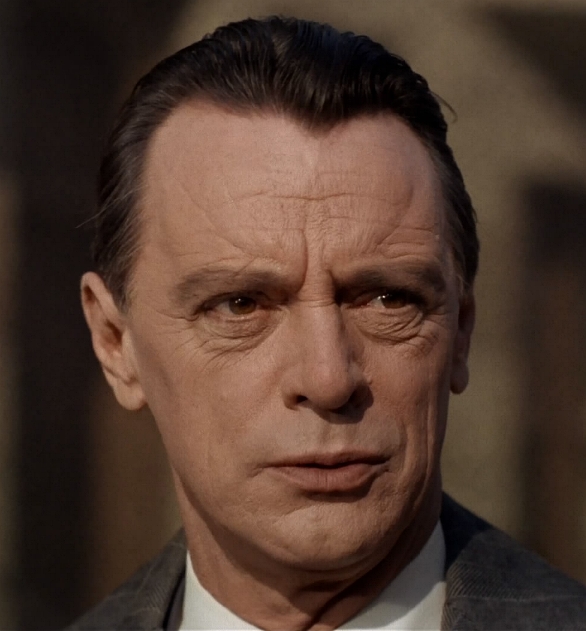
Harry Townes plays the part of Reger, a resistance member who helps Kirk & Company.  Townes was born September 18, 1914 in Huntsville, Alabama.  In addition to Trek, Townes made multiple guest appearances on Perry Mason, Bonanza and Gunsmoke.  In 1974, he was ordained as an Episcopal priest and served at St. Mary of the Angels Church in Hollywood.  He died in Huntsville in 2001.

Sunday, January 5, 2014

Family Movie Night: The Sound of Music

Title: The Sound of Music
Director: Robert Wise
Original Release: 1965
Choice: Mine
My Overall Rating: 4 stars out of 5
via Wikipedia
By any measure, The Sound of Music is one of the most commercially successful and culturally iconic films ever made.   Adjusted for inflation, it is one of the highest grossing movies of all-time.  In addition, the soundtrack is one of the best-selling recordings ever.  While Julie Andrews had rocketed to stardom in 1964's Mary Poppins, The Sound of Music was the film that cemented her status as the undisputed queen of movie musicals.


The story is well-known, though far from historically accurate.  Maria is an aspiring nun in Salzburg, Austria.  She goes to work as a governess for the family Von Trapp.  The stern sea captain and his seven children are a tough sell but, of course, she wins them over.  Then, with the Anschluss, the Nazis demand the captain join their navy, so the family must leave the country.  The truth was less dramatic.  Yes, there was a musical family Von Trapp but they left by train rather than hiking over the Alps.  The real-life Georg Von Trapp had an Italian passport so there was no need to hide behind gravestones at the abbey.

The Sound of Music is front-loaded, not uncommon for musicals.  Most of the best songs and charming scenes occur in the first half.  The second act is darker and slower.  We watched the movie over two nights which worked out well.  Otherwise, the story drags towards the end.

Sometimes, the saccharine sweetness can be a bit much.  Christopher Plummer (the Captain) once described working with Julie Andrews as "being hit over the head with a big Valentine's Day card, every day."  However, there is one scene that gets me every time - guaranteed waterworks.  When the Captain discovers his children singing to the Baroness for the first time, his expression is so pure, so genuine - unmistakable paternal pride.  It's a scene I never fully appreciated until I became a father myself. 

Mainly on the strength of her two most famous films, Julie Andrews was the biggest movie star in the world in the mid-to-late 1960s.  Her career has been unspectacular ever since but with The Sound of Music still airing on television every year at Christmas, she is assured of her place in world culture for generations to come.  Mary Martin, however, was upset not to get the part of Maria as she had originated the role on Broadway - similar to Andrews having been passed over for My Fair Lady.  But Ms. Martin was a smart lady.  She managed to get a cut of the movie's box office take.  She made $8,000,000 on the film as opposed to the $250,000 Andrews got for playing the role.

On the Coffee Table: The Twelve

Title: The Twelve: A Thrilling Novel of Tomorrow, Volume 1
Writer: J. Michael Straczynski
Artist: Chris Weston
via Wikipedia
J. Michael Straczynski is quickly becoming one of my favorite comic book writers.  After I reviewed the first collected volume of Rising Stars, my blogger pal Tony Laplume recommended The Twelve.  For this series, Straczynski and Weston resurrected a dozen obscure characters from Marvel's Golden Age, back when the company was known as Timely Comics.  With shades of Rip Van Winkle, The Twelve were cryogenically frozen by the Nazis in 1945, forgotten, then discovered and awoken by the U.S. military 60 years later.  The story chronicles their adjustment to 21st century society.  Volume 1 collects the first six issues of a twelve-issue run.

The adventure for the reader is in learning more about the individual characters, rather than marveling at the heroic or not so heroic exploits.  What I enjoy about Straczynski's work is his ability to dig into the personal insecurities of his super-powered beings.  A superhero team is hardly a new idea but the writer's investment in each member is deep in The Twelve, just as it is for Rising Stars.

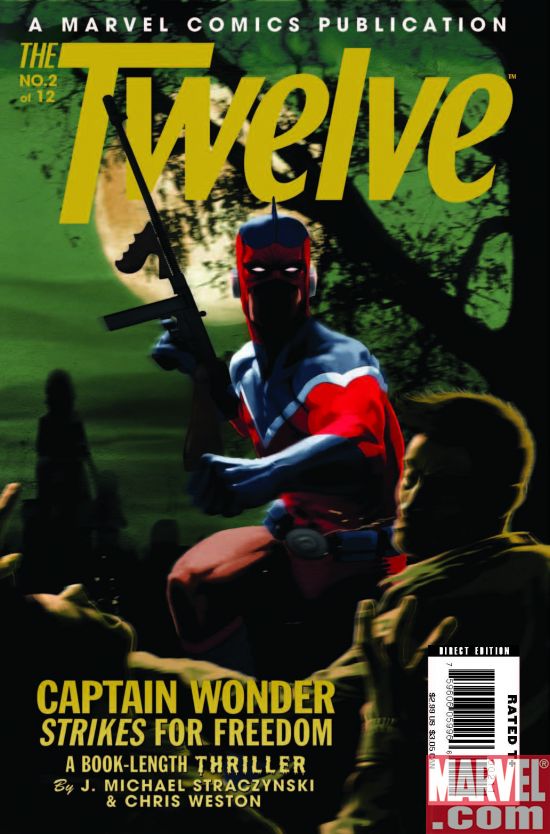
Weston's art is vivid and engaging throughout.  I'm also very impressed with the cover art.  The image at the top of my post is from issue #1, cover art by Kaare Andrews.  Andrews also did the covers for #2-4.  Here's #2:
via Comic Art Community
The covers for #5 and #6 were by Paolo Rivera.  Here's #5:
via Wikipedia
Thanks for the recommendation, Tony!

On the Coffee Table: The Batman Chronicles

Title: The Batman Chronicles, Volume One
Writers: Bill Finger and Gardner Fox
Artist: Bob Kane
via Wikipedia
DC Comics's Chronicles series collects many of their classic comics in full color and chronological order of publication: exactly what I want.  Batman, Volume One, for instance, runs from the Caped Crusader's first appearance in Detective Comics #27 through issue #38 (May 1939-April 1940), plus Batman #1 (Spring 1940).  While popular in his own right, Batman in the beginning was riding the coattails of Superman, as was the rest of the comic book industry.  However, I have always considered Batman to be a more interesting character than Superman.  True, he has no real superpowers and is far from invincible.  But from a literary perspective, his vulnerability only serves to make him more compelling.  The Batman story is darker and earthier (literally: Batman is a native, Superman an alien from Krypton).  However, the best part of the Batman universe has always been the villains, especially the greatest of all superhero nemeses: The Joker.
via Wikipedia
The Joker made his first appearance in Batman #1.  From the beginning, there was something different about him, something that set him apart.  He announced his crimes before committing them: "At precisely twelve o'clock midnight, I will kill Henry Claridge" and sure enough, at 12, Henry dropped dead.  His victims died with a maniacal grin.  He already had his own evil lair with a throne and everything.  He taunted Batman and Robin.  I wouldn't go so far as to say I root for the Joker but, as with Long John Silver in Treasure Island, the story is always more interesting when he is around.

Catwoman also debuts in Batman #1, though she is referred to as simply "The Cat" and has yet to discover bodysuits.  She, more than the Joker, Robin, Commissioner Gordon or anyone else, provides some character development for Batman.  Turns out, he has a weakness for women, even the evil ones.  He essentially lets her escape because he's smitten.

Over the decades, Batman stories have not always worked for me.  I'm way behind on the movies.  The Dark Knight Returns comics by Frank Miller and Klaus Janson are good, though not enough to inspire my long-term devotion.  I preferred the Green Lantern stories in the New 52 relaunch a few years back.  The old 1960s TV show is fun, though I know it irks many among the devoted.  I'm not even sure I like Batman himself as much as I enjoy the supporting cast.  I enjoyed these early stories, though, and will keep an eye out for others - especially if they include The Joker!

Wednesday, January 1, 2014

On the Coffee Table: The Dragonslayer

Title: Bone, Volume 4: The Dragonslayer
Writer and Artist: Jeff Smith
via Examiner.com
We got Volume 4 of the Bone series for Christmas.  Well, it was technically a gift for my daughter but I got to read it after she did.  My thoughts on the first three books can be found here

The story is gradually getting darker.  Fone Bone, Thorn and Gran'ma have all abandoned the farm for the safety of the inn at Barrelhaven.  Meanwhile, at the inn, Phoney Bone is playing on the townspeople's fear of dragons as part of a broader scheme to get out of debt, then out of town with riches aplenty.  More is revealed about Thorn and her special powers, though it is apparent that she still has much to learn about them.

As I wrote in my previous post, the strength of the story lies in its balance between lighter and darker elements.  The most endearing light element in Volume 4 is the appearance of an adorable rat creature cub in town.  The cub takes a shine to Fone who hides it in the barn.  When Fone reveals it to Thorn, though, she threatens to kill it - there's that balance.  Rat creatures killed her family so she wants revenge.  Fone, however, manages to protect the cub.

Looking forward to Volume 5: Rock Jaw: Master of the Eastern Border.

Star Trek: Court Martial

Episode: "Court Martial"
Series: Star Trek: The Original Series
Season 1, Episode 20
Original Air Date: February 2, 1967
via Memory Alpha
Happy New Year!

In this, Star Trek's second courtroom drama episode, Captain Kirk stands trial on charges of perjury and negligence.  A crewman, Lieutenant Commander Ben Finney, has died in a freak accident.  Kirk's account of the incident conflicts with the ship's computer record, thus the charges.  To complicate matters further, the prosecuting attorney is Lt. Areel Shaw, his ex-girlfriend!

I won't spoil the plot twist, except to say that I did not see it coming myself.

*****
via Memory Alpha
Elisha Cook plays Kirk's defense attorney, Samuel T. Cogley, Esq.  The eccentric Cogley is highly amusing, though if I were Kirk, I would have been nervous about the fact that his lawyer slouched in his chair and stared off into space during the trial. 

Cook was born December 26, 1903 in San Francisco.  Growing up in Chicago, he started as a traveling actor on the vaudeville circuit at the age of 14.  He got his big break when he was cast in the Broadway play Ah! Wilderness for a two-year run.  His on-screen resume is lengthy, including films such as The Maltese Falcon, Shane and Rosemary's Baby.  In addition to Trek, his television series appearances included Perry Mason, The Adventures of Superman, Batman, The Bionic Woman and Magnum, P.I.

He was married twice but was apparently a bit of a recluse.  According to director John Huston,
[Cook] lived alone up in the High Sierra, tied flies and caught golden trout between films. When he was wanted in Hollywood, they sent word up to his mountain cabin by courier. He would come down, do a picture, and then withdraw again to his retreat.
Cook died of a stroke in 1995.