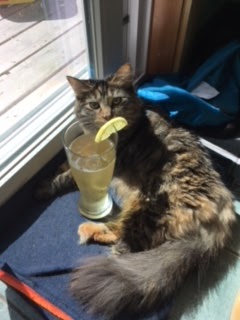
Tuesday, July 31, 2018

Squid Mixes: Gin and Bitters

In our cocktail explorations, I have found that many of the drinks I enjoy the most include Angostura bitters.  This particular concoction is a good test of that affection.  For starters, it includes a full teaspoon of bitters whereas most recipes require only a few dashes.  The preparation's different, too.  According to my recipe in The New York Bartender's Guide, you pour the bitters in a cocktail glass, swirl it around, then add an unspecified amount of gin.  It is a strong drink, though tasty.  The recipe specified room temperature but my wife feels it would be better chilled.

The Scamp took the week off.  A big thanks to The Squirt for being willing to step in for her.

Friday, July 27, 2018

A Window Above: Ice Cream

Song: "Ice Cream"
Writer: Sarah McLachlan
Original Release: October 22, 1993
Performer: Sarah McLachlan
Album: Fumbling Towards Ecstasy

I don't get a lot of celebrity crushes but I fell hard for Sarah McLachlan when I first heard her back in the mid-'90s.  I wasn't even in it for the sex.  I just wanted her to sing me to sleep every night for the rest of my life.  My fondest memories of listening to her are simple ones, sitting on the couch of my dorm room senior year (ah, to be a second-semester senior forever...), blissing out to the voice of an angel.  While my interest has subsided over the years, my wife still refers to Sarah simply as my girlfriend. 

In the fall of '97, I saw Sarah perform live in Tokyo.  "Ice Cream" was her encore.  She sat down at the piano and said, somewhat regretfully, "You know, I don't have a lot of sing-along songs in my set.  Maybe this one will do."  And of course, we all obliged her.  It's such a simple little number compared to the lush production of the rest of the album, a perfect lullaby.


Tuesday, July 24, 2018

Squid Mixes: Gin and Ginger

Gin and ginger, as the name suggests, combines gin with ginger ale.  In fact, it's just like last week's drink except with ginger ale rather than ginger beer.  The result is sweeter and less gingery, perfect if you like a hint of the stuff without blowing out your sinuses.  My recipe came from The New York Bartender's Guide.

Friday, July 20, 2018

A Window Above: All Out of Love

Song: "All Out of Love"
Writers: Clive Davis and Graham Russell
Original Release: February 1980
Band: Air Supply

This is one of my favorite guilty pleasure songs.  I first fell in love with it while driving through the Mt. Fuji region in the summer of '96.  I'm pretty sure my companion and driver got tired of me playing the Air Supply tape over and over again but that's the risk you run when you let me pick the music.  Then again, it was his tape so maybe he didn't mind so much.  Now, if this song comes on the radio at the end of a drive, I won't turn off the car until it's finished.

Tuesday, July 17, 2018

Squid Mixes: Foghorn

A foghorn combines ginger beer and gin.  My recipe comes from The New York Bartender's Guide.  Ginger beer is a super heavyweight as far as flavor goes so pick one you like.  The gin doesn't stand a chance.

Monday, July 16, 2018

On the Coffee Table: Rohinton Mistry

Title: A Fine Balance
Author: Rohinton Mistry
Mistry, an Indian-born Canadian writer, has won a lot of literature's big prizes in his career: Neustadt, James Tait Black, Booker shortlist, etc.  It's the sort of resume that suggests he's likely to win the Nobel one day.   A Fine Balance, published in 1995, was his third book, second novel.

A Fine Balance covers a long, dramatic sweep of Indian history:  1947-1984, Independence to the aftermath of Indira Gandhi's assassination.  The story follows four characters: Dina Dalal, a 42-year-old widow born of a wealthy urban family but determined to make it on her own after her husband's death; Ishvar and Om Darji, two tailors from the countryside, their lives torn apart by inter-caste violence and Maneck Kohlah, student and son of a grocer in the far off mountains.  The four live together in Dina's apartment.  Their relationships initially fraught with tension, they eventually form a strong familial bond. 

The heart of the tale takes place in 1975-76 during Gandhi's Emergency.  In a society built on centuries-old social injustice (aren't they all?), the crackdowns on the poor are especially brutal during this time.  The tailors always manage to be in the wrong place at the wrong time.  Easy as it is to roll one's American, Caucasian eyes and think, "Oh boy, India...", it's not much of a stretch to imagine an African-American or Native American or Latino-American or most any other minority family in the United States feeling they have also been victims of history for generations on end.

Mistry's acclaim is well-deserved.  The text is elegant without overwhelming in detail.  Few characters truly disappear in the story, nearly every chance encounter coming around full-circle to play a meaningful role later in the narrative.  The symbolism can be a bit heavy-handed, especially with a quilt Dina produces. The fine balance of the title is between hope and despair.  Most of the narrative weighs to the despair side but the moments of hope are genuinely touching.  The ending is rotten and unnecessarily so.  Dazzlingly artful through nearly 600 pages, Mistry resorts to the worst of all narrative cop-outs just before the final curtain. 

Friday, July 13, 2018

A Window Above: The Final Cut

Song: "The Final Cut"
Writer: Roger Waters
Original Release: March 21, 1983
Band: Pink Floyd
Album: The Final Cut

After fully immersing myself in the Beatles for a year or so in my early teens, I was ready to explore beyond.  Pink Floyd was the next band I pursued with any depth.  While the heart of the group's opus is contained on three masterful albums - The Dark Side of the Moon, Wish You Were Here and The Wall - there are plenty of treasures to be found beyond those.  

One late album drew my early attention: The Final Cut, especially the title track.  Whereas far too many of Roger Waters's lyrics are devoted to former band member Syd Barrett's descent into schizophrenia, The Final Cut is instead dedicated to Waters's father.  Waters felt the ideals of his father and the rest of the War Generation were betrayed when Britain entered the Falklands War.  The album's material is the usual Pink Floyd dark but unusually political.  The title track, however, is deeply personal.


Here's the funny thing: until I started putting this post together, I'm not sure I'd actually listened to the song or the album in at least 25 years.  I owned it on vinyl back in the day and never upgraded to CD.  As closely as I connected with it in my adolescence, it's not exactly cheery stuff.

I didn't know a lot about love at that age but I knew enough to understand the fear of betrayal.  "The Final Cut" goes beyond the typical petty jealousy one finds in every fifth song.  Even now, I would say I am a fairly guarded man and easily relate to a reluctance to be vulnerable with people.  Over time, if you're lucky, you surround yourself with people you trust but I didn't really have much of that at 14.  Rather, I did but not in the places I was looking for it.  The line about selling "your story to Rolling Stone" is an honest appraisal of the pitfalls of love for a famous man, which Waters certainly was by 1983.