Monday, July 13, 2020

Marvel Immersion Project: Howard the Duck #4-10

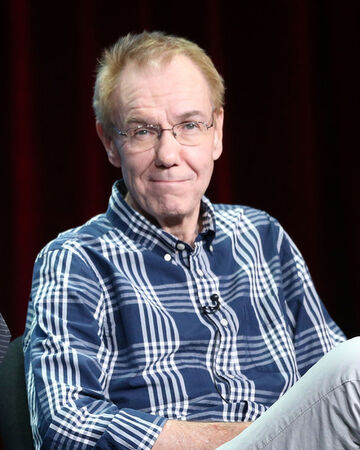
Howard the Duck co-creator Steven Ross Gerber was born September 20, 1947 in St. Louis.  As a teenager, he helped launch one of the first comic fanzines, Headline.  After graduating from St. Louis University, he found work as a copywriter in advertising. 
Steve Gerber - Wikipedia
via Wikipedia
Frustrated, he wrote to Roy Thomas, one of his Headline collaborators and by the time of the letter in 1972, Marvel's editor-in-chief.  Thomas brought him on board.  First came Man-Thing, a monster character introduced in Adventure into Fear #11.  Howard was introduced in issue #19 of the same series. 

Gerber died in 2008 of idiopathic pulmonary fibrosis.  He was posthumously inducted into the Will Eisner Comic Book Hall of Fame in 2010.


My Recent Reads

Howard the Duck #4
Originally Published July 1, 1976
Writer: Steve Gerber
Artist: Gene Colan
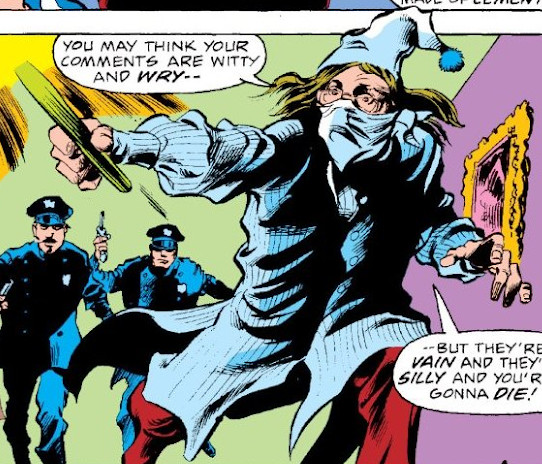
  • Howard and Bev are disturbed by their upstairs neighbor, struggling artist Paul Same.  
Paul Same (Earth-616) | Marvel Database | Fandom
Note: even Winky-Man wears his mask properly.  Via Marvel Database
  • As it turns out, he's a sleepwalker who goes out in the night as a vigilante hero, Winky-Man.

Howard the Duck #5
September 1, 1976
Gerber/Colan
  • Howard and Bev are struggling to pay the bills, Bev's artist modeling work not enough to support them both.  
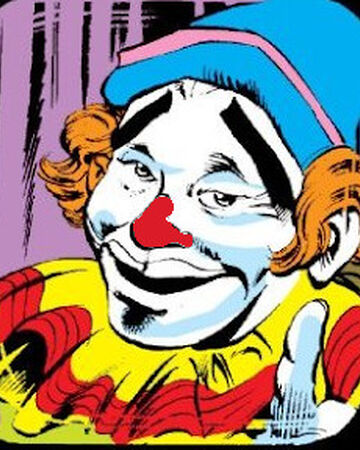
Gonzo the Clown (Earth-616) | Marvel Database | Fandom
via Marvel Database
  • Howard looks for work, including an ill-fated stint on a children's television show with Gonzo the Clown.
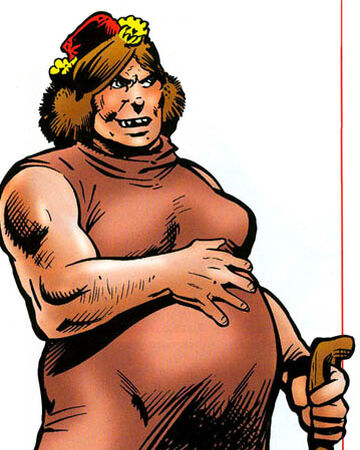
Selma Blotte (Earth-616) | Marvel Database | Fandom
via Marvel Database
  • Also featured: Kidney Lady, her second appearance.  She harasses Howard on the city bus.
  • Fed up with Cleveland, Howard and Bev set out to hitchhike their way to New York.

Howard the Duck #6
November 1, 1976
Gerber/Colan
  • Howard and Bev are stranded in the Poconos.
  • Frustrated with her traveling companion, Bev sets off on her own.  She finds a creepy mansion where she is presumed to be the new governess by
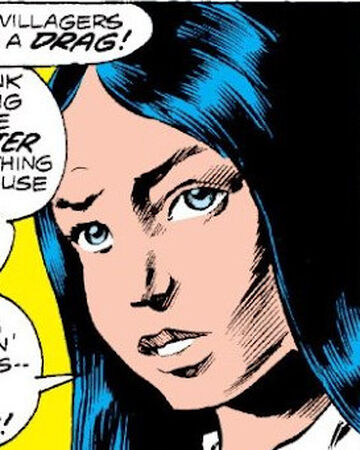
Patsy Dragonsworth (Earth-616) | Marvel Database | Fandom
via Marvel Database
Patsy Dragonworth (last name attached in later stories).

Joon Moon Yuc (Earth-616) | Marvel Database | Fandom
via Marvel Database
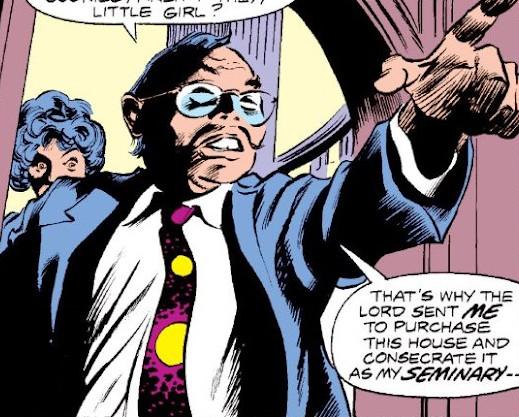
  • Howard is discovered by the followers of a religious zealot, Joon Moon Yuc, who sees our hero as an agent of Satan who must be destroyed.  He is undoubtedly based on real-life lunatic Sun Myung Moon.  Unfortunately, the character image promotes Asian stereotypes.
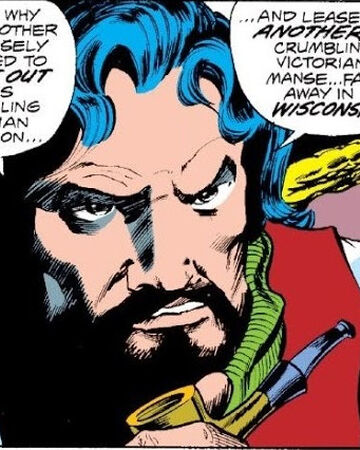
Heathcliff Rochester (Earth-616) | Marvel Database | Fandom
via Marvel Database
  • Howard is rescued by a gallant realtor on horseback, Heathcliff Rochester.
  • References to Wuthering Heights, Frankenstein, Jane Eyre and House of Seven Gables abound. 

Howard the Duck #7
December 1, 1976 (note: upgraded to monthly)
Gerber/Colan
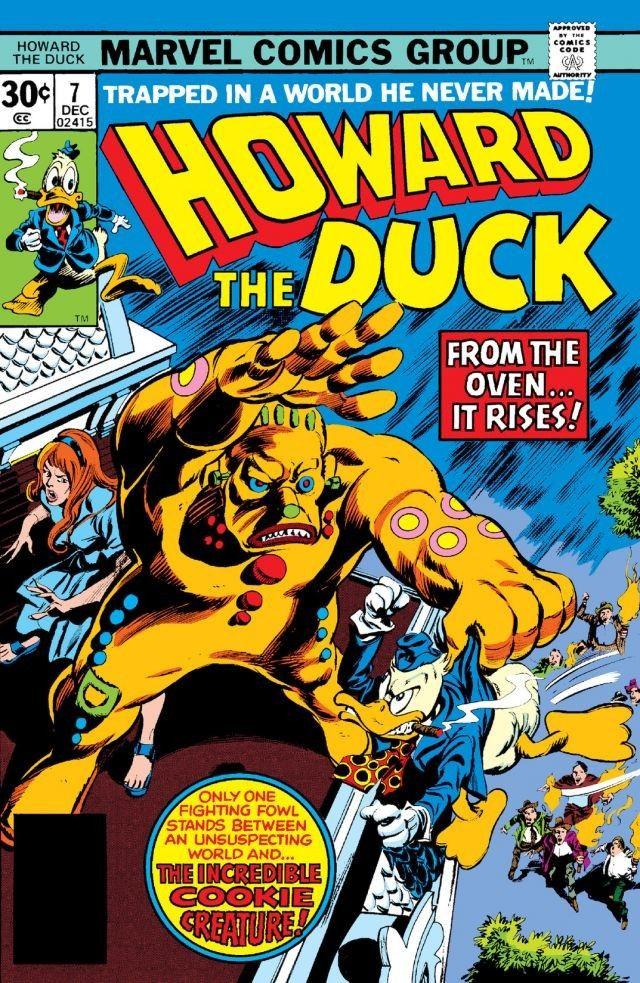
Gingerbread Man (Earth-616) | Marvel Database | Fandom
via Marvel Database
  • Little Patsy brings a Ginger Bread Man to life, Frankenstein-style.
  • Howard and Bev finally make it to New York where they find jobs at the national convention for the All-Night Party.
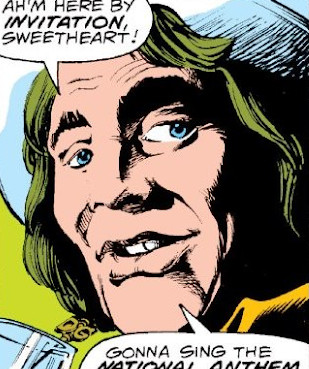
Dreyfus Gultch (Earth-616) | Marvel Database | Fandom
via Marvel Database
  • Introduced: Dreyfuss Gultch, a country singer who picks them up in the Poconos.
  • Howard saves the presumptive presidential nominee from a bomb by pole vaulting into a multi-tiered, celebratory cake (1976 was an Olympic year, too).
  • Overwhelmed by his heroism, the delegates instead select Howard as their nominee!

Howard the Duck #8
January 1, 1977
Gerber/Colan
Howard the Duck #8: Gerber, Steve (Writer) Gene Colan (Artist ...
via Amazon
  • I love the cover for this issue!  I want a t-shirt.  And a campaign button. 
  • Howard is running for President.  He dodges constant assassination attempts.  He tangles with message wranglers.  Most amazingly, he tells the truth.

Howard the Duck #9
February 1, 1977
Gerber/Colan
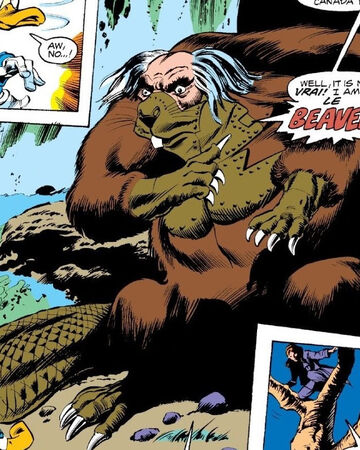
Pierre Dentifris (Earth-616) | Marvel Database | Fandom
via Marvel Database
  • In the previous issue, the Presidential campaign was derailed on Election Day by a scandalous, and doctored, photo of Howard and Bev taking a bath together.  The dirty work was done by a bellhop working for Pierre Dentifris, aka Le Beaver. 
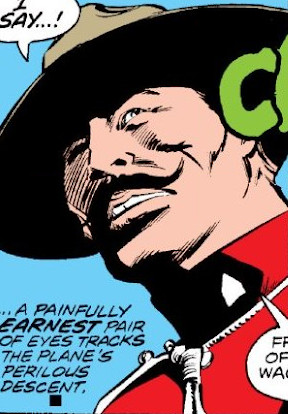
Preston Dudley (Earth-616) | Marvel Database | Fandom
via Marvel Database
  • On their Canadian adventure to clear their names, Howard and Bev are helped by a Canadian Mountie, Preston Dudley.

Howard the Duck #10
March 1, 1977
Gerber/Colan
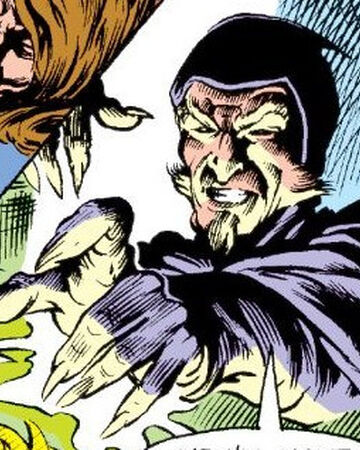
  • Howard has an identity-crisis dream with lots of character cameos, including
Pro-Rata (Earth-616) | Marvel Database | Fandom
via Marvel Database
    • Pro-Rata
Arthur Winslow (Earth-616) | Marvel Database | Fandom
via Marvel Database
    • Turnip-Man 

Friday, July 10, 2020

Star Trek: Samaritan Snare

Episode: "Samaritan Snare"
Series: Star Trek: The Next Generation
Season 2, Episode 17
Original Air Date: May 15, 1989
Samaritan Snare (episode) | Memory Alpha | Fandom
via Memory Alpha
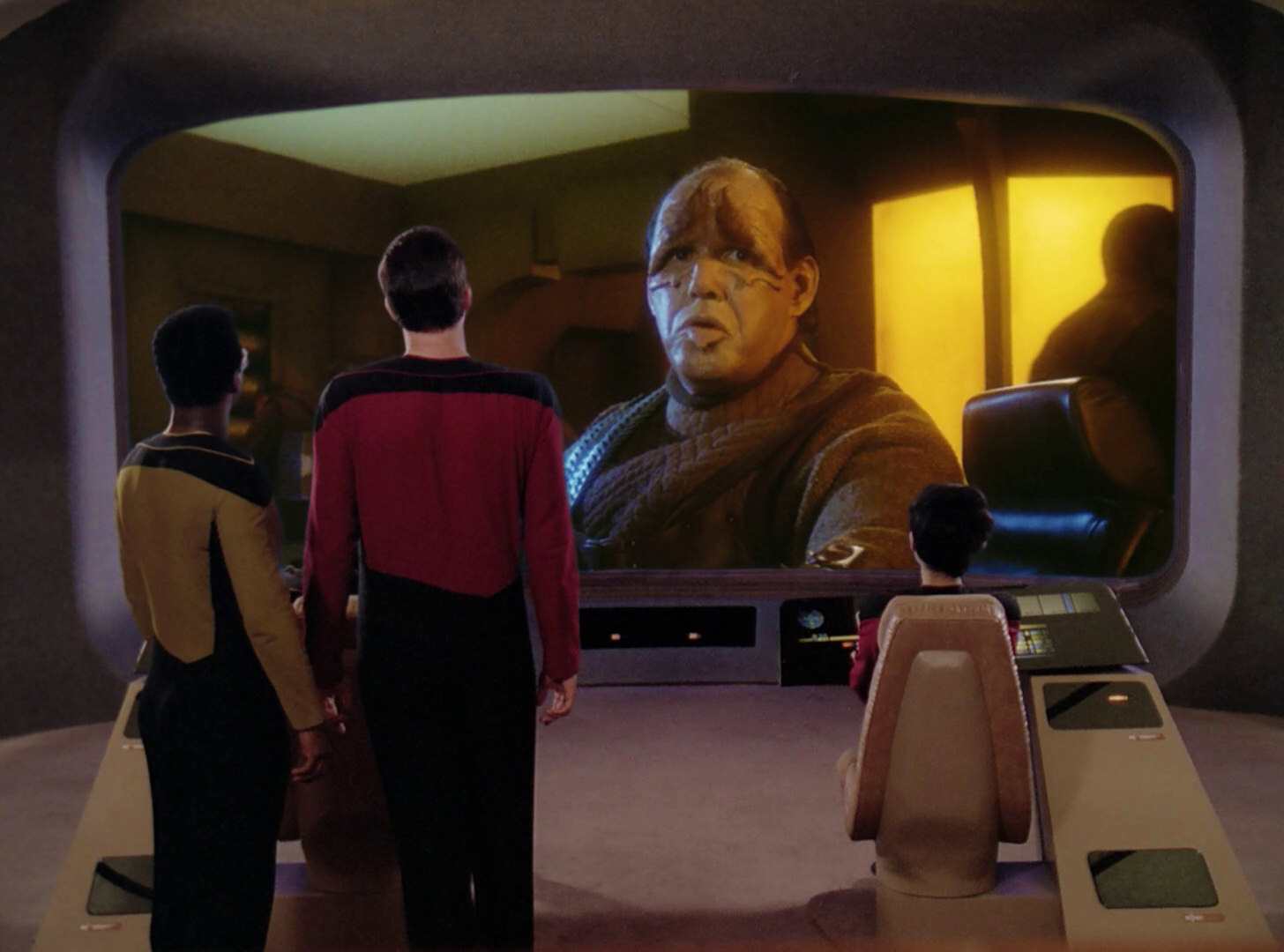
Picard leaves for Starbase 515 for a heart transplant, embarrassed to have Pulaski do the procedure on the Enterprise.  Wesley is along for the ride so he can take another stab at the Starfleet exams.  Meanwhile, Geordi is abducted by the relatively primitive Pakleds, led by Grebnedlog.

"Samaritan Snare" is widely panned for admittedly weak writing.  The Picard story is especially clunky and feels rather tacked on to boot, not good for what is supposedly meant to be the primary narrative.  And there's something a little embarrassing about the simplicity of the Pakleds.  However, to me the dialogue between Picard and Wesley en route to 515 brings a small measure of redemption to the episode.  Picard tells a story of his reckless youth, adding some dimension to our captain.  There's also a nice glimpse of Riker's leadership style in Picard's absence.  It's not so unlike Jean-Luc's in sounding out others for their opinions, and he decides on a good old Kirk-style bluff.


Acting Notes
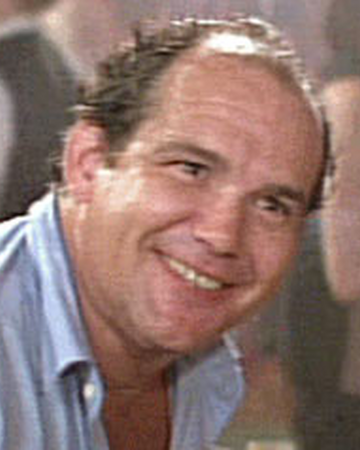
Christopher Collins (Grebnedlog - Goldenberg backwards - haha, just got that) was born Christopher Lawrence Lotta, August 30, 1949 in Orange, New Jersey, though he grew up in Manhattan.  He attended NYU for a year.  He is better known for his voice work than his on-screen credits, having voiced Cobra Commander in GI Joe and Starscream in the original Transformers series.  This was his second of four Trek appearances between TNG and DS9.  He was Captain Kargan in "A Matter of Honor."

Collins voiced the roles of Mr. Burns and Moe during the first season of The Simpsons.  He was let go during that season because, in Matt Groening's words, "he was just kind of jerky to everyone." From that point on, Mr. Burns was voiced by Harry Shearer, Moe by Hank Azaria.  When asked about Collins, Azaria said "That guy could have been on The Simpsons his whole life. Lesson to you kids: always be nice!"

Collins died of a brain hemorrhage, June 12, 1994.

Wednesday, July 8, 2020

Vermouth Battles: Tribuno vs. Martini & Rossi

Full disclosure: I went into this project assuming the vermouth was the least important ingredient in a Manhattan.  After all, most of the flavor comes from the whiskey and the bitters.  Even switching to a higher grade of cherries made more of a difference than I would have expected from a change in vermouth.

Long story short: I was wrong.

Let's back up a little.  What is vermouth and what is its function in my favorite cocktail?  Vermouth is a fortified, aromatized wine.  The fortification distinguishes vermouth from brandy which is distilled wine.  Vermouth came from Italy originally but, naturally, the French can never resist a good Italian food idea so they started making it, too.  Generally, the product comes in one of two forms: sweet and dry.  They are occasionally listed as Italian and French vermouth respectively or red and white vermouth respectively.  There are additional varieties but most of what you'll find in a liquor store sits under one of those two umbrellas.

A traditional cocktail is built upon three legs: base, sweetener and bitters.  While there are some drinks which use vermouth as the base liquor, it more typically serves as the sweetener.  Such is the case with the sweet vermouth in a Manhattan.

As noted in this post, I recently made a discovery about vermouth.  I'd long perceived a wheaty aftertaste in our Manhattans which I'd assumed derived from the barley-based whiskey.  But then I tasted the same in a completely different cocktail which didn't involve whiskey but did include sweet vermouth.  I wouldn't exactly describe the taste as a flaw but given the choice, I could do without it.  As such, trying out different vermouths became a more meaningful exercise.


Martini & Rossi has been our brand of choice for a while.  It was recommended by one author or another - I can't remember whom - and has served us just fine.  The company is based in Turin and has been producing vermouth since 1863.  Tribuno is our first challenger, an American product, originally from New York City, 1938.  Vermouth is relatively cheap so price is not a major consideration but for the record, Tribuno is the less expensive of the two.

The Manhattan Test

Without a doubt, the Martini & Rossi is the culprit in the aftertaste mystery.  It went away with the Tribuno.  Merely sniffing the bottles revealed a significant difference.  Tribuno smells and tastes simply more like, well, wine.  The resulting cocktail is fruitier and, at least to our palettes, better.

Winner and New Champion: Tribuno


Squid on the Vine

Azienda Vinicola I Pastini, Antico Locorotondo White Blend 2019
Starts sweet, finishes sour
A not quite ripe green apple
My rating: 8.0

Denavolo Catavela Malvasia di Candida Blend 2018
An orange wine
Smells of peach, tastes like apricot
Quite dry
Smells better than it tastes
My rating: 8.1

La Garagista Ci Confonde Pétillant Naturel Rosé Blend
Bubbles
Sour cherry
Floral nose
My rating: 8.1

Domaine d'E Croce (Yves Leccia) Ile de Beauté Biancu Gentile 2019
Delicate fruity nose, a hint of metal
Dry but with a kick at the end
My rating 8.5

Tuesday, July 7, 2020

On the Coffee Table: Please Understand Me

Title: Please Understand Me: Character & Temperament Types
Authors: David Keirsey and Marilyn Bates
Please Understand Me: Character and Temperament Types: Keirsey ...
via Amazon
Before we go further, the material of the book, and my post, will be more meaningful if you know your Myers-Briggs (MBTI) personality type.  I am INFJ.  If you don't know yours yet, I recommend the following quick online quiz:

https://www.16personalities.com/free-personality-test

I also recommend reading the type descriptions on the site.  Please share your result in the comments!  I find this stuff fascinating.

Keirsey and Bates's survey of the MBTI types was first published in 1978.  Their particular angle is relating the 16 types to Carl Jung's four temperaments.  They classify the SPs (sensing-perceiving) as Dionysian.  The SJs (sensing-judging) are Epimethean.  The NTs (intuiting-thinking) are Promethean.  The NFs (intuiting-feeling), like me, are Apollonian.  More of the book is devoted to delineating between these four temperaments than the 16 types, though each of those is afforded its due in the appendix.

The book is excellent, though dated.  The sex and gender politics reflect a very different era.  The working woman was not yet a normalized concept and the possibility of homosexuality not even considered.  The text also deals in absolutes and, of course, real people are a lot more complicated than that.  All of that acknowledged, I found the material quite insightful.

A quick rundown of the four dichotomies measured by the MBTI:

Extroverted vs. Introverted
Sensing vs. iNtuiting
Feeling vs. Thinking
Judging vs. Perceiving

To add to my own personal context, I asked everyone in my life to share their types.  I sent out solicitous emails and also posted on Facebook.  The responses were fascinating.  Additionally, I looked into those who have assigned types to characters within various fictional universes, specifically Star Wars, Star Trek, Harry Potter, Cheers, M*A*S*H and the Muppets

A modest sampling of my findings:

SPs, the Dionysians, those who love freedom
Sam Malone | Cheers Wiki | Fandom
via Cheers Wiki
ISTP: Harry Potter, Chewbacca
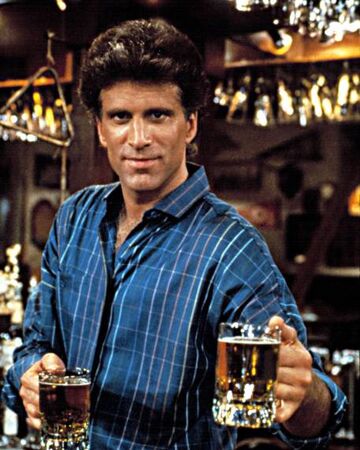
ESTP: Han Solo, Sam Malone
ISFP: my best friend, Hagrid
ESFP: Will Riker, Maxwell Klinger

SJs, the Epimetheans, those devoted to duty
Walter "Radar" O'Reilly | Monster M*A*S*H | Fandom
via The Monster M*A*S*H Wiki
ISTJ: Spock, Margaret Houlihan
ESTJ: Darth Vader, Carla Tortelli
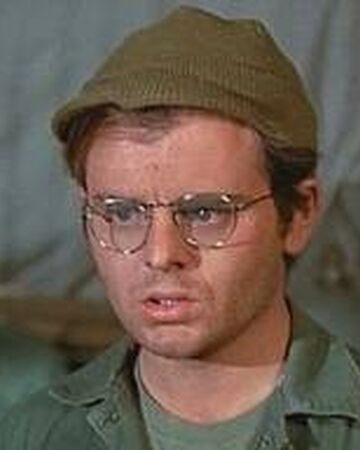
ISFJ: Worf, C-3PO, Radar O'Reilly
ESFJ: my father, Dr. McCoy

NTs, the Prometheans, those who seek power
Tom Riddle | Harry Potter Wiki | Fandom
via Wikipedia
INTP: Data, Yoda, Hermione Granger
ENTP: my daughter, Dr. Crusher, R2-D2
INTJ: Jean-Luc Picard, Draco Malfoy
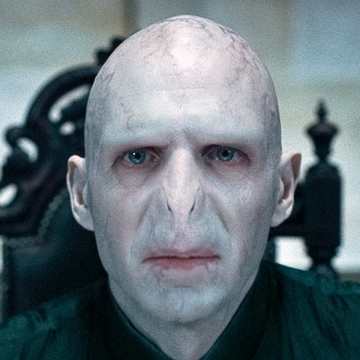
ENTJ: Leia Organa, Miss Piggy, Lord Voldemort

NFs, the Apollonians, those who strive for self-actualization
Kermit the Frog | Muppet Wiki | Fandom
via Muppet Wiki
INFJ: The Armchair Squid, Deonna Troi, Obi-Wan Kenobi
ENFJ: Diane Chambers, Albus Dumbledore
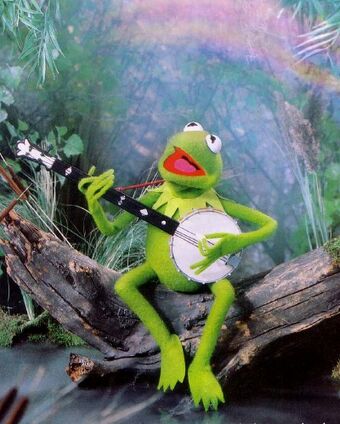
INFP: my wife, Luke Skywalker, Kermit
ENFP: my sister, James Kirk, Hawkeye Pierce, Animal

My most interesting discovery in the fictional world was that I could see the types most clearly in M*A*S*H.  I'm sure it helped that we'd recently binged the show as a family but I also think the series is particularly rich in clearly drawn and differentiated characters.  In my personal life, I was initially surprised to find the prevalence of NTs and especially NFs.  We are in the minority in terms of the broader population.  However, it was less surprising once I learned the NTs and NFs are more likely to go to college.  I expect they're also more likely to spend time on social media and more likely to answer personal, probing questions from me.

My biggest surprise, though, was the importance of SFJs in my life, both E and I.  I don't know so many of them but nearly all whom I do know have played meaningful roles in my personal history - even comparable roles.  I'm sure this fact says more about me than it does about them.  It says plenty about the sorts of people I've been drawn to, and even those who have been drawn to me.

And yes, INFJ has me nailed perfectly.  There are some interesting insights to share there, too.  I was an INFP for years, or at least I thought I was.  In reading the book's type descriptions, I'm not sure I was ever actually a P.  In the past, I may have answered the questions as to how I wanted to be as opposed to how I actually am.  Age has brought greater self-awareness.  The only one of the four factors I'm close on is F/T.  In fact, technically, I was INXJ according to the test in the book, meaning I was evenly split between the two.  However, in the test linked above, I'm an F and I can say with confidence that's closer to who I am.  Noneteless, the T tendencies are there and not insignificant to the broader picture that is me.

The Facebook thread got especially interesting.  One friend asserted that Myers-Briggs is inherently racist and thus unfairly used in hiring practices.  Poking around, there are strong arguments on both sides: it's racist and it's not.  I'm not sure what I think yet.  Obviously, I am fascinated by the types.  However, I can see the capacity for misuse.  Are the questions themselves culturally biased?  I have to acknowledge that's worth examining.  It depends on the particular test, of course, and there are plenty of different ones around.

The more important consideration, though, is how this sort of classification might be used.  Does an employer go into a candidate search with the assumption that some types are better than others or better-suited to particular roles?  Keirsey and Bates certainly devote plenty of material to the latter, if not the former.  To the authors' credit, they imply rather that a variety of types within an organization is ideal.  Also, the types do nothing to measure strengths or skills.  Being extroverted, for instance, does not mean you have better social skills than an introvert.  The differentiation merely identifies a preference in one's social interactions.  One can certainly see how an employer who misinterprets the data could use it unreasonably - if not intentionally unfairly - in hiring decisions.

Before leaving this topic, let me make very clear that there is plenty of racial bias in hiring practices.  That much is demonstrable fact.  I'm just not convinced MBTI is part of the problem.  I'm also not convinced it isn't.

Keirsey, who died in 2013, wrote several more books on the subject.  I'm definitely interested in reading more.

So, what's your type?  Do you think it describes you accurately?  Do you think MBTI is inherently racist?

Monday, July 6, 2020

Marvel Immersion Project: The Amazing Spider-Man #91-92, #121-122 and Howard the Duck #1-3

We have a lot to talk about - best we jump right in.


My Recent Reads

The Amazing Spider-Man #91
Originally Published December 1, 1970
Writer: Stan Lee
Artist: Gil Kane
  • Spidey/Peter Parker struggles to come to terms with George Stacy's death while also dealing with the fact that everyone, most importantly his own girlfriend, blames him for the accident.
  • Nemesis: Sam Bullit, a crooked lawyer running for district attorney, looking to capitalize on Spidey's current unpopularity in his own "tough on crime" campaign
Robbie Robertson (comics) - Wikipedia
Robbie Robertson via Wikipedia
  • Featured: Robbie Robertson, the editor of The Daily Bugle and one of the first recurring Black characters in a major comic book series

The Amazing Spider-Man #92
January 1, 1971
Lee/Kane
  • Featured: Iceman, who picks a fight when he misinterprets (sort of) Spidey's kidnapping of Gwen.  The kidnapping is part of an effort to preserve his secret identity.  It's a little icky.  As much as we want our man to always be right, Iceman was probably correct to interfere.
  • Sam Bullit's evils are exposed.
Gil Kane - Wikipedia
via Wikipedia
  • Artist Gil Kane was born Eli Katz in Riga, Latvia on April 6, 1926.  His family emigrated to Brooklyn, New York in 1929.  He started working in the comics industry at age 16.  Over his career, he worked with every major publisher, including Archie, DC and, of course, Marvel.  He was co-creator of the Silver Age Green Lantern, Atom and Iron Fist.  He was also an early pioneer in the graphic novel format.  Kane passed away in 2000 from complications of lymphoma.
  • Catch your breath.  Here we go...

The Amazing Spider-Man #121
June 1, 1973
Writer: Gerry Conway
Artist: Kane
  • Probably the single most important issue in the history of the American comic book industry.
  • Gwen Stacy dies.
  • It's difficult to overstate the significance of Gwen Stacy's death.  Since 1954, the entire medium had been living under the Comics Code Authority (CCA) which imposed even more stifling restrictions than the comparable code employed for motion pictures.  The lack of dimension in comic books of the 1950s and '60s can largely blamed on the CCA.
  • As a result, the readership had come to have certain expectations about superheroes and their stories.  Marvel had already begun to push the limits with The Amazing Spider-Man.  In issues #96-98, Harry Osborn took LSD and his friends struggled to help him with his drug problem.  They had back up on that one, the US Department of Health, Education and Welfare having asked them to run an anti-drug story.  
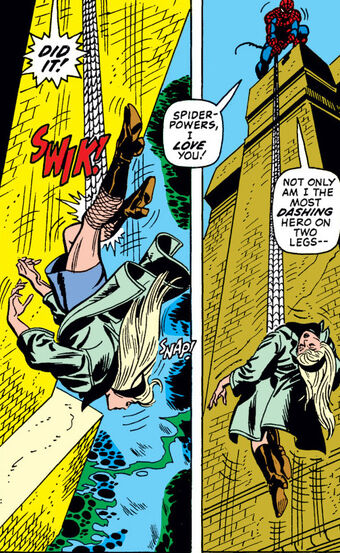
  • George Stacy's death in issue #90 was ground-breaking in itself but Gwen's death went a step further as Spidey's own role in the accident is less clear.  Yes, the Green Goblin threw her off the top of the George Washington Bridge but her neck snapped when Spidey tried to save her with his webbing.  In effect, Spider-Man accidentally caused her death.  Interestingly, the Green Goblin himself lets Spidey off the hook, asserting that the fall itself had likely already killed her.  Nonetheless, the question remains.
Amazing Spider-Man Vol 1 121 | Marvel Database | Fandom
via Marvel Database
  • Gwen Stacy's death is broadly considered to be the moment when the American comic book medium lost its innocence.  Spider-Man's good guy identity ultimately survived but the door was kicked open for morally ambiguous heroes and edgier storylines.
  • This issue is also considered by many to mark the ending of the Silver Age of comic books.
  • As if that weren't enough, Harry has his second bad acid trip in this issue.  Norman Osborn (alias: Green Goblin - boy has that story gotten complicated!) blames Harry's friends, including Peter, and kicks them out of the house when they come around to check on him.
Mary Jane Watson - Wikipedia
via Wikipedia
  • Featured: Mary Jane Watson. When I left the series after #38, we hadn't even seen her face yet.

The Amazing Spider-Man #122
July 1, 1973
Conway/Kane
  • Peter/Spidey is enraged over Gwen Stacy's death. 
  • Peter walks out on Harry while the latter is in need, still freaking out over his bad trip.
  • Mary Jane, however, turns out to be a better friend.  Peter is horrible to her when she meets him at his apartment and he sends her away.  In the issue's final frame, we see she's sticking around to tough it out with him.
Gerry Conway | Spiderman animated Wikia | Fandom
via Spiderman animated Wikia
  • Writer Gerry Conway was born September 10, 1952 in New York City.  A comic book wunderkind, he published his first professional work at age 16 and succeeded Stan Lee as lead writer for The Amazing Spider-Man, Marvel's flagship, at 19.   He also co-created The Punisher for Marvel and Firestorm for DC, where he was the writer for Justice League of America for eight years.
  • Before moving on, I'd like to quickly reaffirm that The Amazing Spider-Man is definitely the best series Marvel had going in the Silver Age and the Peter Parker side of the story is largely the reason why.

Howard the Duck #1
January 1, 1976
Steve Gerber/Frank Brunner
  • And now for something completely different...
Howard the Duck - Wikipedia
via Wikipedia
  • Howard the Duck was the co-creation of Gerber and artist Val Mayerik.  The character first appeared in Adventure into Fear #19 in December 1973.  In 1976, he got his own series.  He is a talking and cigar-smoking duck from outer space.  He's angry.  He's depressed, opening with suicidal thoughts in this initial offering.  Howard's stories are dark satire, spoofing their own genre in the process.  Unsubtle social commentary drips from the (digital) pages.
  • Unlike most of the New York-based Marvel Universe, Howard dwells in the decidedly less glamorous Cleveland, Ohio, an easily maligned city in the mid-'70s.  At one point, Howard accidentally sets fire to the deeply polluted Cuyahoga River.  That happened in the real world, too.  Several times.  Today, there's a beer from the region called Burning River Pale Ale.
  • Well worth noting, though, Cleveland is a very important city to comic book history.  For starters, it was the early stomping ground of Jerry Siegel and Joe Shuster, co-creators of Superman.  It has been home to a thriving indy industry for decades.
  • The city also boasts a top-notch art museum and one of the finest symphony orchestras in the world.  All of that steel money was good for something.
  • It's also where my mom's from so back off!
Beverly Switzler (Earth-616) | Marvel Database | Fandom
via Marvel Database
  • In #1, Howard meets his scantily clad sidekick, though not yet girlfriend, Beverly Switzler.
  • Beverly has been kidnapped by Pro-Rata, a deranged super-villain accountant in a Dr. Strange-esque dreamscape.  Nope, not kidding.  Welcome to Howard the Duck.

Howard the Duck #2
March 1, 1976
Gerber/Brunner
  • Villain: Turnip-Man, created when Arthur Winslow, Beverly's friend-but-not-boyfriend, is possessed by an extra-terrestrial root vegetable.
  • James Bond reference!  The Man with the Golden Gun was, at the time, the most recent film release:


Howard the Duck #3
May 1, 1976
Gerber/John Buscema
  • Villain: Count Macho
  • Horrified by a street brawl turned deadly, and the glorification of violence in general, Howard learns the martial art of Quack-Fu.

Friday, July 3, 2020

Star Trek: Q Who

Episode: "Q Who"
Series: Star Trek: The Next Generation
Season 2, Episode 16
Original Air Date: May 8, 1989

Q Who (episode) | Memory Alpha | Fandom
via Memory Alpha

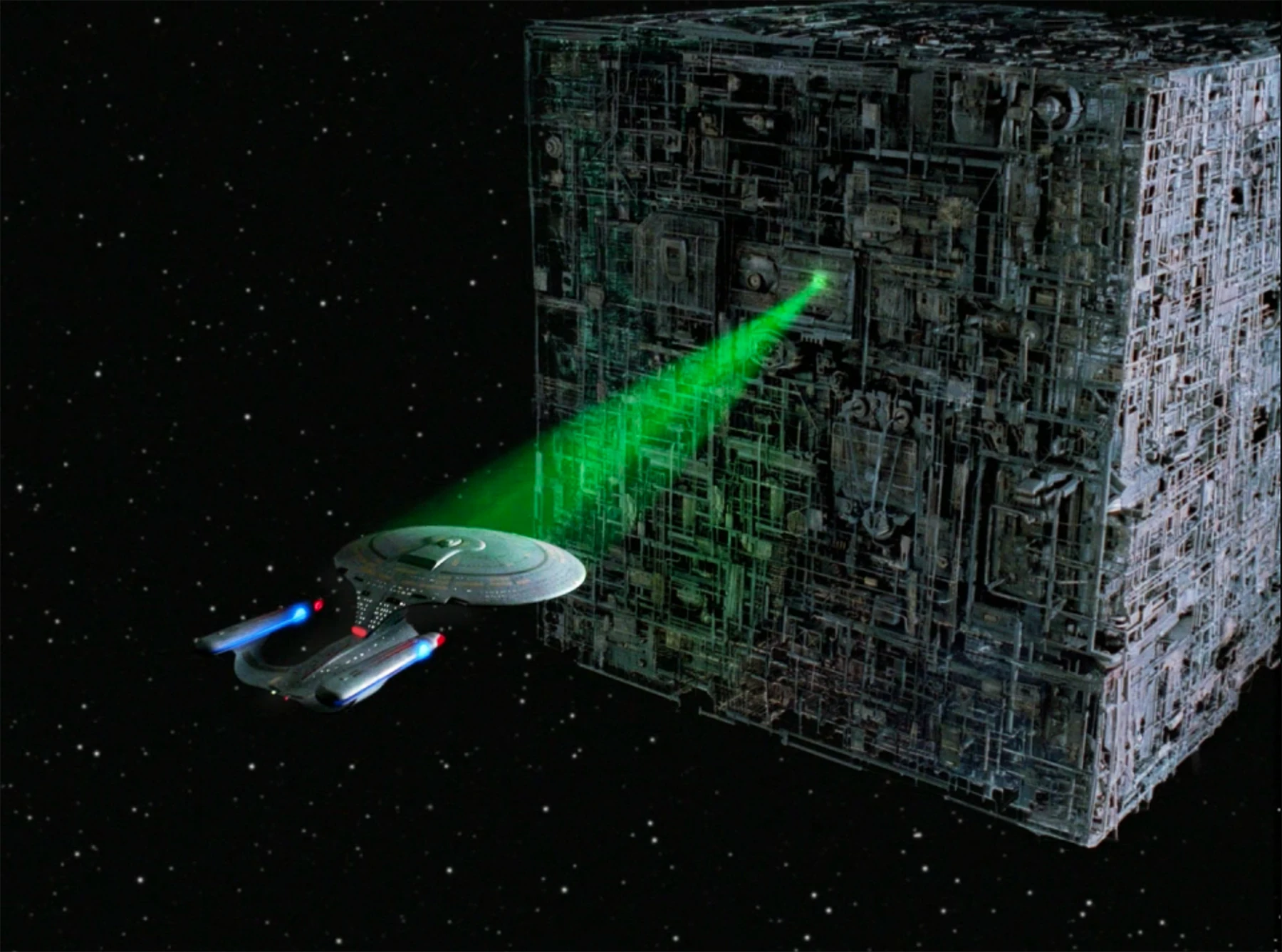
The mischievous Q sends the Enterprise careening into a new, distant part of the galaxy and into contact with the Borg, the ultimate in heartless, irresistible conquerors.  The Borg would become the primary adversary for TNG, the Ferengi having failed miserably in that capacity.  Despite their significance, the Borg only appear in six series episodes.  This is not unusual for Trek.  After all, the Klingons only appeared in seven TOS episodes, the Romulans only two.  In the dying days of the Cold War, a metaphorical threat to individuality and free will was still topical.  In this, the Borg were comparable to Doctor Who's Cybermen.

In the years since, there has been much discussion over how much of a "favor" Q did for our friends in bringing them into early contact with the Borg.  At the end of the episode, it is acknowledged that the collective will be heading to Earth now that they know it's there.  Damn Q!  But were they headed that way already and Q was providing early warning to prepare?  Had they, in fact, already been to Earth?  Later stories would imply both.  History can be revised to suit needs in a storytelling context.

Q Who (episode) | Memory Alpha | Fandom
via Memory Alpha


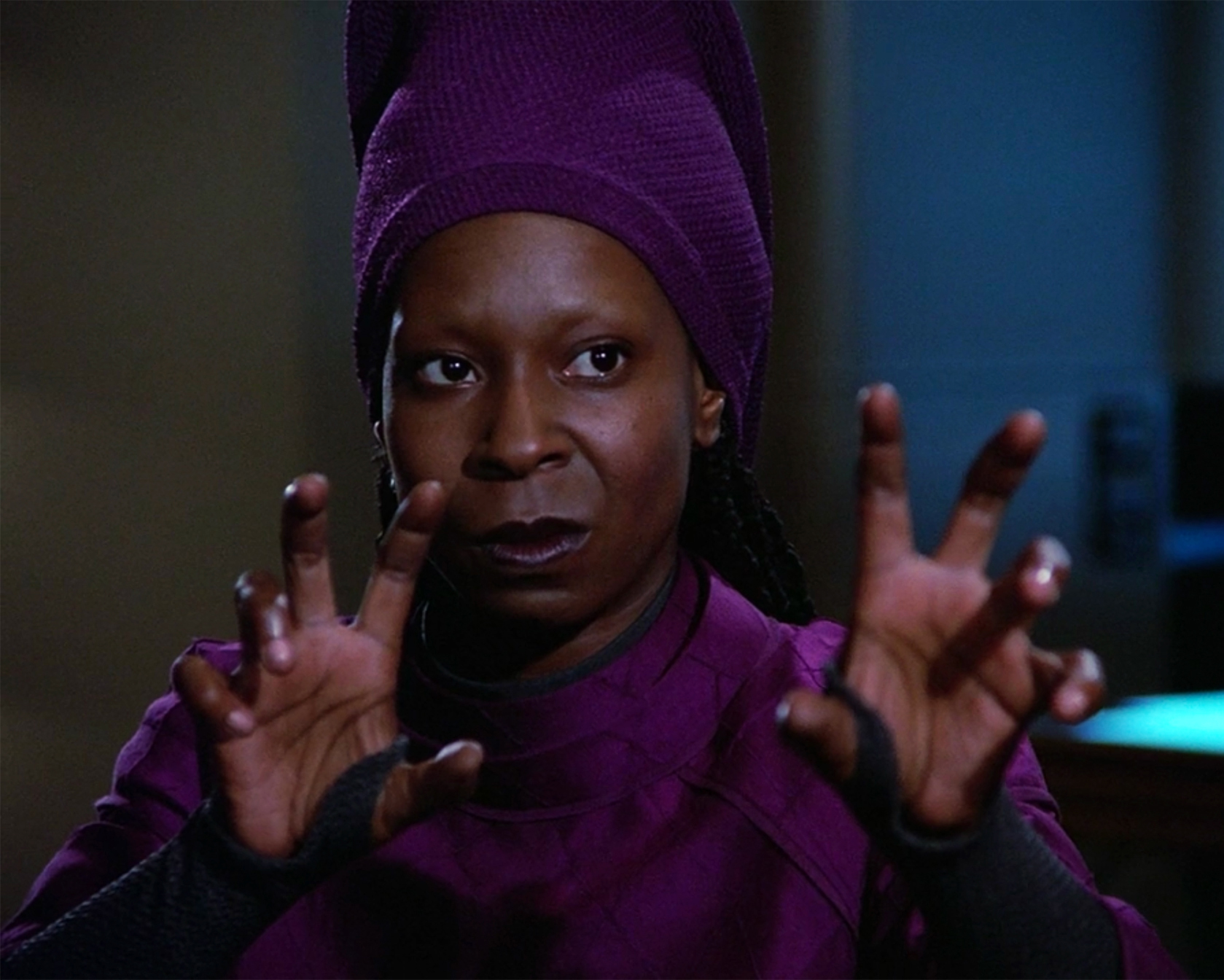
"Q Who" is also a rare development episode for Guinan.  We learn a lot - and yet not much at all - in Q's standoff with Gunian on Ten Forward.  Q knows her and, far more interestingly, fears her.  And if she is truly as dangerous as he claims, it's revealing that he didn't realize she was aboard the Enterprise - omniscient entity fail.  The series has already hinted that there's a lot more to our favorite bartender than meets the eye and this is the first story that probes.  We never make it far down that thread which is too bad. 


Acting Notes

Image result for john de lancie first nights
via Wikipedia

John de Lancie (Q) was born November 13, 1948 in Philadelphia.  His father was the principal oboist for the Philadelphia Orchestra for 23 years.  He struggled in school due to un-diagnosed dyslexia but was encouraged by a teacher to pursue acting, eventually winning a scholarship to Julliard.

De Lancie made 12 appearances as Q on three different Star Trek series.  Even though his is only a recurring role, he has acknowledged that the association opened quite a lot of doors for him.  In addition to his acting, he's done significant work in the classical music realm.  He has written and directed ten symphonic plays, hosted an adult concert series at Disneyland and even directed Tosca with the Atlanta Opera company.  He toured with Star Trek: Music, a concert series devoted to music from the franchise, narrated by him and Robert Picardo.  He is also a successful voice actor, most prominently as Discord in My Little Pony: Friendship Is Magic series.

Wednesday, July 1, 2020

Bitters of the Month: Peychaud's


Like Angostura, Peychaud's bitters is gentian-based.  However, Peychaud's has a distinctive anise flavor that sets it apart.  It's also sweeter than either Angostura or orange bitters.  My wife described it as herbal in flavor.  It's a pretty, dark pink in the glass as well.

Peychaud's bitters was invented by Antoine Amédée Peychaud, a Creole apothecary, in 1830.  Peychaud is also credited with inventing the Sazerac cocktail, the bitters being one of its key ingredients.  The product was historically produced in New Orleans, though the current parent company, Sazerac, is now headquartered in Louisville, Kentucky.


Squid on the Vine

Cave Saint Cyr, Pet Nat Beujolais Gamay Rosé
Bubbly
Delicate nose
Apple
Light
My rating: 8.3

Corte Gardoni, Greoto Bianco di Custoza Garganega Blend 2019
Dry
A little sour
My rating: 8.0